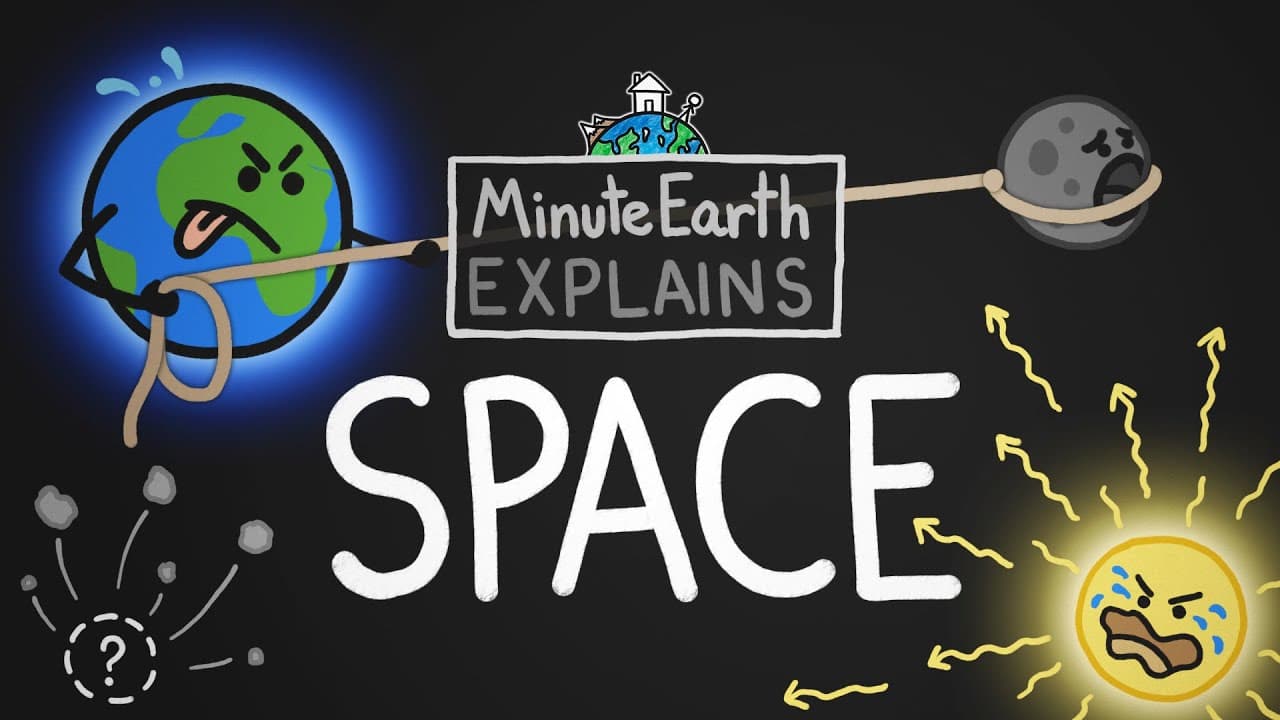
MinuteEarth Explains: Space
TL;DR
Meteorites breaking off from the asteroid Hebe contribute to space debris that could potentially collide with Earth. The Moon's rotation and orbit prevent us from seeing its far side. Earth's atmosphere protects us from extreme temperature fluctuations by trapping heat and shielding us from harmful solar radiation.
Transcript
Hi, this is Kate from MinuteEarth, and that’s no moon, it’s a meteorite. Although I’m starting to get what it must be like to live on a moonbase – like many of you I’m stuck at home right now. So we’re going to keep these compilations of our classic MinuteEarth videos coming for you, your kids, my kids, and anyone else that is going a little loony!... Read More
Key Insights
- 🏷️ Meteorites on Earth likely originate from the asteroid Hebe, located in the asteroid belt.
- 😀 The Moon's rotation and orbit keep one side permanently facing Earth, creating the illusion of a "dark side."
- 🧑🏭 Earth's atmosphere acts as a shield, protecting us from harmful solar radiation and maintaining stable temperatures.
- 🫢 The interaction between gas molecules in Earth's atmosphere allows for the absorption and trapping of infrared radiation.
- 💱 Variations in atmospheric carbon dioxide can produce significant changes in Earth's temperature.
- 😎 The faint young sun paradox refers to the discrepancy between the early sun's dimness and the warm conditions on ancient Earth.
- 🫢 Possible explanations for the paradox include the presence of ultra-insulating gases in Earth's early atmosphere or the effects of intense solar winds during the sun's early stages.
Install to Summarize YouTube Videos and Get Transcripts
Explore YouTube Video Summarizer or Get YouTube Transcript Extractor
Questions & Answers
Q: Why do more than a third of meteorites have the same chemical signature?
The meteorites that reach Earth are believed to have broken off from the asteroid Hebe, which is located in the asteroid belt between Mars and Jupiter. These meteorites share a similar chemical signature due to their common origin.
Q: How does the location of Hebe in the asteroid belt contribute to its unique status?
Hebe is located at the edge of an empty band in the asteroid belt. Its orbital resonance with Jupiter distorts its orbit and eventually destabilizes it, potentially causing it to cross paths with Earth.
Q: Why can't we see the far side of the Moon?
The Moon's rotation and orbit are perfectly synced, causing one side to always face Earth. This synchronization was likely the result of the Moon's initial spin and orbit being adjusted by Earth's gravitational influence over time.
Q: How does Earth's atmosphere protect us from extreme temperatures?
During the day, Earth's atmosphere shields us from harmful solar radiation and blocks out a significant amount of intense visible light. At night, it traps the infrared radiation that is radiated from the sun-warmed surface, keeping us from freezing.
Summary & Key Takeaways
-
Meteorites on Earth originate from the asteroid Hebe, located on the edge of an empty band in the asteroid belt between Mars and Jupiter.
-
The Moon's rotation and orbit keep one side permanently facing Earth, preventing us from seeing its far side.
-
Earth's atmosphere acts as a shield, blocking harmful sun rays and trapping heat to maintain livable temperatures on our planet.
Read in Other Languages (beta)
Share This Summary 📚
Summarize YouTube Videos and Get Video Transcripts with 1-Click
Try YouTube Summary with ChatGPT & Claude or YouTube Transcript Generator
Explore More Summaries from MinuteEarth 📚



Summarize YouTube Videos and Get Video Transcripts with 1-Click
Try YouTube Summary with ChatGPT & Claude or YouTube Transcript Generator