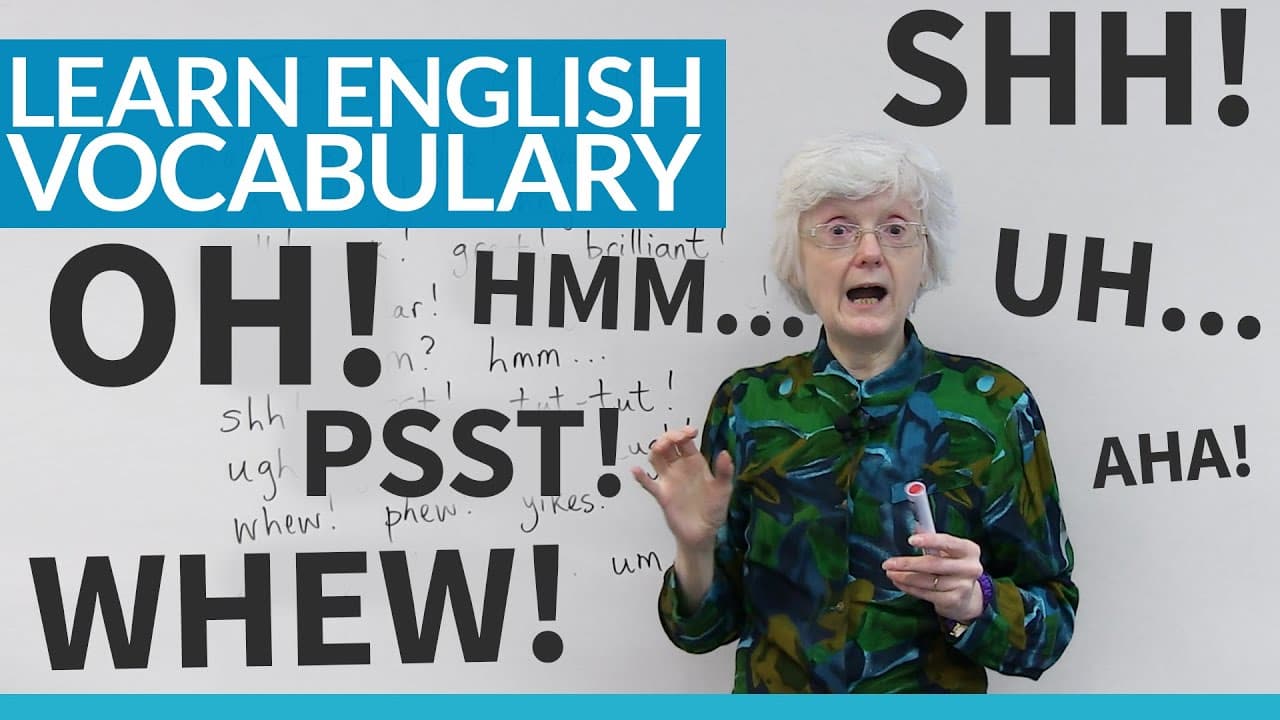
Interjections! Yay! Hmm? What are they?
TL;DR
Learn how to express different feelings in English using interjections like "ha," "aha," and "wow."
Transcript
Hi. This is Gill, here, at www.engvid.com, and today the lesson is about "Interjections". That's a very long word. What it really means is something quite short: Little expressions that we make to express a particular feeling. Okay? And just to say thank you, someone on our website at engVid, somebody... One of you suggested this topic, so thank yo... Read More
Key Insights
- 😑 Interjections in English are short expressions used to convey specific feelings, such as surprise, amusement, or disappointment.
- 😑 Body language, tone of voice, and facial expressions can influence the meaning of interjections.
- 😄 Different interjections have various connotations, whether positive (e.g., "yay," "great") or negative (e.g., "oh," "ugh").
- ❓ Interjections like "psst" or "hey" can be used to get someone's attention.
- 😑 Some interjections, such as "whew" or "phew," express relief after a stressful situation.
Install to Summarize YouTube Videos and Get Transcripts
Explore YouTube Video Summarizer or Get YouTube Transcript Extractor
Questions & Answers
Q: What are interjections?
Interjections are short words or expressions used to convey specific feelings, such as surprise, amusement, or disappointment.
Q: How does body language and tone of voice impact the meaning of interjections?
Body language and tone of voice can change the meaning of interjections. For example, saying "ha" sarcastically can imply disbelief or mockery.
Q: Can interjections be used in other languages?
While other languages may have their own expressions, interjections in English are specific to English-speaking countries and may not have direct equivalents in other languages.
Q: What are some positive interjections in English?
Some positive interjections include "yay," "whey," "wa-hey," "great," and "brilliant." These expressions are used to show excitement or celebration.
Q: What are some negative interjections in English?
Negative interjections include "oh," "oh dear," "hey," "just a minute," "what," "mm," "hmm," "shh," "psst," "tut-tut," "ugh," "yuk," and "eugh." These expressions convey annoyance, disgust, or surprise.
Q: How can interjections be used to get someone's attention?
Saying "psst" or "hey" can be used as attention-getting interjections to attract someone's notice and indicate that you have something to say to them.
Q: When are interjections used to express relief?
Interjections like "whew" or "phew" are used to express relief after being worried or stressed, indicating that everything is now okay.
Q: Why do people use pauses like "uh," "er," or "um" in their speech?
People use these pauses to indicate uncertainty or that they are thinking about what to say next.
Summary & Key Takeaways
-
Interjections are short expressions used to convey specific feelings, such as surprise, amusement, and sarcasm.
-
Different tones of voice, body language, and facial expressions can change the meaning of interjections.
-
Some common interjections in English include "ha," "aha," "oh," "well," "okay," "great," and "yikes."
Read in Other Languages (beta)
Share This Summary 📚
Summarize YouTube Videos and Get Video Transcripts with 1-Click
Try YouTube Summary with ChatGPT & Claude or YouTube Transcript Generator
Explore More Summaries from Learn English with Gill · engVid 📚




Summarize YouTube Videos and Get Video Transcripts with 1-Click
Try YouTube Summary with ChatGPT & Claude or YouTube Transcript Generator