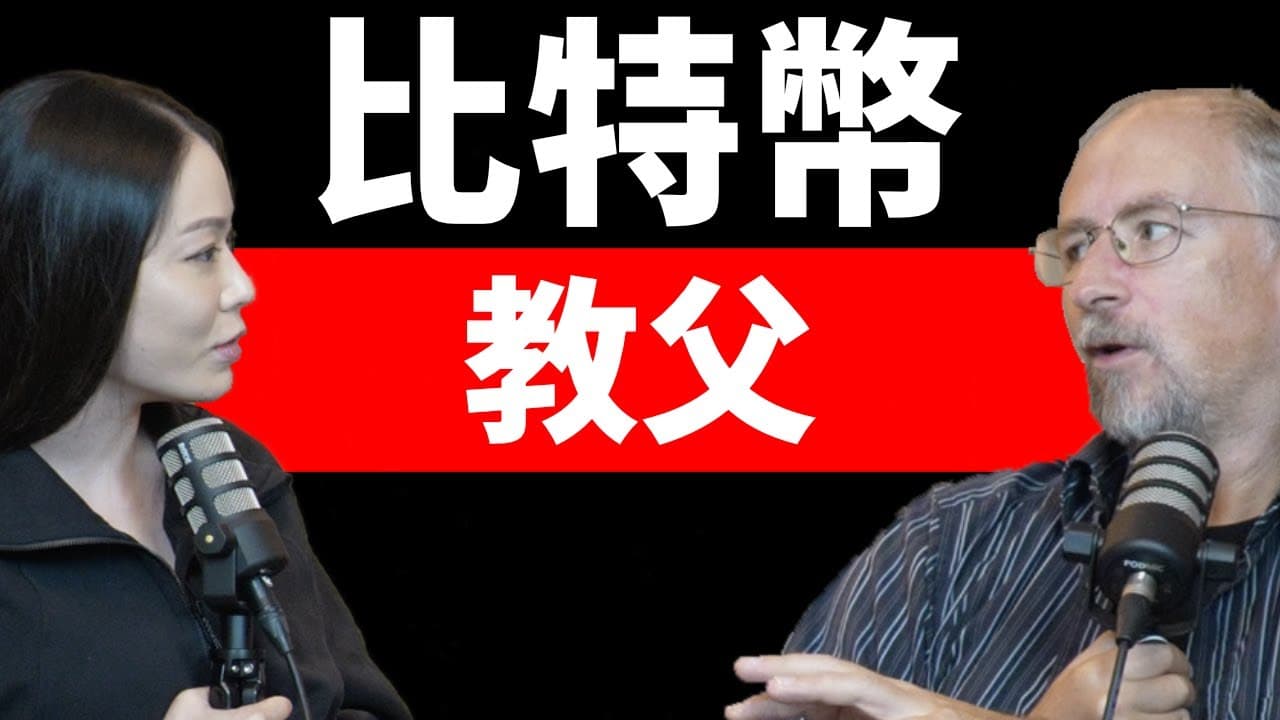
教父:我以為 BTC $1 已經很高了!極珍貴訪談!Adam Back 與中本聰的交手!【比特幣10萬壓軸來賓】【邦妮區塊鏈】
TL;DR
Adam Back discusses Bitcoin's origins and his influence on Satoshi.
Transcript
people say you're Satoshi I got an email from him in August uh 2008 that was the first email he sent anybody what was the email about he was asking is this I sent him a exchange a few emails suggesting from the academic side when they saw Bitcoin they were dismissive if I could go back in time and told you that Bitcoin will be 100K one day ... Read More
Key Insights
- Adam Back received the first email from Satoshi Nakamoto in August 2008, discussing Bitcoin's implementation and citing Hashcash.
- Back's invention, Hashcash, inspired Bitcoin's mining process, highlighting its role as digital gold due to its scarcity.
- Despite initial academic dismissal, Bitcoin eventually gained traction, proving its decentralized model could work without a central server.
- Back's early interest in cryptography and reverse engineering video games led him to create Hashcash, a precursor to Bitcoin's proof-of-work.
- The anonymity of Bitcoin's creator, Satoshi Nakamoto, remains intact due to careful use of anonymity systems and ceasing communication by 2011.
- Blockstream, co-founded by Back, focuses on enhancing Bitcoin's privacy and modularity through projects like sidechains and confidential transactions.
- Bitcoin's initial lack of privacy was understood by Back, who later contributed to improving it through his cryptographic expertise.
- Blockstream is globally distributed, seeking talent worldwide, and has initiatives in Taiwan, including partnerships with local universities.
Install to Summarize YouTube Videos and Get Transcripts
Explore YouTube Video Summarizer or Get YouTube Transcript Extractor
Questions & Answers
Q: What was Adam Back's first interaction with Satoshi Nakamoto?
Adam Back received the first email from Satoshi Nakamoto in August 2008, discussing the implementation of Bitcoin and citing Hashcash, Back's invention. This email exchange marked the beginning of Back's involvement in Bitcoin's early development and highlighted the influence of Hashcash on Bitcoin's proof-of-work mechanism.
Q: How did Hashcash influence Bitcoin's development?
Hashcash, created by Adam Back, was a proof-of-work system that inspired Bitcoin's mining process. It introduced the concept of digital scarcity, which is crucial for Bitcoin's value as digital gold. This scarcity made digital assets hard to copy, addressing challenges faced by previous digital cash systems and contributing to Bitcoin's success.
Q: Why was Bitcoin initially dismissed by academics?
Academics initially dismissed Bitcoin because it deviated from established electronic cash models, which typically involved a central server and strong privacy features. Bitcoin's decentralized model lacked these elements, leading to skepticism. However, as Bitcoin gained traction and proved its viability, the academic community began to take it more seriously.
Q: What role does Blockstream play in Bitcoin's ecosystem?
Blockstream, co-founded by Adam Back, plays a significant role in enhancing Bitcoin's privacy and modularity. The company develops technologies like sidechains and confidential transactions, allowing for permissionless innovation without altering Bitcoin's main chain. Blockstream's efforts aim to improve Bitcoin's functionality and expand its use cases.
Q: How does Adam Back view Satoshi Nakamoto's anonymity?
Adam Back believes that Satoshi Nakamoto's anonymity benefits Bitcoin by preventing any central authority from influencing its development. Satoshi's careful use of anonymity systems and cessation of communication by 2011 has kept their identity hidden, ensuring Bitcoin remains a decentralized and community-driven project.
Q: What initiatives does Blockstream have in Taiwan?
Blockstream is involved in initiatives in Taiwan, including partnerships with local universities. The company co-sponsors a lab at a Technical University, focusing on IT and management with computer science students. Blockstream is also open to hiring technical talent in Taiwan, reflecting its commitment to global collaboration and innovation.
Q: How did Adam Back's early experiences influence his work in cryptocurrency?
Adam Back's early experiences with cryptography and reverse engineering video games sparked his interest in digital security and encryption. These skills led him to create Hashcash, which played a pivotal role in Bitcoin's development. His background in cryptography also informed his contributions to improving Bitcoin's privacy features.
Q: What challenges did early electronic cash systems face?
Early electronic cash systems struggled with issues like centralization and lack of privacy. Many relied on central servers, making them vulnerable to failure and government interference. Bitcoin addressed these challenges with its decentralized model, eliminating the need for a central authority and enhancing security through its proof-of-work mechanism.
Summary & Key Takeaways
-
Adam Back, known for creating Hashcash, discusses his early interactions with Satoshi Nakamoto and the development of Bitcoin. Despite initial skepticism from academics, Bitcoin's decentralized model eventually gained acceptance and success.
-
Back's background in cryptography and reverse engineering video games led to his creation of Hashcash, which inspired Bitcoin's proof-of-work mechanism. His company, Blockstream, focuses on improving Bitcoin's privacy and modularity.
-
Satoshi Nakamoto's anonymity remains intact due to careful use of anonymity systems, and Back believes this benefits Bitcoin. Blockstream is globally distributed, with initiatives in Taiwan and partnerships with local universities.
Read in Other Languages (beta)
Share This Summary 📚
Summarize YouTube Videos and Get Video Transcripts with 1-Click
Try YouTube Summary with ChatGPT & Claude or YouTube Transcript Generator
Explore More Summaries from 邦妮區塊鏈 Bonnie Blockchain 📚






Summarize YouTube Videos and Get Video Transcripts with 1-Click
Try YouTube Summary with ChatGPT & Claude or YouTube Transcript Generator