Caselet DI | Students in Engineering | DI | Reasoning | Part - 02 | Bharath Kumar
TL;DR
A detailed breakdown of college seat allocation across various engineering branches.
Transcript
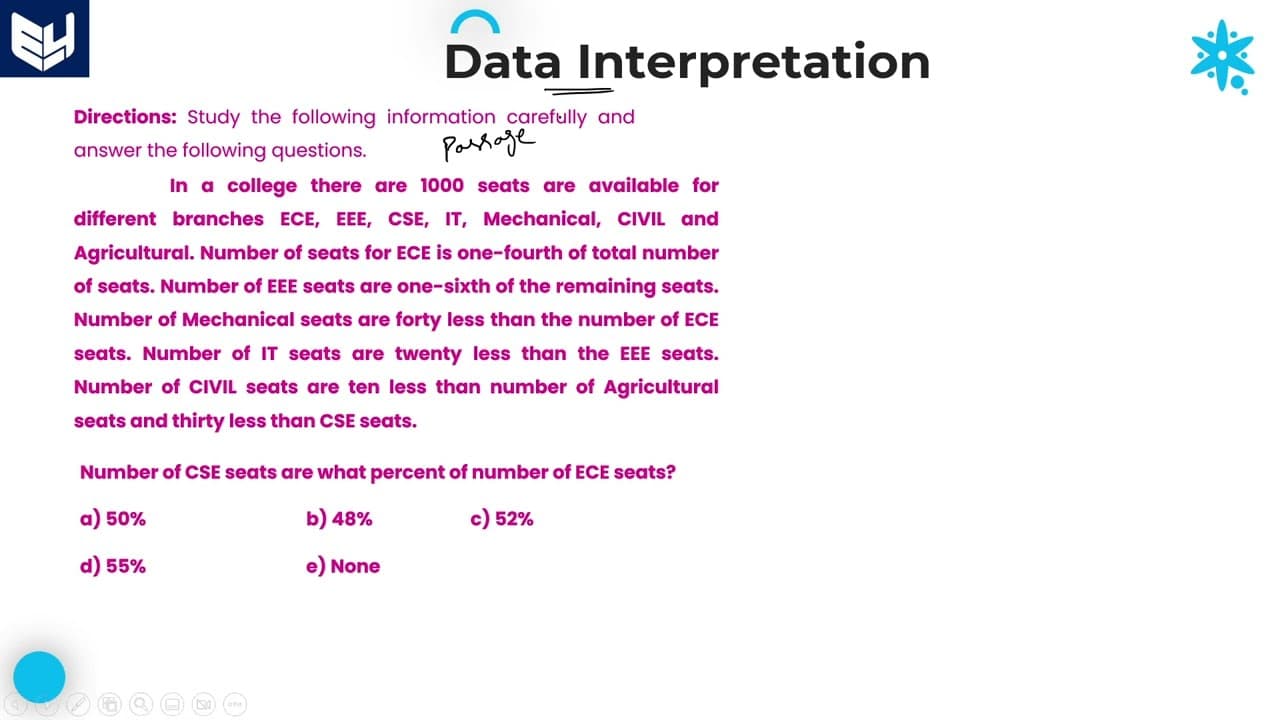
hi everyone welcome to the session in this session I am continuing case like data interpretation first of all uh we need to read the information carefully based on that information we need to solve the questions accordingly here the uh in case data and repetition information will be provided based in terms of a passage in terms of a passage so some... Read More
Key Insights
- 🤢 The total number of seats across all engineering branches is effectively distributed based on specified proportions, leading to a clearer understanding of branch allocations.
- 🤢 Calculating seat allocations often requires understanding the relationships between various branches, such as how one branch's seat count can affect another's.
- 🤔 Critical thinking is essential in interpreting the given data and translating it into actionable insights, including calculating percentages and ratios.
- ❓ The methodology employed in these calculations emphasizes teamwork between numerical reasoning and logical deduction to derive solutions efficiently.
- 🤢 Seat allocation in educational institutions showcases real-world applications of mathematical principles, particularly in ratio and proportion.
- ⁉️ The step-by-step breakdown of questions illustrates the importance of methodical problem-solving in data interpretation challenges.
- 🤔 Understanding the relationship between different values enhances a student's ability to think critically about data in the context of educational environments.
Install to Summarize YouTube Videos and Get Transcripts
Explore YouTube Video Summarizer or Get YouTube Transcript Extractor
Questions & Answers
Q: What are the available seats in the ECE branch?
The ECE branch has 250 seats, which is one-fourth of the total 1000 seats available across all branches. This understanding is crucial in the overall seat allocation analysis as it sets the foundation for calculating the remaining seats in other branches.
Q: How is the number of Mechanical seats determined in relation to ECE seats?
The number of Mechanical seats is calculated as 40 seats less than the ECE branch. Since ECE has 250 seats, Mechanical has 250 - 40 = 210 seats. This relative calculation helps in evaluating the distribution of seats among different engineering branches accurately.
Q: How can one calculate the percentage increase of Mechanical seats over IT seats?
To find the percentage increase, calculate the difference between Mechanical seats (210) and IT seats (105). The formula is: ((210 - 105) / 105) * 100, which yields a 100% increase, indicating that Mechanical seats are double the available IT seats.
Q: What is the combined total of Agriculture and Tripoli seats?
The combined total of Agriculture (100 seats) and Tripoli (125 seats) is 225 seats, found by simply adding the two figures together, demonstrating how to handle basic summation within data interpretation tasks.
Summary & Key Takeaways
-
The content provides an analysis of engineering seat allocation across various departments, emphasizing the need for careful reading and calculations based on provided data.
-
It outlines the methodology for calculating available seats for different engineering branches, including ECE, Tripoli, Mechanical, and others, based on given proportions.
-
Calculations, along with corresponding questions and their answers, illustrate how to derive percentages, differences, and ratios from the total available seats, encouraging accuracy in data interpretation.
Read in Other Languages (beta)
Share This Summary 📚
Summarize YouTube Videos and Get Video Transcripts with 1-Click
Try YouTube Summary with ChatGPT & Claude or YouTube Transcript Generator