Unit 8: Decision Analysis 1, Video 1: Advantages
TL;DR
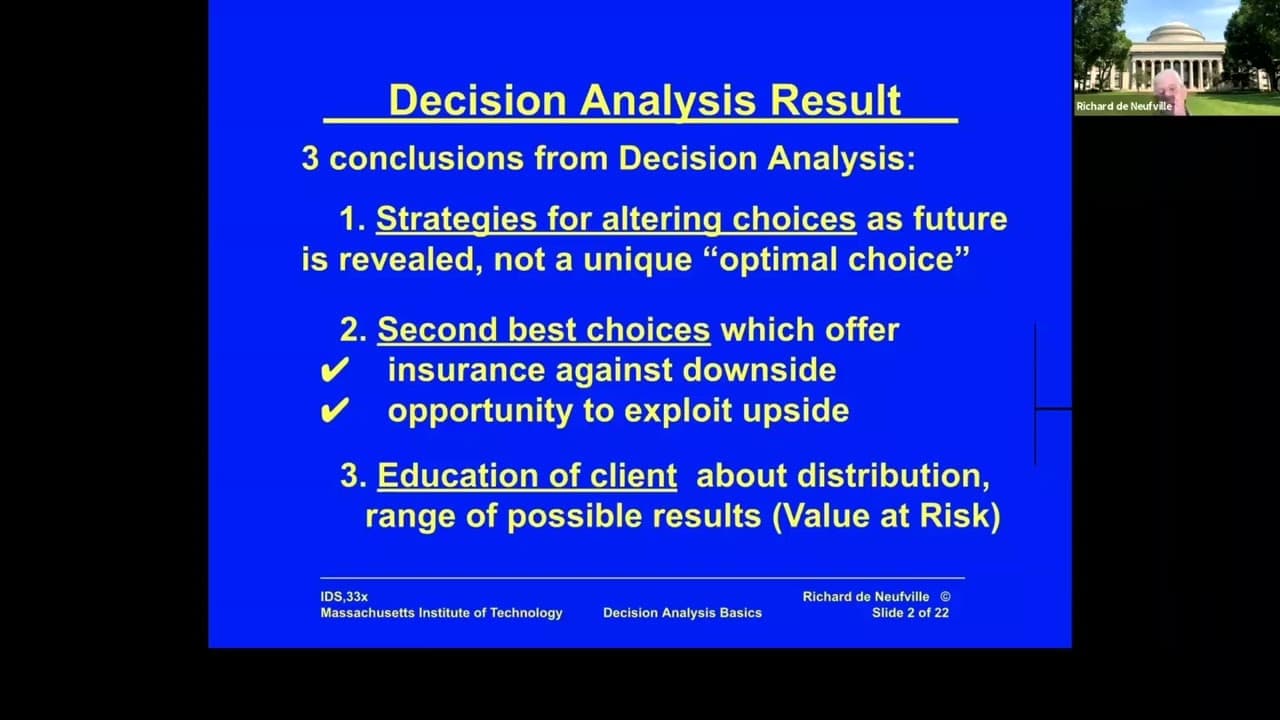
Decision analysis is a useful technique for analyzing uncertainties and has several advantages, including the ability to alter choices as new information arises, the recognition that the best choice is not always the first one, and the education of the client about the risks involved.
Transcript
[SQUEAKING] [RUSTLING] [CLICKING] RICHARD DE NEUFVILLE: This is the first of a couple of sessions revolving around decision analysis. And what I want to do here is to introduce a useful technique in this way of thinking about analyzing how we respond to uncertainties. And it's appropriate for simple uncertain situations. I emphasize that. So the ot... Read More
Key Insights
- ❓ Decision analysis is a valuable technique for analyzing uncertain situations.
- 👶 Having a strategy for altering choices based on new information is beneficial.
- 🥺 The best choice is not always the first one, and the recognition of this can lead to better decision-making.
- ✳️ Decision analysis helps educate clients about risks and uncertainties.
- 🤝 People often struggle to deal with complex uncertain situations intuitively.
- 💨 Decision analysis provides a structured and efficient way to recognize and address complexity.
- 🥡 The probabilities of various outcomes should be taken into account.
Install to Summarize YouTube Videos and Get Transcripts
Explore YouTube Video Summarizer or Get YouTube Transcript Extractor
Questions & Answers
Q: What is decision analysis and why is it important?
Decision analysis is a technique for analyzing uncertain situations and is important because it allows for the evaluation and alteration of choices based on new information, rather than sticking to a fixed plan.
Q: How does decision analysis differ from other approaches to decision-making?
Decision analysis differs from other approaches by emphasizing the importance of having a strategy for altering choices, recognizing that the best choice is not always the first one, and educating the client about the risks involved.
Q: How does decision analysis help in dealing with uncertainty?
Decision analysis helps in dealing with uncertainty by providing a structured and efficient way to recognize the complexity of a situation, evaluate probabilities, and make informed decisions based on the available information.
Q: What are the advantages of using decision analysis?
The advantages of using decision analysis include the ability to alter choices as new information arises, the recognition that the best choice is not always the first one, and the education of the client about the risks involved.
Summary & Key Takeaways
-
Decision analysis is a technique for analyzing uncertain situations and was popularized by Howard Raiffa and Ralph Keeney in the 70s.
-
While decision analysis is not as widely taught in business schools today, it is still valuable for addressing uncertainty in decision-making.
-
Three key conclusions that decision analysis leads to include the importance of having a strategy for altering choices, the recognition that the first choice is not always the best, and the education of the client about the risks involved.
Read in Other Languages (beta)
Share This Summary 📚
Summarize YouTube Videos and Get Video Transcripts with 1-Click
Try YouTube Summary with ChatGPT & Claude or YouTube Transcript Generator
Explore More Summaries from MIT OpenCourseWare 📚



Summarize YouTube Videos and Get Video Transcripts with 1-Click
Try YouTube Summary with ChatGPT & Claude or YouTube Transcript Generator