Bar graph | Students Results | Data Interpretation | Reasoning | Part - 07 | Bharath Kumar
TL;DR
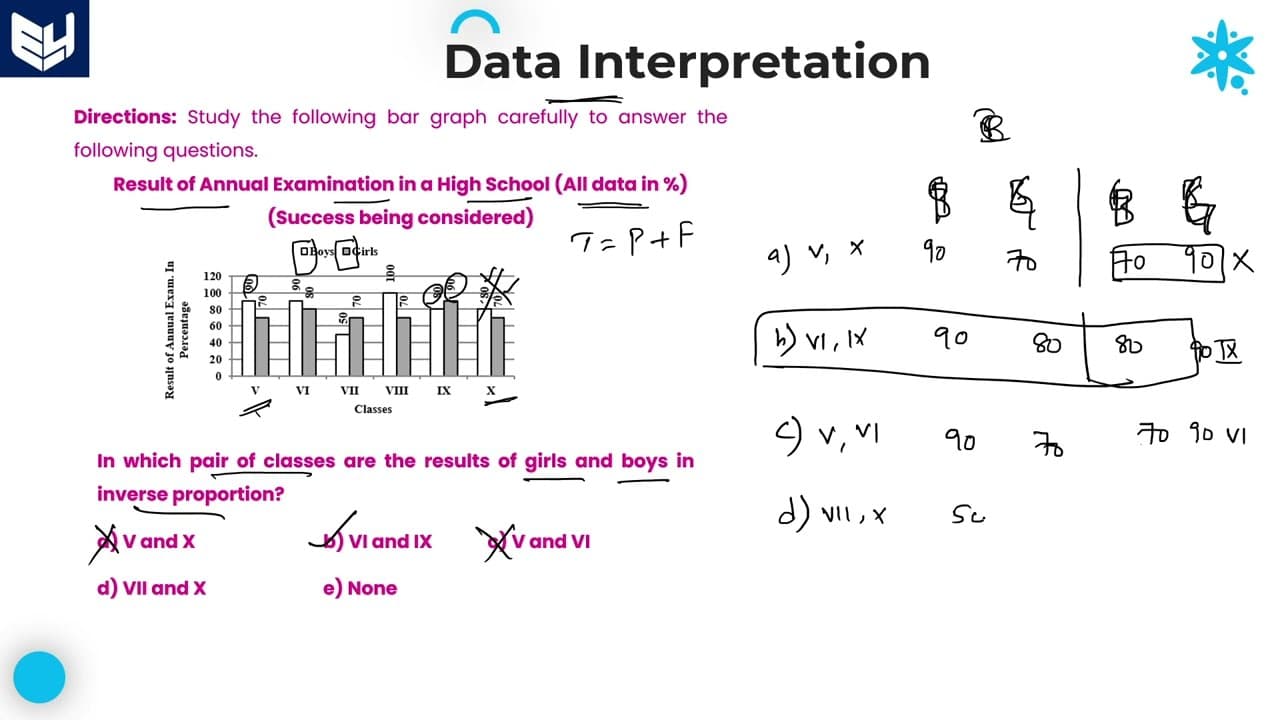
This session analyzes a bar graph displaying students' examination results by class and gender.
Transcript
hi everyone welcome to this session in this session I am continuing bar graph data and operation I am continuing bar graph data and prediction first we need to read the information carefully and then we need to solve the questions according to the given information see the first information result of annual examination in a high school here the bar... Read More
Key Insights
- 🤠 The analysis indicated that Class 8 boys achieved a 100% pass rate, showcasing successful educational strategies in that cohort.
- 😘 Class 7 had the lowest pass rate for boys, emphasizing a need for targeted interventions or support.
- 👨👩👧👦 The differences between boys' and girls' results were notably significant in Class 8, underlining varying levels of academic achievement across genders.
- 🤠 The average pass percentage for boys was around 81.66%, which provides a benchmark for evaluating individual class performances.
- 👻 Understanding reverse proportion among classes allows for better assessments of educational equity between genders.
- 👧 Class 9 emerged as a stronghold for girls, highlighting areas where female students excel in academic settings.
- 📈 Overall, interpreting bar graph data requires careful analysis and comparison to grasp the trends and implications of student performance.
Install to Summarize YouTube Videos and Get Transcripts
Explore YouTube Video Summarizer or Get YouTube Transcript Extractor
Questions & Answers
Q: What is the significance of percentages in the bar graph?
The percentages in the bar graph illustrate the success rates of students in each class, showing how many passed or failed the annual examination. A higher percentage indicates better performance, while lower percentages reflect more failures, which helps educators assess performance trends within the school.
Q: How can we determine which classes have results in reverse proportion?
To determine reverse proportion, compare the pass rates of boys and girls across the classes. If the percentage of boys in one class correlates inversely with the percentage of girls in another class, they are said to be in reverse proportion, such as the relationship shown between classes 6 and 9.
Q: In which class did boys achieve a 100% pass rate?
Boys achieved a 100% pass rate in Class 8, meaning all students from that class passed the examination, resulting in a zero percentage of failure. This is a significant achievement demonstrating effective teaching or preparation methods for that particular class.
Q: What was the average pass percentage of boys across all classes?
The average pass percentage of boys across all classes was calculated at approximately 81.66%. This average is useful for comparing individual class results to overall performance, allowing educators to spot trends in boys' performance relative to the school's overall performance.
Q: Which class had the highest failure rate for boys?
Class 7 had the highest failure rate for boys, with a pass percentage of only 50%. This indicates that only half of the boys passed the examination, suggesting potential areas for improvement in teaching or student support in this class.
Q: What class had the maximum difference between boys' and girls' results?
The class with the maximum difference between boys' and girls' results was Class 8, with a difference of 30 percentage points (boys at 100% and girls at 70%). This significant gap highlights disparities in performance between genders within that particular class.
Q: How do we calculate the average result of girls in the school?
The average result of girls is calculated by summing their pass percentages across all classes and dividing by the number of classes. With the given percentages, this average turns out to be 75%, which indicates the overall performance level of girls in the school.
Q: What key observations can we make about the pass rates?
Key observations include patterns in gender performance, with boys generally having higher pass rates in some classes, while girls excel in others. Additionally, Class 8 demonstrates exceptional performance for boys, and significant differences highlight areas where certain groups may need additional support.
Summary & Key Takeaways
-
The content focuses on interpreting a bar graph representing annual examination results of boys and girls from classes 5 to 10, displayed in percentages.
-
It addresses a series of questions related to student performance, including trends in pass and fail rates, as well as comparisons of results between boys and girls.
-
The session provides solutions to multiple-choice questions regarding the relationship between percentages and identifies classes with notable pass rates.
Read in Other Languages (beta)
Share This Summary 📚
Summarize YouTube Videos and Get Video Transcripts with 1-Click
Try YouTube Summary with ChatGPT & Claude or YouTube Transcript Generator