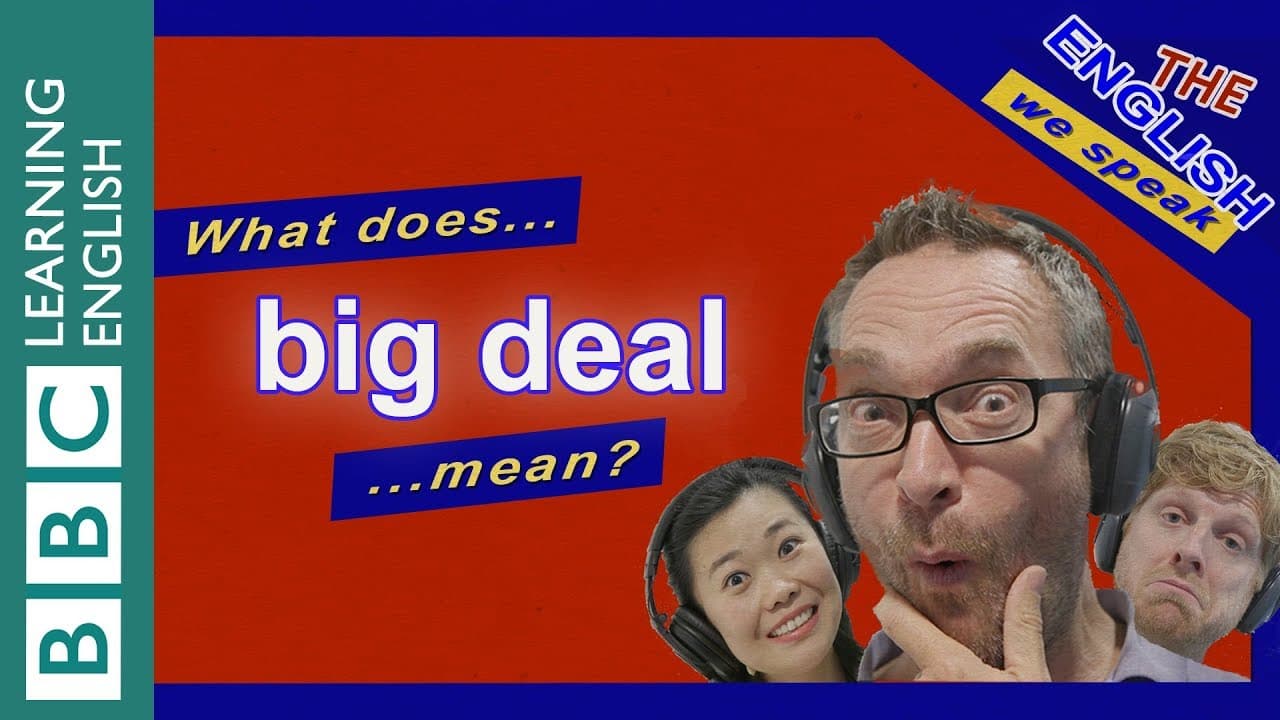
What does 'big deal' mean?
TL;DR
'Big deal' often expresses sarcasm or unimpressiveness.
Transcript
Feifei: Hello and welcome to The English We Speak. I'm Feifei... Rob: And hello, I'm Rob! Feifei: You're looking pleased with yourself today, Rob. Rob: I am. Look - biscuits! Feifei: Hmm, are biscuits really that exciting? Rob: Well, it's not actually the biscuits, it's the price. I got five pence off the packet - a great discount, hey? Feifei: Fiv... Read More
Key Insights
- The phrase 'big deal' is commonly used sarcastically to indicate that something is not impressive or special.
- When someone says 'big deal,' they might be downplaying an achievement or event that another person finds significant.
- The expression 'no big deal' is used to convey that something is not a serious problem or issue.
- Making a 'big deal' about something means creating a fuss or overemphasizing its importance.
- In the context of discounts, 'big deal' can be used to humorously exaggerate the significance of small savings.
- The conversation highlights how expressions can have multiple meanings based on context and tone.
- Feifei uses sarcasm to indicate her lack of interest in Rob's excitement over a small discount.
- The exchange demonstrates how language nuances can affect interpersonal communication and perceptions.
Install to Summarize YouTube Videos and Get Transcripts
Explore YouTube Video Summarizer or Get YouTube Transcript Extractor
Questions & Answers
Q: What does the phrase 'big deal' mean in this context?
In the context of this conversation, 'big deal' is used sarcastically by Feifei to indicate that she is not impressed by Rob's excitement over a five pence discount on biscuits. It is a way to downplay the significance of something that someone else finds noteworthy.
Q: How does Feifei use sarcasm in her conversation with Rob?
Feifei uses sarcasm when she responds to Rob's excitement about saving five pence on biscuits by saying 'big deal.' Her tone and choice of words imply that she finds the discount insignificant and not worth the excitement, thus highlighting the sarcastic use of the phrase.
Q: What other meanings can 'big deal' have?
Besides its sarcastic use, 'big deal' can also mean making a fuss over something, as seen when Rob makes a 'big deal' about buying 100 packets of biscuits. Additionally, 'no big deal' is used to indicate that something is not a serious issue or problem.
Q: Why does Rob consider the discount a 'big deal'?
Rob considers the discount a 'big deal' because he sees any savings, even small ones, as significant. He humorously exaggerates the importance of the five pence discount by calculating it as a five percent saving, and he further emphasizes it by buying 100 packets.
Q: How does the episode illustrate language nuances?
The episode illustrates language nuances by showing how the phrase 'big deal' can have different meanings based on context and tone. Feifei's sarcastic use contrasts with Rob's genuine excitement, highlighting how expressions can convey different attitudes and emotions.
Q: What role does context play in understanding 'big deal'?
Context plays a crucial role in understanding 'big deal' as it determines whether the phrase is used sarcastically, genuinely, or to indicate a fuss. The surrounding conversation, tone, and situation help listeners interpret the intended meaning of the expression.
Q: What is the significance of the biscuit example in the episode?
The biscuit example serves as a humorous illustration of how people can have different perceptions of what constitutes a 'big deal.' Rob's excitement over a small discount contrasts with Feifei's sarcastic dismissal, showcasing how personal values and perspectives influence language use.
Q: How does the episode contribute to learning English?
The episode contributes to learning English by providing a practical example of how expressions like 'big deal' are used in everyday conversation. It helps learners understand the importance of context and tone in communication, enhancing their ability to interpret and use language effectively.
Summary & Key Takeaways
-
This episode of The English We Speak explores the phrase 'big deal,' which is often used sarcastically to downplay something. Rob is excited about saving five pence on biscuits, but Feifei sarcastically dismisses it as a 'big deal.'
-
The phrase 'big deal' can also mean making a fuss about something, as shown when Rob buys 100 packets of biscuits for a small discount. The conversation illustrates different uses of the expression in everyday English.
-
Feifei and Rob's discussion highlights how context and tone influence the meaning of expressions like 'big deal.' The episode is a humorous take on language nuances and is part of BBC Learning English's efforts to enhance vocabulary.
Read in Other Languages (beta)
Share This Summary 📚
Summarize YouTube Videos and Get Video Transcripts with 1-Click
Try YouTube Summary with ChatGPT & Claude or YouTube Transcript Generator
Explore More Summaries from BBC Learning English 📚
Summarize YouTube Videos and Get Video Transcripts with 1-Click
Try YouTube Summary with ChatGPT & Claude or YouTube Transcript Generator