25.1 Force is the Derivative of Potential
TL;DR
The content explains how potential energy and mechanical energy are related and how to determine force based on the potential energy function.
Transcript
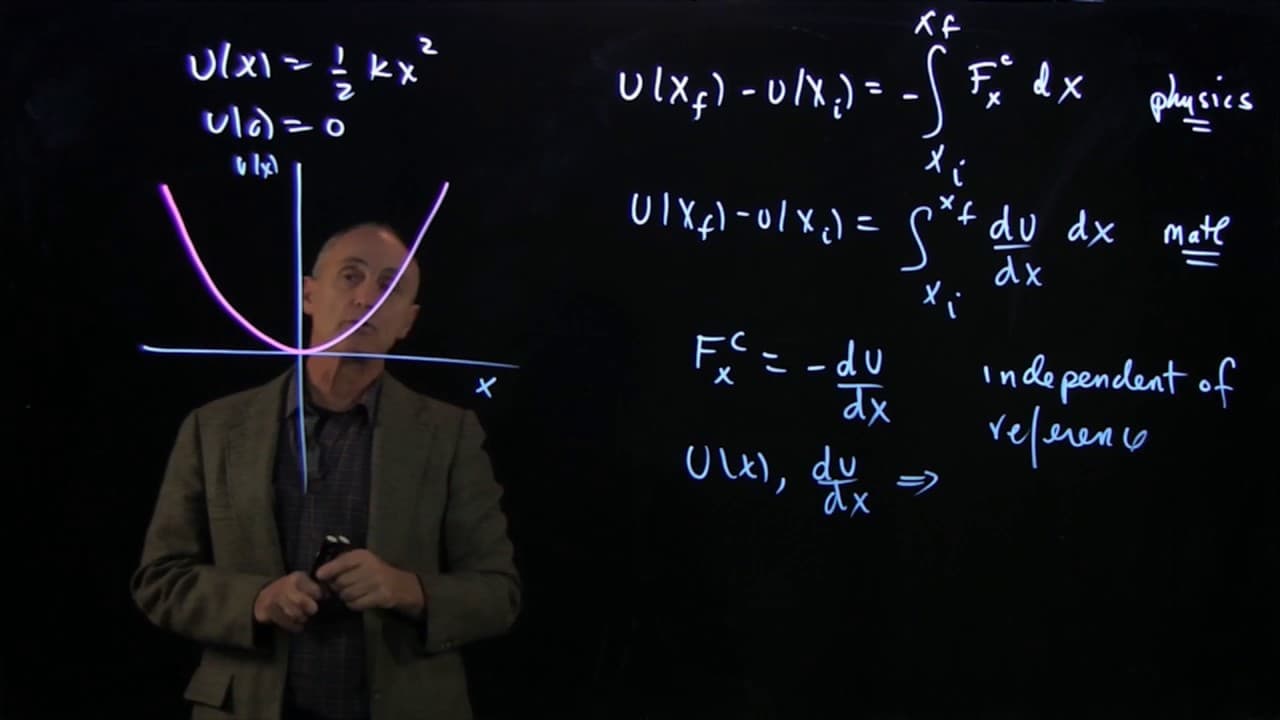
Now that we've introduced mechanical energy in our potential energy functions, we're describing our systems differently. We talk about states. We talk about the potential energy of that state. We talk about the mechanical energy of that state. Remember we're always referring to a reference state for a reference potential. But in one dimension, what... Read More
Key Insights
- 🦾 Mechanical energy is described in terms of states, potential energy, and mechanical energy.
- 🫡 The potential energy difference can be determined by integrating the force with respect to dx.
- 👻 The fundamental theorem of calculus allows the recovery of the conservative force from the potential function.
- 😥 The knowledge of the potential function and its first derivative provides information about the force at any point.
- ❓ The potential function alone is sufficient to determine the force in a system.
- 🌸 The example of a spring potential function illustrates the relationship between the potential function, its derivative, and the force.
- ❎ Positive and negative slopes of the potential function represent opposite forces.
Install to Summarize YouTube Videos and Get Transcripts
Explore YouTube Video Summarizer or Get YouTube Transcript Extractor
Questions & Answers
Q: How does the content describe systems in terms of states, potential energy, and mechanical energy?
The content describes systems by considering different states and their potential energy. It also talks about how mechanical energy relates to these states.
Q: What is the role of the reference state and potential energy difference in one dimension?
The reference state helps determine the potential energy difference. The content explains that the potential energy difference can be found by integrating the force with respect to dx.
Q: How can the conservative force be recovered from the potential function?
By taking the derivative of the potential function and subtracting it from the derivative, the content explains that the conservative force can be recovered.
Q: How does the content demonstrate the relationship between the potential function and force using an example?
The content uses the example of a spring potential function and shows how the slope of the function (du/dx) represents the force. It explains how positive and negative slopes correspond to opposite forces.
Summary & Key Takeaways
-
The content introduces the concept of mechanical energy in potential energy functions.
-
It explains the relationship between states, potential energy, and mechanical energy.
-
The fundamental theorem of calculus is discussed, showing how to recover conservative force from the potential function.
Read in Other Languages (beta)
Share This Summary 📚
Summarize YouTube Videos and Get Video Transcripts with 1-Click
Try YouTube Summary with ChatGPT & Claude or YouTube Transcript Generator
Explore More Summaries from MIT OpenCourseWare 📚



Summarize YouTube Videos and Get Video Transcripts with 1-Click
Try YouTube Summary with ChatGPT & Claude or YouTube Transcript Generator