Turing Machine | Example-2 | TOC | Lec-91| Bhanu Priya
TL;DR
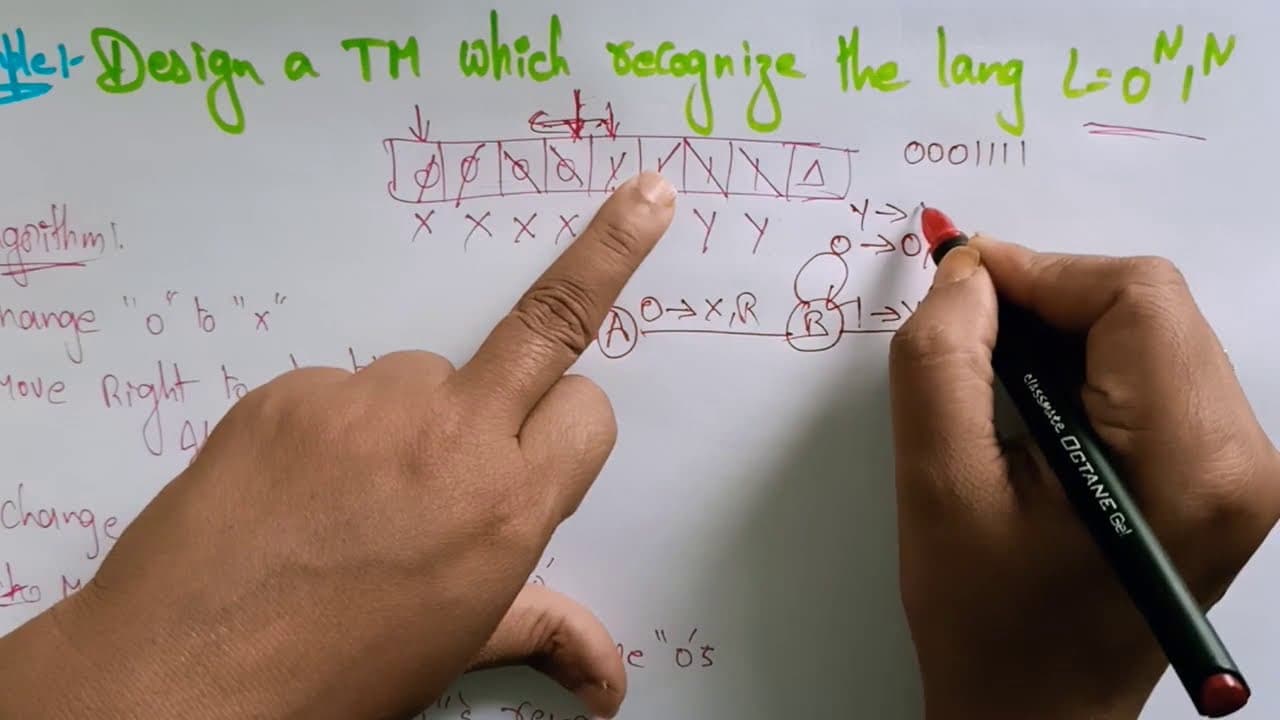
The content outlines how to design a Turing machine to recognize the language with equal zeros and ones.
Transcript
hi students welcome back so coming to the next example that is so here they're asking to design a Turing machine which recognizes the language they are given the language L is equal to zero power and and one power and okay means the same number of zeros and the same number of ones and one should beat that suppose if you are taking four zeros and fo... Read More
Key Insights
- 😒 The Turing machine effectively uses a simple algorithm to recognize patterns in strings, highlighting the fundamental principles of computation.
- 🤑 Symbol replacement is central to the Turing machine's operation, enabling it to track the parity of zeros and ones efficiently.
- 🤬 The process is iterative, illustrating the importance of the leftmost symbol in determining future operations and rechecking conditions.
- 0️⃣ A key part of the Turing machine's design is ensuring consistency; no zeros or ones should remain in their original form after being processed.
- 🤕 The machine's acceptance criteria are notably clear, set by the final state changes in the head's movement across the tape.
- 💱 The algorithm emphasizes systematic checks, reinforcing computational theories related to state changes and language recognition.
- 💐 The practical aspects of drawing a Turing machine's diagram provide visual assistance for understanding complex operational flows.
Install to Summarize YouTube Videos and Get Transcripts
Explore YouTube Video Summarizer or Get YouTube Transcript Extractor
Questions & Answers
Q: What is the purpose of the Turing machine described in the content?
The Turing machine aims to recognize and accept strings from the language L = {0^n 1^n}, meaning it identifies strings with an equal number of zeros followed by an equal number of ones. It processes these strings through a systematic replacement of symbols as part of its operational algorithm.
Q: How does the Turing machine process the input strings?
The Turing machine processes input strings by sequentially replacing zeros with 'X' and ones with 'Y'. In each step, it checks the first zero and one, marking them, then moves left and repeats this until all symbols are either marked or no more pairs are left. It accepts the string if the conditions are satisfied.
Q: What happens if the Turing machine encounters an inappropriate string?
If the Turing machine encounters a string that does not satisfy the conditions of having equal zeros and ones, it rejects the input. The operations ensure that each zero matches a corresponding one, and any imbalance will lead to the machine halting and indicating rejection of the string.
Q: Can you explain the state transitions of the Turing machine?
The Turing machine transitions between several states (e.g., states A, B, C, D) based on the symbols it reads. Each state corresponds to replacing a character or moving the tape head in a specific direction, following a well-defined set of rules that determine whether the input string will ultimately be accepted or rejected.
Summary & Key Takeaways
-
The task involves constructing a Turing machine that recognizes a language consisting of equal numbers of zeros and ones, specifically formatted as 0^n 1^n.
-
The algorithm describes a step-by-step process where zeros are replaced with 'X' and ones with 'Y', ensuring the counts of both symbols are equal.
-
The content includes a detailed explanation of the Turing machine's state transitions and operational procedures to accept or reject the input strings based on the defined criteria.
Read in Other Languages (beta)
Share This Summary 📚
Summarize YouTube Videos and Get Video Transcripts with 1-Click
Try YouTube Summary with ChatGPT & Claude or YouTube Transcript Generator