Improper integrals are not equal to infinite series
TL;DR
Learn how to use partial fractions and integration to solve a quadratic equation.
Transcript
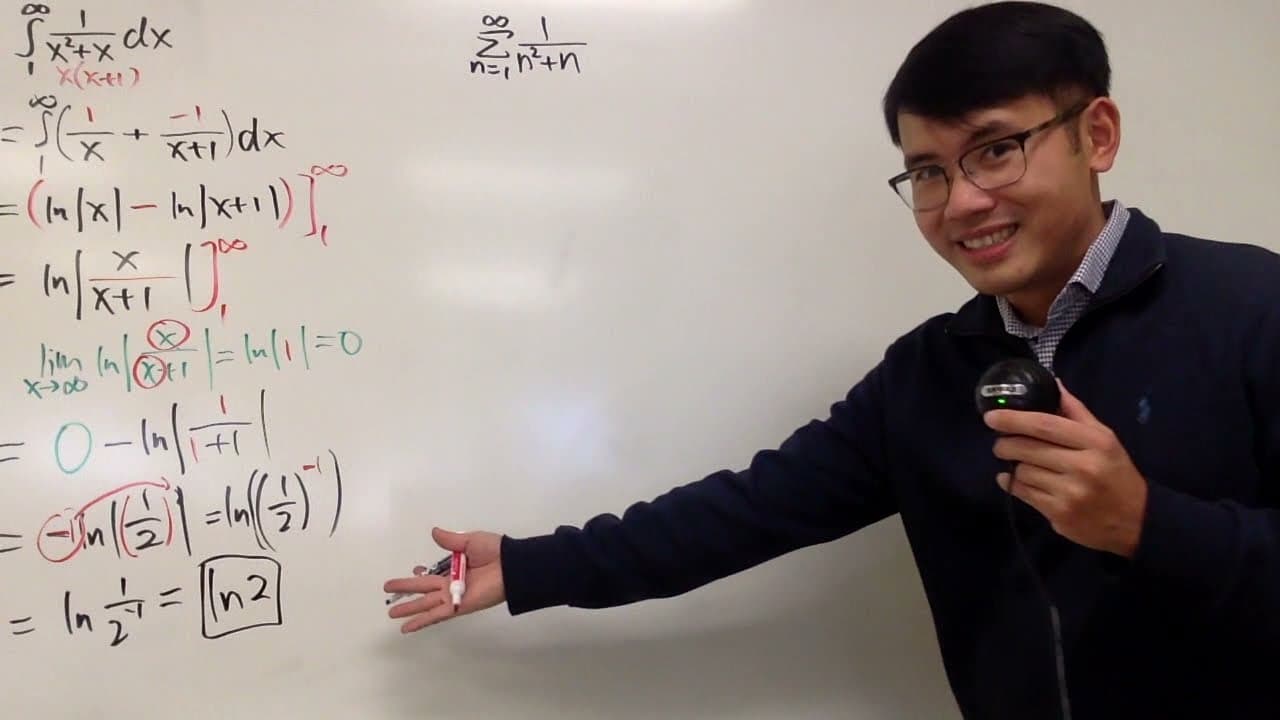
First of all, to integrate this, we have to make sure we do partial fractions and then we integrate these two little fractions. Do not just put on ln(𝑥²+𝑥) because this is a quadratic, right? Anyway, factor this; we can take out 𝑥 and then we have 𝑥+1. Now, let's go ahead and look at the integral from 1 to ∞. For the first fraction, we must hav... Read More
Key Insights
- 🔨 Partial fractions are a powerful tool in integration, especially for complex rational functions.
- 📔 The cover-up method can be used to find coefficients for the partial fractions.
- ❓ Integrating partial fractions involves using logarithmic functions.
- ❓ Improper integrals can converge to finite values, while infinite series can converge to specific values.
- 🥺 The convergence of both improper integrals and infinite series may lead to different values.
- 🥡 Taking the limit of an infinite series can determine its value.
- 🤯 It is important to keep in mind that both improper integrals and infinite series may converge or diverge.
Install to Summarize YouTube Videos and Get Transcripts
Explore YouTube Video Summarizer or Get YouTube Transcript Extractor
Questions & Answers
Q: What is the purpose of using partial fractions in integration?
Partial fractions are used to break down complex rational functions into simpler fractions, making it easier to integrate them.
Q: How do you find the coefficients for the partial fractions?
The coefficients can be found by using the cover-up method. By setting certain values to zero, the coefficients can be determined.
Q: How do you integrate the partial fractions?
Integrating the partial fractions involves using logarithmic functions. Each fraction can be integrated separately, and the resulting expressions can be combined.
Q: Can improper integrals converge to finite values?
Yes, improper integrals can converge to finite values. In the given example, the integral from 1 to infinity converges to the value ln(2).
Summary & Key Takeaways
-
Partial fractions are used to break down a complex rational function into simpler fractions.
-
Integrating the partial fractions involves using logarithmic functions.
-
Improper integrals can converge to finite values, while infinite series can converge to specific values.
Read in Other Languages (beta)
Share This Summary 📚
Summarize YouTube Videos and Get Video Transcripts with 1-Click
Try YouTube Summary with ChatGPT & Claude or YouTube Transcript Generator
Explore More Summaries from blackpenredpen 📚
Summarize YouTube Videos and Get Video Transcripts with 1-Click
Try YouTube Summary with ChatGPT & Claude or YouTube Transcript Generator