Episode 5: Entity Embeddings for Categorical Variables
TL;DR
Learn about entity embeddings, a method for representing categorical variables, and how they can be used in machine learning models.
Transcript
hello everyone and welcome to the new episode in this episode I'll be talking about entity and bearings for categorical variables and before I begin I would like to ask you to like subscribe and share my videos if you like them and it motivates me to keep making new videos so in the previous episode one of the previous episodes which was about cate... Read More
Key Insights
- 👻 Entity embeddings are a method for representing categorical variables that allows for simpler features and improved performance in machine learning models.
- 👾 They work by mapping categories into Euclidean spaces and can be learned using neural networks.
- ☕ Entity embeddings are a model-focused approach to dealing with categorical variables, as opposed to pre-processing methods such as binarization and one-hot encoding.
- ✋ They can handle different types of categorical features, including those with high cardinality.
- 🛩️ Embedding dimensions can be chosen based on the number of unique categories, with smaller dimensions reducing memory constraints.
- 👶 Entity embeddings can be trained with new data and can handle rare values effectively.
- ❓ The implementation of entity embeddings can be done using TensorFlow Keras, and the resulting models can be used for binary classification tasks.
- 🇨🇫 Converting the TensorFlow Keras model to a PyTorch model and sharing it in a public kernel is a possible task for further exploration.
Install to Summarize YouTube Videos and Get Transcripts
Explore YouTube Video Summarizer or Get YouTube Transcript Extractor
Questions & Answers
Q: What are some common methods for dealing with categorical variables?
Common methods include binarization, label encoding, and one-hot encoding. Binarization represents categories as 0s and 1s, label encoding assigns each category a numerical value, and one-hot encoding creates binary columns for each category.
Q: How do entity embeddings represent categorical variables?
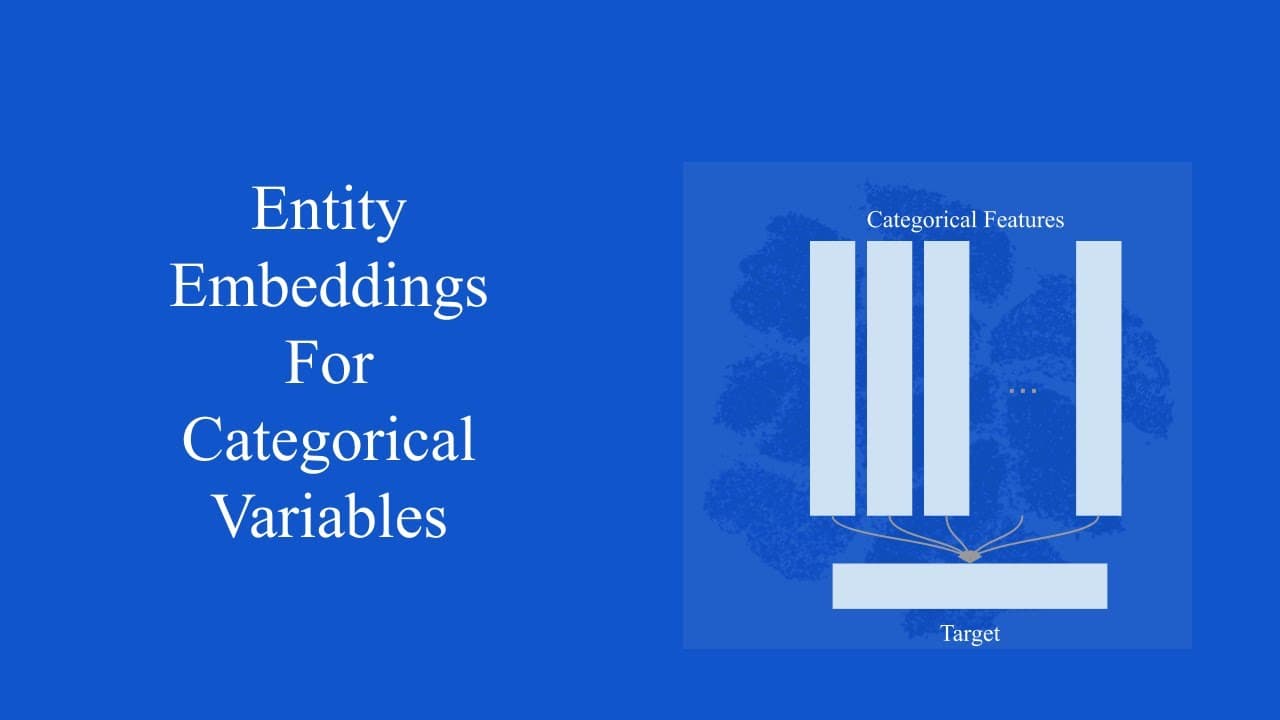
Entity embeddings map categories into Euclidean spaces. Instead of creating a vector of a fixed size for each category, embeddings allow for a smaller vector size while still capturing the relationships between categories. This reduces memory constraints and allows for handling high-cardinality categorical features.
Q: How are entity embeddings learned?
Entity embeddings can be learned using neural networks. The embeddings are fed into the network, undergo operations such as dropout and flattening, and then are concatenated and passed through dense layers before predicting the target variable.
Q: What are the advantages of using entity embeddings?
Entity embeddings offer simpler features, improved performance, and the ability to handle various types and high-cardinality categorical features. They can also handle rare values well and allow for updating the model with new data.
Summary & Key Takeaways
-
Entity embeddings are a way of representing categorical variables in machine learning models from a modeling perspective.
-
They can be used as an alternative to binarization, label encoding, and one-hot encoding methods for dealing with categorical variables.
-
Entity embeddings map categories into Euclidean spaces, allowing for simpler features and improved performance in machine learning models.
Read in Other Languages (beta)
Share This Summary 📚
Summarize YouTube Videos and Get Video Transcripts with 1-Click
Try YouTube Summary with ChatGPT & Claude or YouTube Transcript Generator
Explore More Summaries from Abhishek Thakur 📚


Summarize YouTube Videos and Get Video Transcripts with 1-Click
Try YouTube Summary with ChatGPT & Claude or YouTube Transcript Generator