Boundary Conditions Replace Initial Conditions
TL;DR
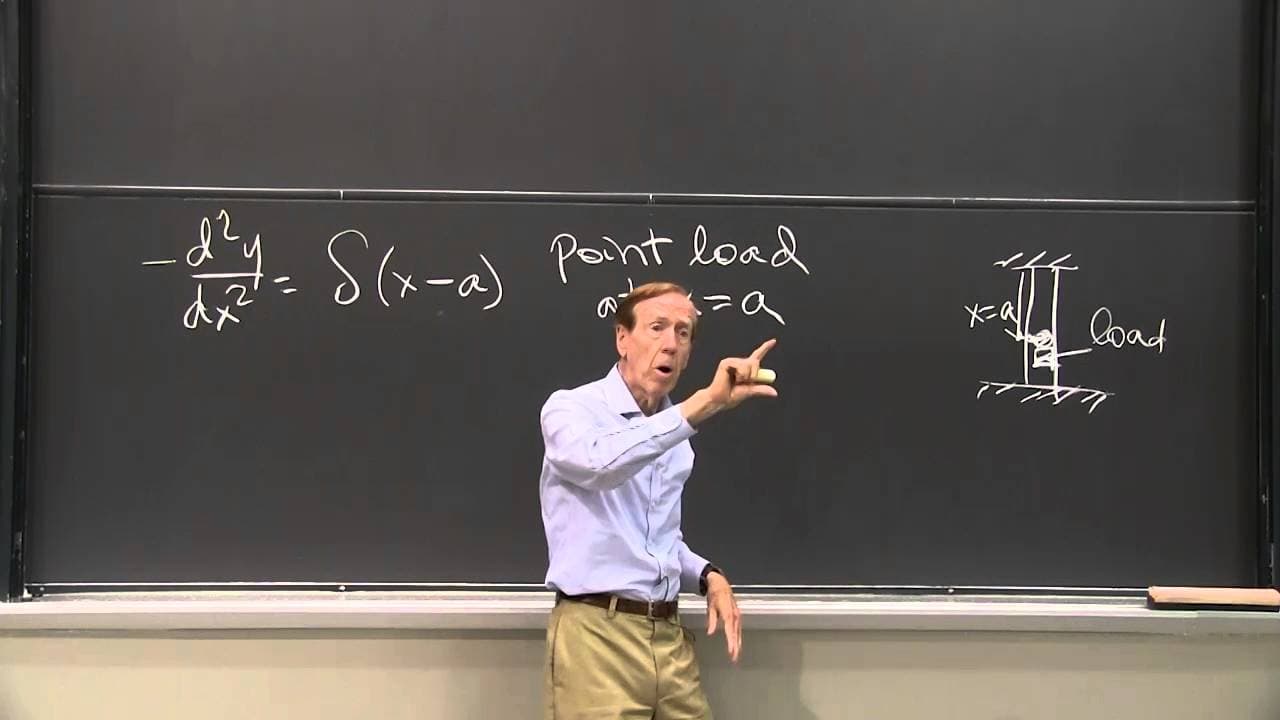
This content discusses boundary value problems in which two boundary conditions are given instead of initial conditions for a second-order differential equation, and includes an example involving a point load represented by a delta function.
Transcript
GILBERT STRANG: OK. Well my problem today is a little different. Because I don't have two initial conditions, as we normally have for a second-order differential equation. Instead, I have two boundary conditions. So let me show you the equation. So I'm changing t to x because I'm thinking of this as a problem in space rather than in time. So there'... Read More
Key Insights
- ❓ Boundary value problems involve two boundary conditions instead of initial conditions.
- ❓ The particular solution satisfies the differential equation given the load.
- ❓ The constants in the solution are determined from the boundary conditions.
Install to Summarize YouTube Videos and Get Transcripts
Explore YouTube Video Summarizer or Get YouTube Transcript Extractor
Questions & Answers
Q: What is the main difference between a boundary value problem and an initial value problem in differential equations?
In a boundary value problem, two boundary conditions are given, usually involving values at the endpoints of the interval, while in an initial value problem, the conditions are given at a single point at the start of the interval.
Q: How is the particular solution for the equation found?
The particular solution is found by choosing a function that satisfies the equation, given the load. In the example given, the function -1/2x^2 is chosen as it has a second derivative equal to 1.
Q: How are the constants C and D determined from the boundary conditions?
The constants C and D are determined by evaluating the solution at the left and right endpoints of the interval and setting them equal to the given values. Solving the resulting system of equations gives the values of C and D.
Q: What is the physical interpretation of the solution in the application example?
The solution represents the displacement of a thin bar under the effect of its own weight and the elastic force. The solution, which is 0 at both ends and positive in between, gives the distribution of the displacement along the bar.
Summary & Key Takeaways
-
The content introduces a new type of problem in differential equations, which involves two boundary conditions instead of initial conditions.
-
It explains how to find the particular solution and the homogeneous solution for the equation using these boundary conditions.
-
An application example is provided, demonstrating how the solution can be used to determine the displacement of a bar under a point load.
Read in Other Languages (beta)
Share This Summary 📚
Summarize YouTube Videos and Get Video Transcripts with 1-Click
Try YouTube Summary with ChatGPT & Claude or YouTube Transcript Generator
Explore More Summaries from MIT OpenCourseWare 📚


Summarize YouTube Videos and Get Video Transcripts with 1-Click
Try YouTube Summary with ChatGPT & Claude or YouTube Transcript Generator