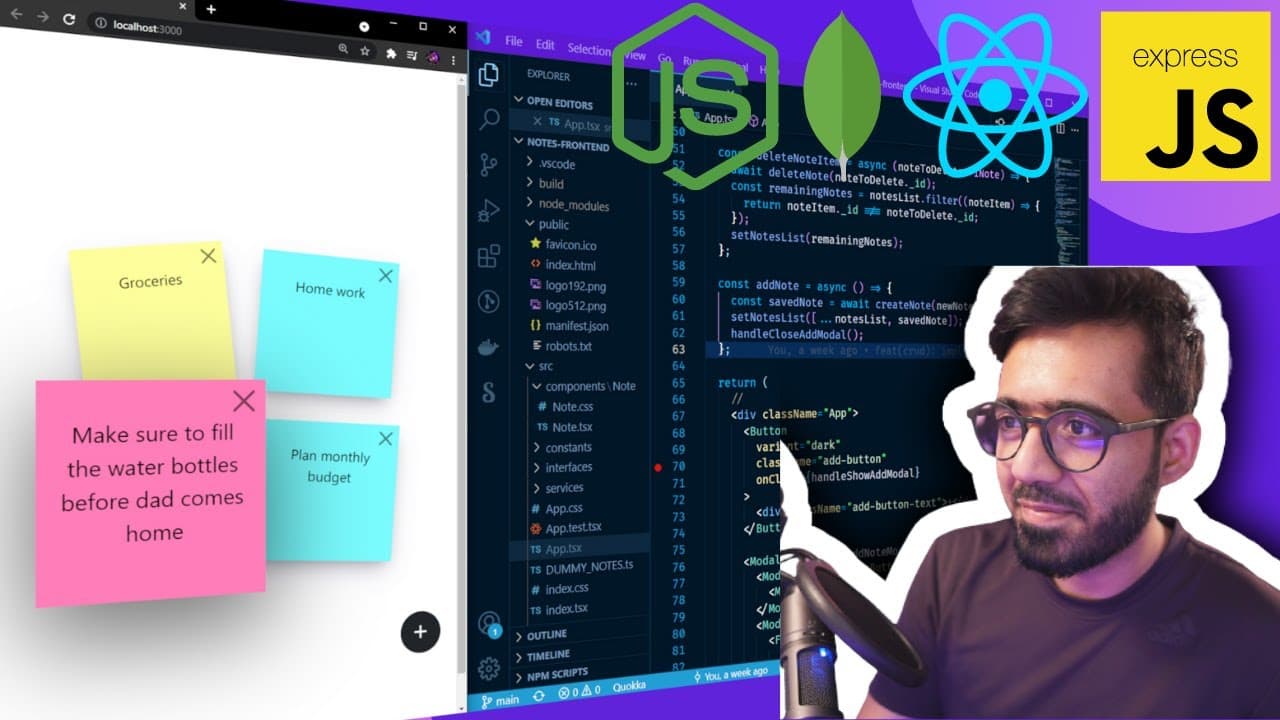
MERN Stack Crash Course for beginners (MongoDB, ExpressJs, React, NodeJS in 8 hours)
TL;DR
This video tutorial teaches viewers the basics of the MERN (MongoDB, Express, React, Node.js) stack, from setting up a backend server to creating a frontend application.
Transcript
are you an aspiring web developer and you want to learn mustache but you might have tried several tutorials which do not start from scratch well this video will teach you one stack right from the scratch and by the end of this video you will learn the basics of merge stack so you can continue your journey of becoming an amazing web developer hey ev... Read More
Key Insights
- 📝 Showing dummy nodes in the UI:
- Instead of fetching nodes from the backend, the app now uses dummy nodes, which are hard-coded in the
dummyNodes.tsfile. - The
dummyNodes.tsfile exports the dummy nodes array as the default export. - In the app component, the
useEffecthook is used to initialize thenodesListstate variable with the dummy nodes array when the component first renders. - The dummy nodes are logged to the console to verify their retrieval from the state.
- The backend server is no longer needed, as the app now uses the hard-coded dummy nodes as data.
- The
getNotesfunction, which made a request to the backend, has been removed from the app component. - The
useEffecthook is used to perform an action when the component is first rendered. - The
useEffecthook takes a callback function as its first parameter. This function is executed when the component first renders. - The dependency array is an optional second parameter of the
useEffecthook. By passing an empty array, the callback function is only executed once, when the component first renders. - In this case, the
useEffecthook is used to update thenodesListstate variable with the dummy nodes array when the component first renders.
Install to Summarize YouTube Videos and Get Transcripts
Explore YouTube Video Summarizer or Get YouTube Transcript Extractor
Questions & Answers
Q: What is the MERN stack and what are its components?
The MERN stack is a web development stack that consists of MongoDB (a NoSQL database), Express (a backend web framework), React (a frontend library), and Node.js (a runtime environment for the server-side JavaScript).
Q: What are the advantages of using the MERN stack for web development?
The MERN stack allows for a seamless full-stack JavaScript development experience, as it uses the same language and codebase for both the frontend and backend. It also provides flexibility, scalability, and a large community for support and resources.
Q: What is the role of a frontend framework like React in the MERN stack?
React is responsible for building the user interface of an application. It allows for modular and reusable components, efficient rendering, and a virtual DOM for better performance.
Q: How can beginners get started with learning the MERN stack?
Beginners can start by setting up a basic Node.js backend, learning about REST APIs and CRUD operations. They can then move on to building a React frontend and integrating it with the backend. Online tutorials, documentation, and practicing on small projects can help in the learning process.
Summary & Key Takeaways
-
The instructor, a software architect and Angular expert, streams on Twitch to teach beginners web development.
-
The tutorial focuses on building a MERN stack application, starting with creating a Node.js backend and setting up REST APIs.
-
The backend is hosted on a free tier platform, with the frontend deployed on GitHub Pages and the database hosted on MongoDB Atlas.
Read in Other Languages (beta)
Share This Summary 📚
Summarize YouTube Videos and Get Video Transcripts with 1-Click
Try YouTube Summary with ChatGPT & Claude or YouTube Transcript Generator
Explore More Summaries from Code with Ahsan 📚
Summarize YouTube Videos and Get Video Transcripts with 1-Click
Try YouTube Summary with ChatGPT & Claude or YouTube Transcript Generator