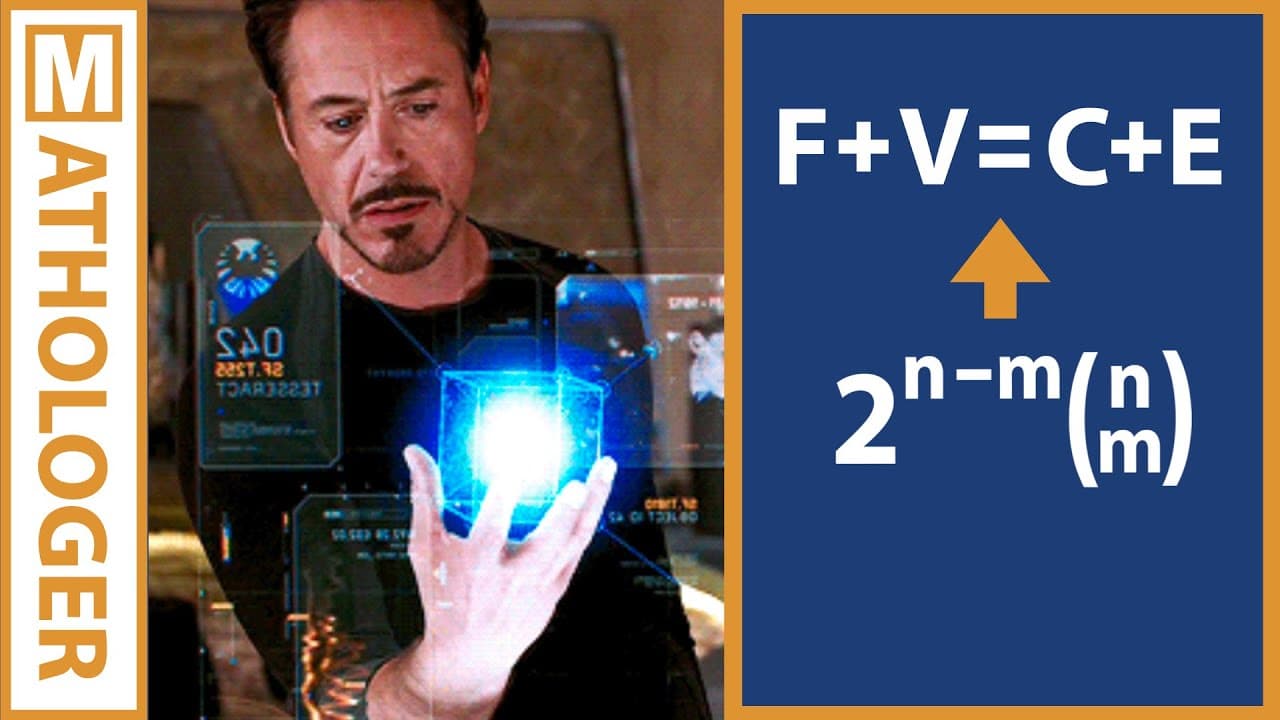
The Iron Man hyperspace formula really works (hypercube visualising, Euler's n-D polyhedron formula)
TL;DR
Learn about the mathematical concept of cubes in different dimensions and how they can be visualized through shadows.
Transcript
welcome to another mathologer video let me start by showing you something very cute x plus two cubed cute okay okay here's a kitten definitely cute but bear with me x plus two cubed is also cute let's expand 6 12 8 numbers ring a bell no how about now aha a cube has six 2d faces 12 on the edges and eight dimensionless zero dimensional vertices damn... Read More
Key Insights
- ☺️ The x plus 2 to the power of n formula accurately predicts the structure of cubes in different dimensions.
- 😀 The formula for higher-dimensional cubes follows a pattern that can be applied to calculate their number of vertices, edges, faces, and cells.
- ❓ The Euler-Schlafli formulas provide insights into the relationship between the components of convex 3D polyhedra.
Install to Summarize YouTube Videos and Get Transcripts
Explore YouTube Video Summarizer or Get YouTube Transcript Extractor
Questions & Answers
Q: What is the formula for expanding the structure of cubes in different dimensions?
The formula is x plus 2 to the power of n, where x represents the dimension and n represents the power or exponent.
Q: Can the formula be used to calculate the number of vertices, edges, faces, and cells in higher-dimensional cubes?
Yes, by substituting different values for x, such as 0 for a point, 1 for a line segment, and so on, the formula accurately predicts the number of each component in higher-dimensional cubes.
Q: What are the Euler-Schlafli formulas?
The Euler-Schlafli formulas describe the relationship between the number of vertices, edges, and faces of convex 3D polyhedra. One of the most well-known formulas is V - E + F = 2, which holds true for all convex 3D polyhedra.
Q: How do shadows of higher-dimensional cubes work?
Shadows of higher-dimensional cubes can be visualized by projecting their vertices onto a lower-dimensional plane. By using mathematical projections and adding an extra dimension, the shadows of cubes in higher dimensions can be accurately represented.
Summary & Key Takeaways
-
The video introduces the concept of cubes in different dimensions and explains how the formula x plus 2 to the power of n can be used to expand their structure and calculate their number of vertices, edges, faces, and cells.
-
The video explores the connections between the dimensions of cubes and the number of bits and pieces they contain, revealing a pattern that holds true for higher-dimensional cubes as well.
-
The Euler-Schlafli formulas are introduced, which provide insights into the relationship between the number of vertices, edges, and faces of convex 3D polyhedra, including cubes.
-
The video concludes by showcasing the shadows of 3D and 4D cubes and how they can be visualized using mathematical projections.
Read in Other Languages (beta)
Share This Summary 📚
Summarize YouTube Videos and Get Video Transcripts with 1-Click
Try YouTube Summary with ChatGPT & Claude or YouTube Transcript Generator
Explore More Summaries from Mathologer 📚



Summarize YouTube Videos and Get Video Transcripts with 1-Click
Try YouTube Summary with ChatGPT & Claude or YouTube Transcript Generator