Middle-of-the-Night Melatonin Supplementation: Better Sleep, Improved HRV and RHR?
TL;DR
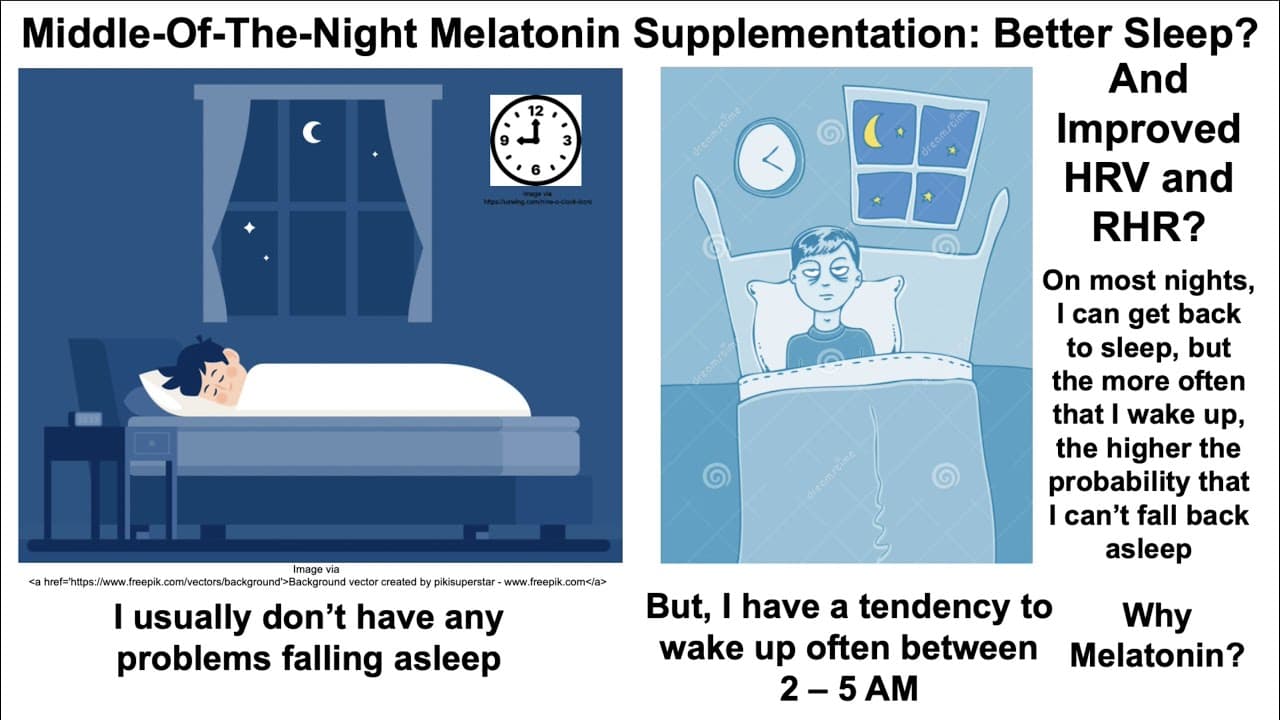
Supplementing with melatonin in the middle of the night may improve sleep quality and show positive effects on heart rate variability and resting heart rate.
Transcript
i usually don't have any problems falling asleep but i have a tendency to wake up often between two to five am sometimes as much as three times during that three hour period now on most nights i can get back to sleep but the more often that i wake up the higher the probability that i can't fall back asleep so with that in mind in january i started ... Read More
Key Insights
- 🌙 Melatonin supplementation can potentially improve sleep quality and reduce the frequency of awakenings during the night, increasing the probability of falling back asleep. It may also have positive effects on heart rate variability (HRV) and resting heart rate (RHR).
- 🌞Melatonin levels are impacted by circadian rhythm disorders and nighttime light exposure, which can disrupt sleep quality. Age also affects melatonin levels, with younger children having higher levels during wakefulness and peak levels around 2 am.
- 💤 With middle-of-the-night melatonin supplementation, there was a significant increase in sleep duration, with an average increase of 30 minutes per day compared to days without supplementation.
- ❤️Supplementation with melatonin also resulted in a small but significant increase in heart rate variability (HRV) and a decrease in resting heart rate (RHR) compared to days without supplementation.
- 🕒Heart rate variability (HRV) declines with age, with values decreasing from around 80 in 20-year-olds to around 40 in 60-year-olds. Resting heart rate (RHR) increases until the early 50s and then declines up until 85 years old.
- 📉 Melatonin supplementation appears to have beneficial effects on heart rate variability and resting heart rate that align with characteristics of youth, suggesting that it may help offset age-related declines in cardiovascular health.
- ♂️ Physical activity levels and calorie intake did not differ significantly between days with and without melatonin supplementation, indicating that these variables did not account for the observed improvements in heart rate variability and resting heart rate.
- ⚖️By considering sleep, physical activity, calorie intake, and melatonin supplementation together, it was found that a higher melatonin intake was significantly associated with higher heart rate variability and lower resting heart rate, even after accounting for other factors. This suggests that melatonin supplementation plays a role in improving cardiovascular fitness.
Install to Summarize YouTube Videos and Get Transcripts
Explore YouTube Video Summarizer or Get YouTube Transcript Extractor
Questions & Answers
Q: How does melatonin supplementation affect sleep quality?
Melatonin supplementation in the middle of the night can improve sleep duration by an average of 30 minutes, indicating better sleep quality.
Q: What are the age-related changes in melatonin levels?
Melatonin levels decline with age, with peak levels occurring at 2 am in young children (5-10 years old) and reduced levels in individuals over the age of 70.
Q: How does melatonin supplementation affect heart rate variability?
Melatonin supplementation is associated with a small but significant increase in heart rate variability, which is typically higher in youth.
Q: Does melatonin supplementation impact resting heart rate?
Yes, melatonin supplementation is associated with a small but significant decrease in resting heart rate, resembling characteristics of a younger individual.
Q: What factors, other than melatonin supplementation, may influence heart rate variability and resting heart rate?
Sleep duration, physical activity level, and calorie intake are all factors that can impact heart rate variability and resting heart rate. Melatonin supplementation remains significantly associated with these metrics even after accounting for these factors.
Q: Are there any potential side effects or risks associated with middle-of-the-night melatonin supplementation?
The video does not mention any potential side effects or risks of using middle-of-the-night melatonin supplementation. However, it is important to consult with a healthcare professional before starting any new supplement regimen.
Summary & Key Takeaways
-
Melatonin is a hormone produced by the pineal gland that helps regulate the sleep-wake cycle.
-
A circadian rhythm disorder or nighttime light exposure can disrupt melatonin levels and lead to poor sleep quality.
-
Aging also affects melatonin production, with older adults having significantly lower levels compared to younger individuals.
-
Middle-of-the-night melatonin supplementation may improve sleep duration and increase heart rate variability while decreasing resting heart rate, resembling youth-like characteristics.
Read in Other Languages (beta)
Share This Summary 📚
Summarize YouTube Videos and Get Video Transcripts with 1-Click
Try YouTube Summary with ChatGPT & Claude or YouTube Transcript Generator
Explore More Summaries from Conquer Aging Or Die Trying! 📚




Summarize YouTube Videos and Get Video Transcripts with 1-Click
Try YouTube Summary with ChatGPT & Claude or YouTube Transcript Generator