Clipping circuits | Double ended | Pulse Digital Circuits | Lec-29
TL;DR
The video explains double-ended clipping circuits using diodes and reference voltages at two independent levels.
Transcript
hi everyone so in this video I am going to explain about some double ended clipping circuits in the previous video I have given you the explanation of clipping at two independent levels with the two diodes two reference voltages okay where we have considered as VR1 is positive and VR2 is negative signal now few more circuit diagrams are also there ... Read More
Key Insights
- ⚡ Understanding the role of reference voltages is crucial for effective signal clipping in circuits.
- ⚡ Diode states can shift based on the relationship between input voltage and reference voltages, significantly impacting the output waveform.
- ✊ Zener diodes provide a robust method to establish precise reference voltages for clipping applications, crucial in regulated power supply designs.
- 📋 The choice of diodes, whether standard or Zener, directly influences the operational characteristics of a clipping circuit.
- 📋 Designing circuits with dual diodes enables versatile clipping capabilities, enhancing the circuit's applicability across various scenarios.
- 🧡 The relationship between VR1 and VR2 dictates the boundaries of input voltage ranges for different clipping scenarios.
- ⚡ Proper assumptions regarding voltage levels are necessary for accurate circuit analysis and waveform interpretation.
Install to Summarize YouTube Videos and Get Transcripts
Explore YouTube Video Summarizer or Get YouTube Transcript Extractor
Questions & Answers
Q: What is the significance of reference voltages VR1 and VR2 in double-ended clipping circuits?
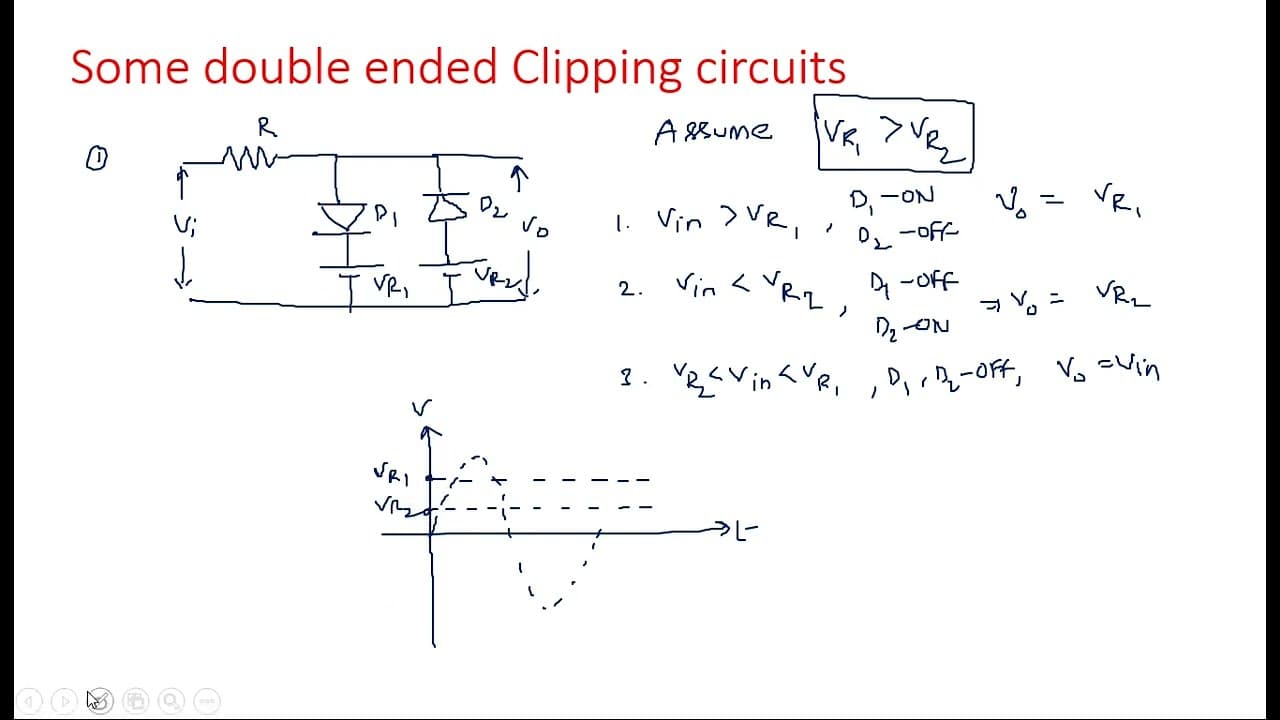
Reference voltages VR1 and VR2 determine the clipping levels in a double-ended clipping circuit. They decide when the diodes D1 and D2 will conduct or remain off, thereby controlling the output voltage based on the input voltage. Without properly defined reference voltages, accurate analysis of the circuit's behavior becomes impossible.
Q: How does the state of the diodes change with varying input voltage in a clipping circuit?
The state of diodes D1 and D2 changes depending on whether the input voltage exceeds VR1 or falls below VR2. If the input exceeds VR1, D1 conducts, resulting in output equal to VR1, while D2 remains off. Conversely, if the input is below VR2, D2 conducts, and output equals VR2. In the range between VR2 and VR1, both diodes remain off, leading to output equal to the input.
Q: Can you explain how Zener diodes are utilized within clipping circuits?
Zener diodes act as reference points in clipping circuits. They allow for setting a specific voltage level (Vz) at which the circuit will clip the signal. When the input exceeds this breakdown voltage, the diode conducts, ensuring the output doesn't exceed the specified Zener voltage, thus controlling output across various input conditions.
Q: What are the implications of using both positive and negative reference voltages in a circuit?
When using both positive and negative reference voltages, it allows clipping at both ends of the input signal waveform. This creates a more flexible circuit that can limit output on both sides, improving performance in applications that require controlled signal amplitudes in both directions, leading to better system stability.
Summary & Key Takeaways
-
The content illustrates the operation of double-ended clipping circuits, highlighting how different voltage levels affect output behavior in circuits with single and dual diodes.
-
It discusses specific scenarios when input voltage is compared to reference voltages VR1 and VR2, illustrating how diodes D1 and D2 switch states to clip the signal.
-
The video also introduces the concept of using a Zener diode as a reference for clipping, explaining how it operates in forward and breakdown conditions for effective voltage regulation.
Read in Other Languages (beta)
Share This Summary 📚
Summarize YouTube Videos and Get Video Transcripts with 1-Click
Try YouTube Summary with ChatGPT & Claude or YouTube Transcript Generator