Increasing and Decreasing Functions - Calculus
TL;DR
Learn how to determine when a function is increasing and decreasing using the first derivative and sign charts.
Transcript
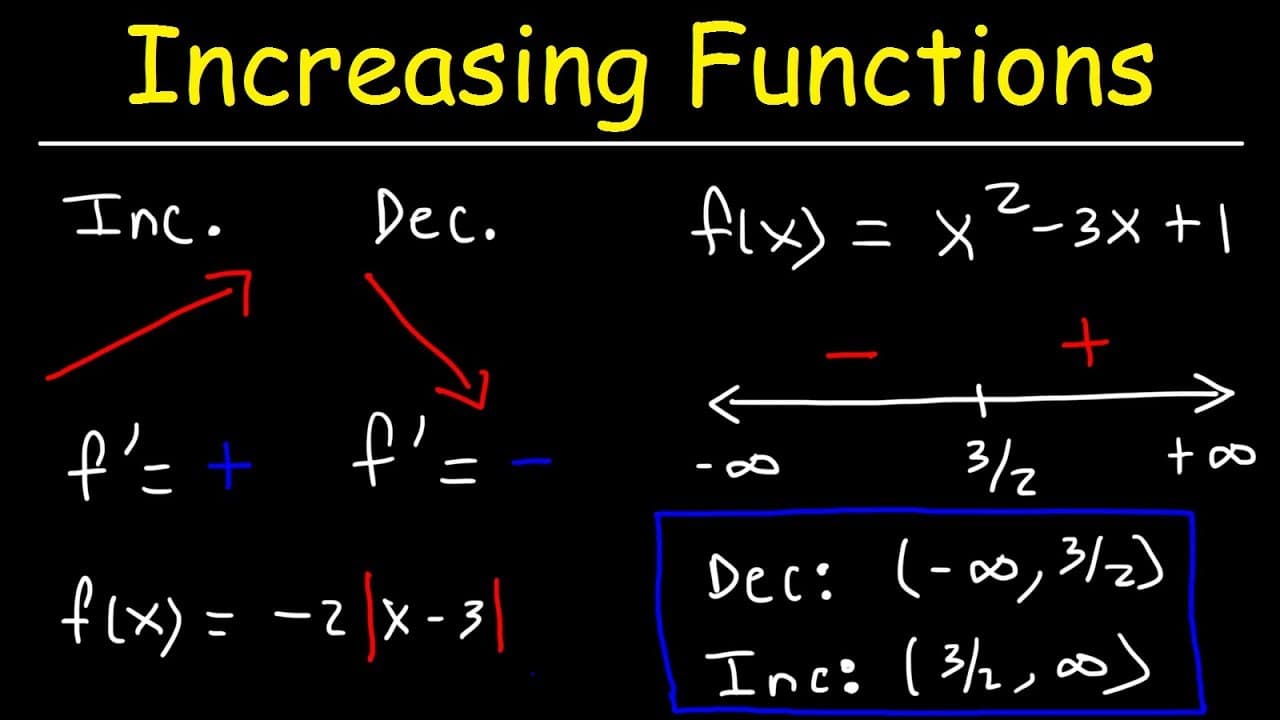
in this video we're going to focus on finding the intervals where a function is increasing and when it's decreasing so let's say if you have a graph anytime the graph is going upward if it's going up then the function is increasing the first derivative is positive now if the graph is going down it can be going down in many different ways when it's ... Read More
Key Insights
- ❓ A function is increasing when the first derivative is positive, indicating a positive slope.
- ❎ A function is decreasing when the first derivative is negative, indicating a negative slope.
- 📈 Sign charts can be used to determine the intervals of increase and decrease without graphing the function.
- 📈 Absolute value functions can be analyzed by comparing the inside part of the function to zero and graphing the resulting transformation.
- ☺️ Critical numbers of a function are values of x where the first derivative is zero or undefined.
- 😥 Test points within intervals can be used to evaluate the sign of the first derivative and determine if the function is increasing or decreasing.
- 🤬 Intervals of increase and decrease are written using inequality symbols with infinity as appropriate.
Install to Summarize YouTube Videos and Get Transcripts
Explore YouTube Video Summarizer or Get YouTube Transcript Extractor
Questions & Answers
Q: How can we determine whether a function is increasing or decreasing without graphing it?
To determine if a function is increasing or decreasing, we need to find the first derivative by differentiating the function. Set the first derivative equal to zero and create a sign chart to determine the intervals of increase and decrease.
Q: How do we create a sign chart to analyze the intervals of a function?
To create a sign chart, list the critical numbers (values of x where the first derivative is zero or undefined) and choose test points within the intervals. Evaluate the first derivative for each test point to determine if it is positive or negative. Positive values indicate increasing intervals, while negative values indicate decreasing intervals.
Q: What does it mean when the first derivative is positive?
If the first derivative is positive, it means the function is increasing. This indicates that the slope of the function is positive, and the graph is going upward.
Q: How can we determine the intervals of increase and decrease for an absolute value function?
Absolute value functions can be analyzed by graphing them. The vertex of the absolute value function determines the point where the function changes from increasing to decreasing (or vice versa). Compare the inside part of the absolute function to zero to find the x-coordinate of the vertex and determine the intervals of increase and decrease.
Summary & Key Takeaways
-
The video explains how to find intervals of function increase and decrease without graphing the function by finding the first derivative, setting it equal to zero, and creating a sign chart.
-
It provides examples of finding intervals for different functions, such as f(x) = x^2 - 3x + 1 and f(x) = x^3 - 9x^2 + 24x.
-
The video also demonstrates how to analyze absolute value functions and determine their intervals of increase and decrease.
Read in Other Languages (beta)
Share This Summary 📚
Summarize YouTube Videos and Get Video Transcripts with 1-Click
Try YouTube Summary with ChatGPT & Claude or YouTube Transcript Generator
Explore More Summaries from The Organic Chemistry Tutor 📚




Summarize YouTube Videos and Get Video Transcripts with 1-Click
Try YouTube Summary with ChatGPT & Claude or YouTube Transcript Generator