Did 'Rick and Morty' Address 9/11 in a Recent Episode?
TL;DR
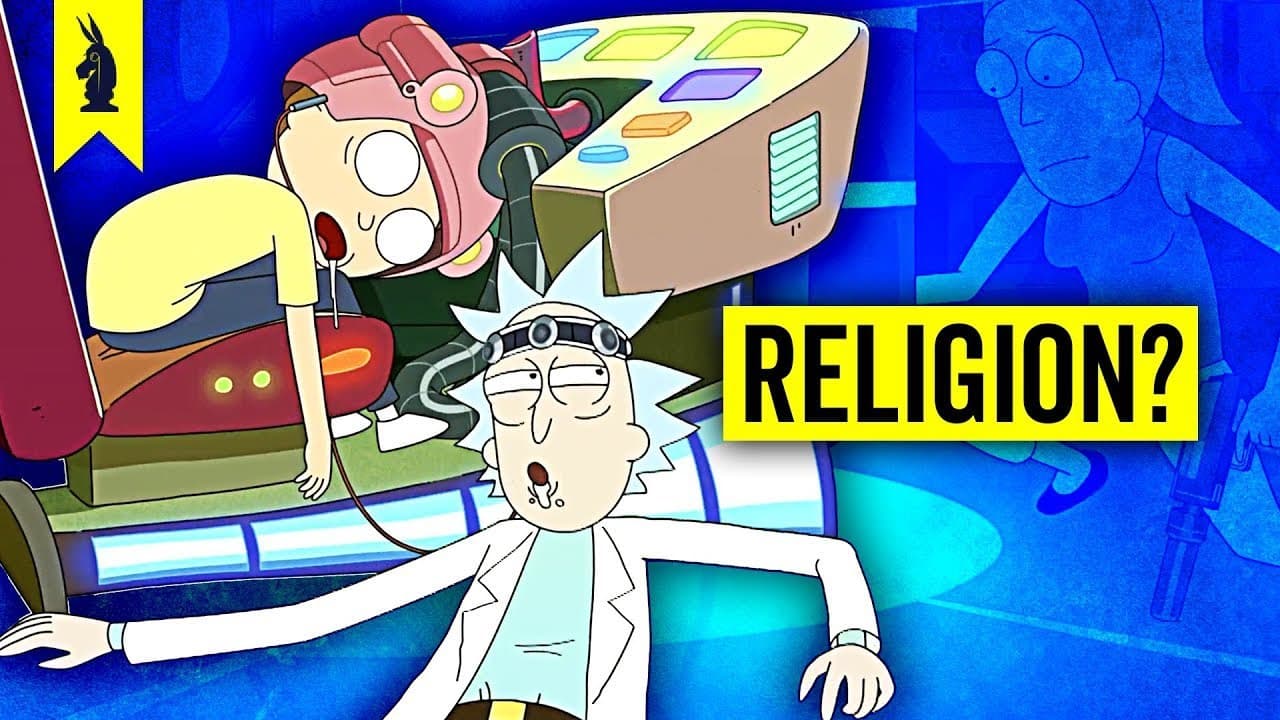
Yes, the 'Rick and Morty' episode aired on 9/11 and explores themes of religious violence through its absurd narrative. It critiques the simplistic distinction between secular and religious violence, suggesting both can lead to irrational conflict. The episode uses humor to highlight how arbitrary beliefs can incite serious consequences in society.
Transcript
(smooth music) - What's up, everyone? Michael here to talk about the most recent episode of "Rick and Morty," "Rick: A Mort Well Lived." This one has it all. Rick starts a new religion that's absolutely not a religion, Morty's consciousness gets shattered into pieces inside a video game, and Summer does a "Die Hard." But something else stood out to... Read More
Key Insights
- 🖼️ The episode utilizes absurd humor to explore the serious consequences of religious narratives, framed in the context of a fictional universe.
- 🎮 The interplay of video game mechanics and consciousness fragmentation symbolizes the complexities of identity within belief systems.
- 👥 The emergence of "grandsonism" represents how arbitrary beliefs can foster in-group and out-group divisions with dangerous implications.
- 🧑🤝🧑 The episode's release date prompts reflection on significant historical events and their lingering impact on cultural narratives around violence.
- 🥰 The portrayal of love as a preventive measure against conflict underscores the importance of emotional connections in human relationships.
- 🚱 Cavanaugh's insights on the non-distinction between secular and religious violence enhance the show's critique of ideological justifications for violence.
- 💨 The continued relevance of myths, such as "Die Hard," illustrates the way cultural narratives can evolve and perpetuate cycles of violence across civilizations.
Install to Summarize YouTube Videos and Get Transcripts
Explore YouTube Video Summarizer or Get YouTube Transcript Extractor
Questions & Answers
Q: How does the episode "Rick: A Mort Well Lived" reflect on real-world religious conflicts?
The episode mirrors real-world religious conflicts by portraying a fictional scenario where a fabricated religion, "grandsonism," incites violence among its followers. The timing of the episode's air date on 9/11 further emphasizes the connection to historical and contemporary violence associated with religious ideologies, suggesting that the basis for such conflicts often arises from arbitrary beliefs.
Q: What role does the character Summer play in exploring the themes of violence and religion?
Summer's storyline embodies the absurdity of how foundational myths, like "Die Hard," can catalyze violence. While engaging with these myths, she uses them to attain her goals, reflecting the way real-world religions can become instruments for promoting conflict and justifying violence, transforming cultural narratives into mechanisms for aggression.
Q: How does the episode's setting in a video game contribute to its themes?
The video game setting allows for an exploration of identity, consciousness, and belief systems in a unique environment. By fragmenting Morty’s consciousness, the show illustrates how individuals can become caught up in collective identities that lead to irrational violence, mirroring how real-life religious movements often fracture people's agency under communal ideologies.
Q: Do Rick and Morty suggest that religion is inherently violent?
Rather than claiming religion is inherently violent, the episode critiques the simplistic binary between religious and secular violence. It implies that both realms can harbor absolutist ideologies that lead to conflict, emphasizing that the human capacity for violence transcends the religious-secular divide, driven instead by a desire for power and truth.
Q: How does the episode tackle the relationship between love and conflict?
The conflict escalates when Rick hesitates to express his love for Morty, ultimately leading to a holy war among their factions. This highlights the episode's message that communication and emotional connection are vital in preventing misunderstandings and conflicts, mirroring the significance of love and understanding in mitigating real-world violence.
Q: What philosophical perspective does the episode align with regarding violence?
The episode aligns with William T. Cavanaugh's perspective, which argues that the distinction between secular and religious violence is misleading. It posits that both forms of violence share characteristics of absolutism and irrationality, suggesting that all forms of ideological conflict stem from a universal human tendency to justify violence in pursuit of perceived truth or goodness.
Q: How does the episode reflect on the narratives surrounding the War on Terror?
By airing on 9/11 and paralleling the absurdity of intergalactic conflicts to real-world violence post-9/11, the episode critiques the narratives used to justify conflicts, such as the War on Terror. It suggests that ideological narratives, whether secular or religious, can lead to large-scale violence, questioning the motivations and morality behind such justifications.
Summary & Key Takeaways
-
In the episode "Rick: A Mort Well Lived," Rick and Morty face challenges within a video game emerging as a metaphor for religious beliefs and the violence they can incite.
-
The episode aired on 9/11, resonating with themes of holy wars and the absurdity surrounding human conflicts fueled by religious narratives.
-
The show critiques the simplistic distinction between secular and religious violence, suggesting that both can lead to irrational violence in various contexts.
Read in Other Languages (beta)
Share This Summary 📚
Summarize YouTube Videos and Get Video Transcripts with 1-Click
Try YouTube Summary with ChatGPT & Claude or YouTube Transcript Generator