Terminal Velocity
TL;DR
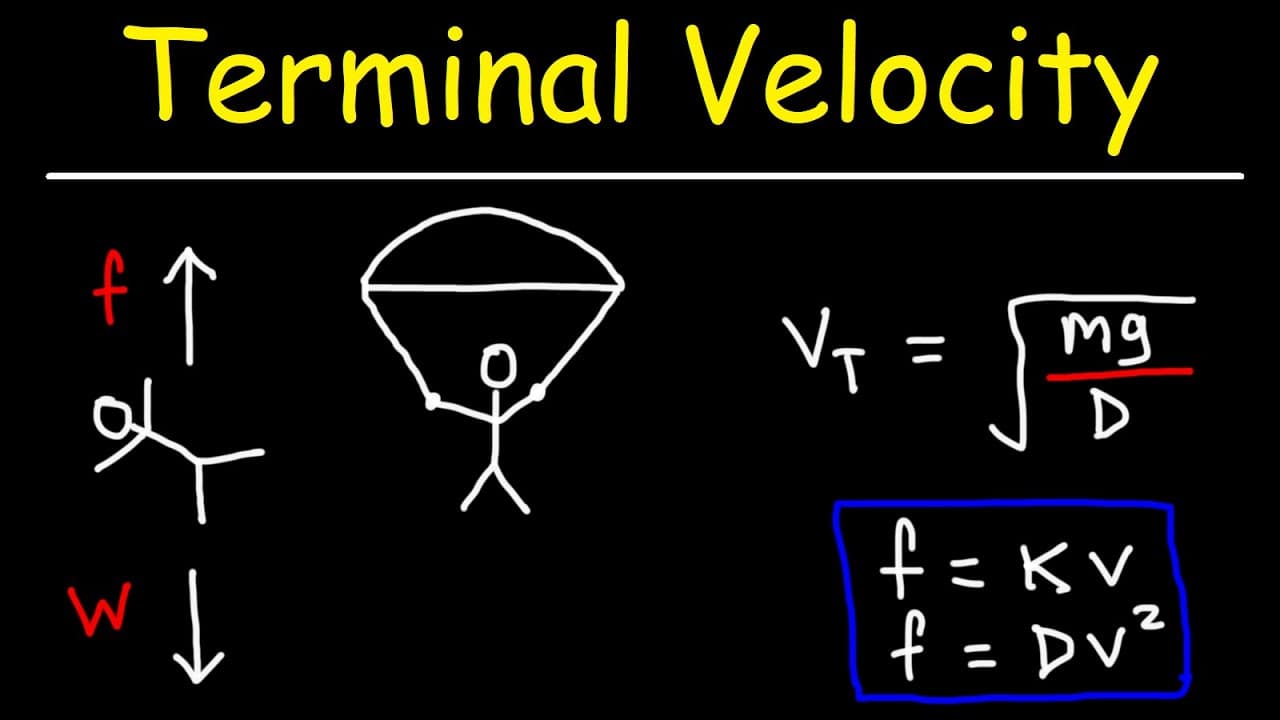
Terminal velocity is the maximum speed reached by a falling object when the force of gravity equals the force of air resistance.
Transcript
in this video we're going to talk about terminal velocity particularly the concepts that relate to it so let's say if you have an object at some height H above the ground and you drop it you release it from Russ initially there's only one force acting on this object and that is the weight Force so as soon as you drop it the vertical velocity is zer... Read More
Key Insights
- 👱 Terminal velocity is the maximum speed achieved by a falling object when air resistance equals the force of gravity.
- 👱 Air resistance increases as the speed of the falling object increases.
- 🧑🏭 Terminal velocity can be calculated using different equations based on the speed and factors like mass, projected area, and density.
- 💆 Increasing mass or decreasing projected area will increase terminal velocity.
- 😘 Objects with larger projected areas, like parachutes, have lower terminal velocities due to increased air resistance.
- 🧑🏭 The proportionality constant in the equations for terminal velocity depends on factors like density and projected area.
Install to Summarize YouTube Videos and Get Transcripts
Explore YouTube Video Summarizer or Get YouTube Transcript Extractor
Questions & Answers
Q: What is terminal velocity?
Terminal velocity is the maximum speed reached by a falling object when the force of gravity equals the force of air resistance, resulting in zero net force and constant velocity.
Q: What factors affect terminal velocity?
The two main factors that affect terminal velocity are the mass of the object and the projected area of the object interacting with the air molecules. Increasing mass or decreasing projected area will increase the terminal velocity.
Q: How does air resistance affect terminal velocity?
Air resistance increases as the object falls faster, opposing the force of gravity. As air resistance increases, it eventually equals out the weight force, resulting in zero net force and constant velocity.
Q: How can you calculate terminal velocity?
Terminal velocity can be calculated using different equations depending on the speed of the object. For low speeds, terminal velocity is the weight force divided by the proportionality constant. For high speeds, it is the square root of the weight force divided by another proportionality constant that depends on factors like density and projected area.
Summary & Key Takeaways
-
Terminal velocity is achieved when the weight force and air resistance are equal, resulting in zero net force and constant velocity.
-
Air resistance is dependent on the speed of the object, increasing as the object falls faster.
-
The equations to calculate terminal velocity differ for low and high speeds, taking into account the proportionality constant and factors like density and projected area.
Read in Other Languages (beta)
Share This Summary 📚
Summarize YouTube Videos and Get Video Transcripts with 1-Click
Try YouTube Summary with ChatGPT & Claude or YouTube Transcript Generator
Explore More Summaries from The Organic Chemistry Tutor 📚



Summarize YouTube Videos and Get Video Transcripts with 1-Click
Try YouTube Summary with ChatGPT & Claude or YouTube Transcript Generator