What Are Unsaturated, Saturated, and Supersaturated Solutions?
TL;DR
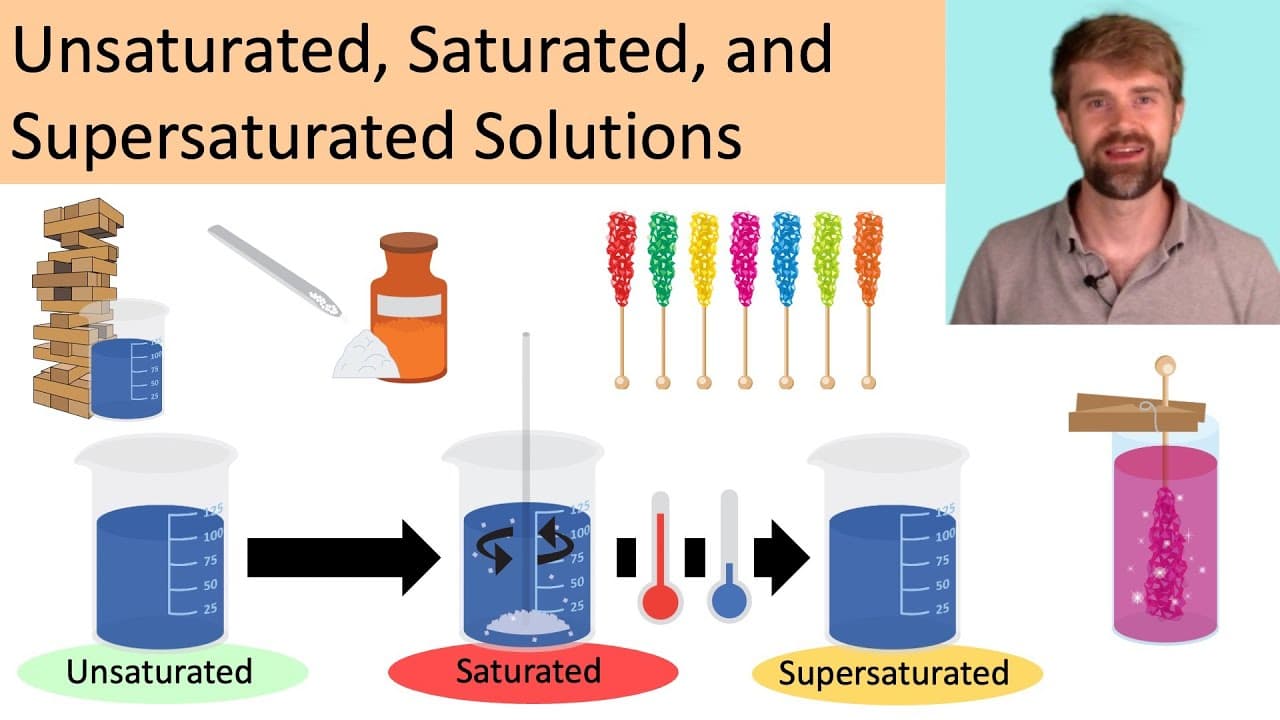
Unsaturated solutions can still dissolve more solute, while saturated solutions have reached their maximum solute capacity at a given temperature. Supersaturated solutions hold more solute than theoretically possible but are unstable and can recrystallize if additional solute is added. Temperature influences solubility, with higher temperatures typically allowing for more solute to dissolve.
Transcript
in this video we're going to look at three types of solutions unsaturated saturated and super saturated these categories have to do with the amount of solute that's dissolved in a solution we're going to explore these types of solutions by looking at how a substance dissolves in water so here's a substance we're going to dissolve to make things eas... Read More
Key Insights
- ❓ Solubility is the amount of solute that can dissolve in a given amount of solvent.
- ✋ Temperature affects solubility, with higher temperatures generally increasing solubility.
- ❓ Unsaturated solutions can still dissolve more solute, while saturated solutions have reached their maximum capacity.
- 🦸 Super saturated solutions are unstable and can recrystallize when a small amount of additional solute is added.
Install to Summarize YouTube Videos and Get Transcripts
Explore YouTube Video Summarizer or Get YouTube Transcript Extractor
Questions & Answers
Q: What is solubility?
Solubility refers to the maximum amount of solute that can dissolve in a given amount of solvent, usually measured in grams per 100 grams of solvent.
Q: How does temperature affect solubility?
Generally, an increase in temperature increases solubility for most solid solutes. Higher temperatures allow more solute to dissolve, while lower temperatures lead to the formation of undissolved crystals.
Q: What is the difference between an unsaturated and a saturated solution?
An unsaturated solution can still dissolve more solute and has not reached its maximum capacity. In contrast, a saturated solution has dissolved the maximum amount of solute for that specific temperature.
Q: How can a super saturated solution be created?
A super saturated solution can be achieved by saturating a solution at a higher temperature and then carefully lowering the temperature without disturbing the solution. It temporarily holds more solute than is theoretically possible at that temperature.
Summary & Key Takeaways
-
The video introduces the concept of solubility, which is the amount of solute that can dissolve in a given amount of solvent.
-
It explains unsaturated solutions, which can still dissolve more solute, and saturated solutions, which have reached their maximum capacity.
-
The video also discusses super saturated solutions, which hold more solute than theoretically possible, and how they can become unstable and recrystallize.
Read in Other Languages (beta)
Share This Summary 📚
Summarize YouTube Videos and Get Video Transcripts with 1-Click
Try YouTube Summary with ChatGPT & Claude or YouTube Transcript Generator
Explore More Summaries from Tyler DeWitt 📚




Summarize YouTube Videos and Get Video Transcripts with 1-Click
Try YouTube Summary with ChatGPT & Claude or YouTube Transcript Generator