What do Wall Street quants actually do?
TL;DR
Quants are reshaping Wall Street with algorithms and data-driven strategies.
Transcript
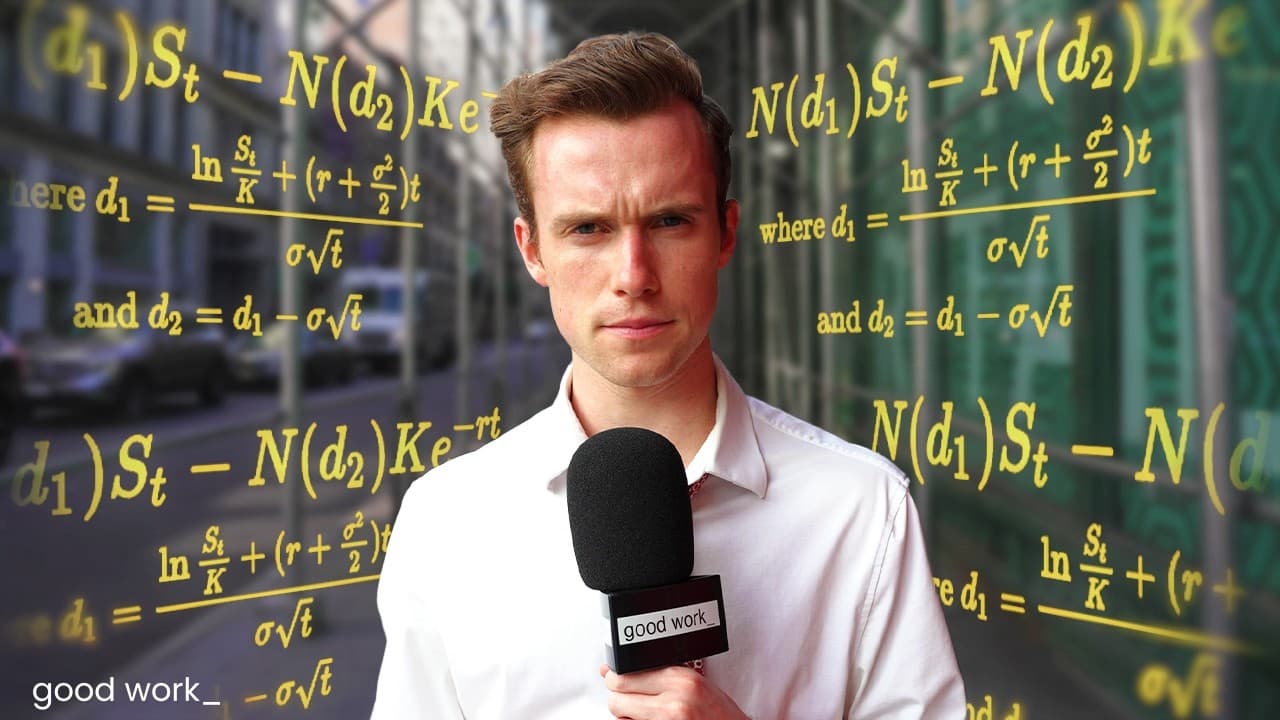
Quants short for quantitative. They're a special type of nerd that has come to invade our beautiful world of finance. I have always imagined the classic Wall Street trader to be your typical, handsome fella who knows how to handle the cross stick and a non-disclosure agreement. But lately, it's come to my attention that the real wol... Read More
Key Insights
- Quants, short for quantitative analysts, have become pivotal in finance, utilizing complex algorithms to predict market trends and drive investment strategies.
- The role of quants is primarily held by young, highly educated individuals from top-tier schools, often with backgrounds in mathematics and computer science.
- Renaissance Technologies, founded by Jim Simons, is a pioneer in the quant trading movement, achieving unparalleled returns through algorithmic trading.
- Despite their success, quants and their firms operate with high secrecy, often bound by strict non-disclosure agreements to protect their competitive edge.
- Quantitative strategies now account for a significant portion of U.S. stock market trading, raising concerns about algorithmic risks and market volatility.
- The quant industry is characterized by a blend of human intuition and machine precision, with firms like Renaissance advocating for a man-plus-machine approach.
- Algorithmic trading has led to market disruptions in the past, highlighting the potential risks of relying heavily on automated systems.
- Quants are not just motivated by financial gain; many are driven by the intellectual challenge of solving complex mathematical problems.
Install to Summarize YouTube Videos and Get Transcripts
Explore YouTube Video Summarizer or Get YouTube Transcript Extractor
Questions & Answers
Q: What role do quants play in the financial industry?
Quants, or quantitative analysts, play a crucial role in the financial industry by using mathematical models and algorithms to predict future values of financial products. They analyze large datasets to identify market signals that are not apparent to traditional traders, enabling more informed and precise trading decisions.
Q: How did Renaissance Technologies influence the quant trading movement?
Renaissance Technologies, founded by Jim Simons, was a pioneer in the quant trading movement. The firm embraced algorithmic trading before it became mainstream, achieving extraordinary returns through its data-driven strategies. Renaissance's success demonstrated the potential of quantitative methods in finance, inspiring other firms to adopt similar approaches.
Q: Why is secrecy important in the quant industry?
Secrecy is vital in the quant industry to protect the proprietary algorithms and strategies that give firms their competitive edge. Quants often sign strict non-disclosure agreements, and firms take legal action to prevent the leakage of their intellectual property. This secrecy helps maintain their advantage in the highly competitive financial markets.
Q: What concerns exist regarding algorithmic trading?
Algorithmic trading raises concerns about market stability and the potential for rapid, large-scale disruptions. Past incidents, such as the 2010 flash crash, illustrate how automated systems can lead to significant market volatility. Additionally, the use of 'black box' algorithms, where the decision-making process is not fully understood, adds to the uncertainty.
Q: How do quants differ from traditional traders?
Quants differ from traditional traders in that they rely heavily on mathematical models and data analysis to make trading decisions, rather than intuition or experience. They use advanced tools and algorithms to identify market patterns and predict future movements, offering a more scientific and precise approach to trading.
Q: What motivates individuals to become quants?
While financial compensation is a factor, many quants are motivated by the intellectual challenge of solving complex mathematical problems. They enjoy the process of applying their analytical skills to real-world financial scenarios, finding satisfaction in developing models that can accurately predict market trends.
Q: How has the role of quants evolved in recent years?
The role of quants has expanded significantly in recent years, with their strategies now accounting for a substantial portion of market trading. As technology advances, quants continue to refine their models and algorithms, playing an increasingly central role in shaping financial markets and investment strategies.
Q: What is the future outlook for the quant industry?
The future of the quant industry looks promising, as the integration of technology and data-driven strategies becomes more prevalent in finance. However, the industry must navigate challenges related to algorithmic risks and market volatility. Continued innovation and a balance between human intuition and machine precision will be key to the industry's success.
Summary & Key Takeaways
-
Quants, or quantitative analysts, have revolutionized Wall Street by using sophisticated algorithms to predict market movements and inform trading decisions. These individuals often come from elite educational backgrounds and possess strong skills in mathematics and computer science.
-
Renaissance Technologies, led by Jim Simons, is a key player in the quant trading field, achieving remarkable returns through its algorithmic strategies. Despite their success, quants maintain a low profile, operating under strict confidentiality to preserve their competitive advantage.
-
The growing influence of quantitative trading has raised concerns about market stability, with past incidents illustrating the potential risks of algorithmic trading. Nonetheless, the quant industry continues to thrive, blending human expertise with machine efficiency to navigate the complexities of modern finance.
Read in Other Languages (beta)
Share This Summary 📚
Summarize YouTube Videos and Get Video Transcripts with 1-Click
Try YouTube Summary with ChatGPT & Claude or YouTube Transcript Generator