TM and TE modes | Rectangular Wave guide | Cutoff wavelength | Microwave Engineering | Lec-18
TL;DR
This video explains the calculation and significance of cutoff wavelength for TM and TE modes in waveguides.
Transcript
hi everyone in this video I am going to calculate the cutoff wavelength for TM and te modes so in the previous video I have given you the calculation for the cutoff wavelength what do you mean by cut off wavelength the wavelength Beyond which the waves will not be traveled in the rectangular waveguard so what do you mean by cut off wavelength let u... Read More
Key Insights
- 👋 The cutoff wavelength is a fundamental parameter in waveguide theory, determining the maximum operational wavelength for effective wave propagation.
- 👋 Understanding the relationships between mode numbers and waveguide dimensions is essential in predicting and optimizing wave behavior.
- 🧑🔬 TM and TE modes exhibit different cutoff characteristics, necessitating unique calculations for engineers and scientists in electromagnetics.
- 🖐️ Dominant modes, represented by TM11 and TE10, play critical roles in wireless communication, influencing the efficiency of signal transmission.
- 👋 The cutoff frequency contrasts with cutoff wavelength, highlighting different aspects of wave behavior within the electromagnetic spectrum.
- 🌸 Rectangular waveguides have specific design considerations that must be addressed to achieve the desired propagation modes and minimize losses.
- 🈸 The discussed formulas enable engineers to tailor waveguide systems, enhancing performance for various technical applications, including telecommunications and radar.
Install to Summarize YouTube Videos and Get Transcripts
Explore YouTube Video Summarizer or Get YouTube Transcript Extractor
Questions & Answers
Q: What is the cutoff wavelength, and why is it important?
The cutoff wavelength, indicated as Lambda C, is the maximum wavelength that can successfully propagate within a rectangular waveguide. It denotes the threshold beyond which no wave transmission occurs, thus defining the operational limits of waveguides important for designing efficient electromagnetic systems.
Q: How is Lambda C calculated for TM and TE modes?
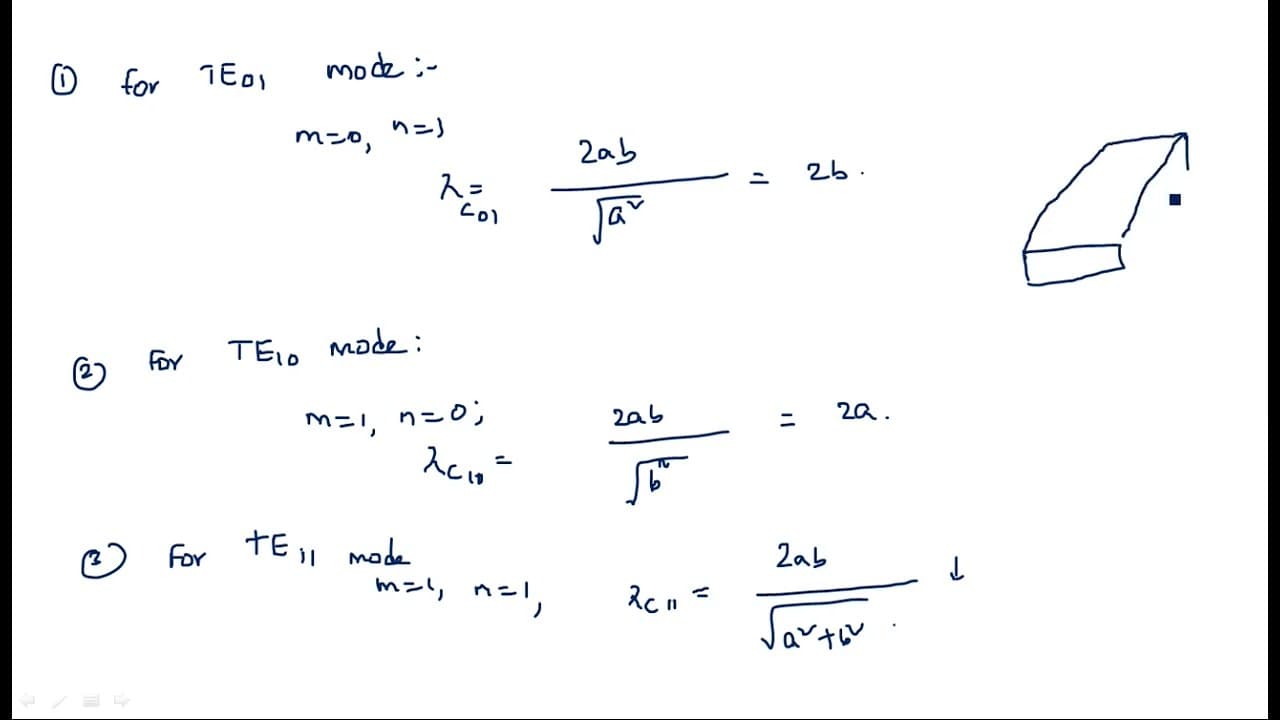
For TM modes, Lambda C is determined by the formula Lambda C(m,n) = 2ab / √(m²b² + n²a²). Similarly, for TE modes, the calculation follows a parallel expression. These formulas factor in the dimensions of the waveguide and the mode numbers, allowing for specific wavelength assessment based on operational requirements.
Q: What distinguishes TM11 as the dominant mode?
The TM11 mode is considered the dominant mode due to its highest cutoff wavelength among all modes calculated. Its lower denominator value in the cutoff wavelength equation results in a higher overall value, making it the most efficient mode for propagation in rectangular waveguides.
Q: Can you explain the significance of the TE10 mode?
The TE10 mode is the dominant mode in the TE category because it shows the highest cutoff wavelength under the defined conditions. This characteristic allows it to effectively propagate signals, contributing significantly to the functionality of rectangular waveguides in communication systems.
Q: What are the implications of a wave exceeding its cutoff wavelength?
When a wave exceeds its cutoff wavelength, it cannot effectively propagate through the waveguide, leading to attenuation and loss of signal. This situation necessitates careful design and analysis of waveguide dimensions and operating frequencies to ensure efficient signal transmission in relevant applications.
Q: How do mode numbers M and N affect the cutoff wavelength?
Mode numbers M and N directly influence the configuration of the electric and magnetic fields within the waveguide. Changing these values modifies the parameters in the cutoff wavelength formula, resulting in different propagation characteristics, crucial for tuning waveguide performance according to specific application needs.
Summary & Key Takeaways
-
The cutoff wavelength, denoted by Lambda C, is defined as the maximum wavelength that can propagate within a rectangular waveguide. Beyond this wavelength, the waves cannot travel effectively, indicating the waveguide's limitations.
-
The video explores the TM and TE modes, detailing the calculations for their respective cutoff wavelengths, using defined parameters such as M and N to derive various expressions.
-
The dominant modes in both TM and TE classifications are highlighted, with TM11 and TE10 identified as having the highest cutoff wavelengths, determining their significance in wave propagation within waveguides.
Read in Other Languages (beta)
Share This Summary 📚
Summarize YouTube Videos and Get Video Transcripts with 1-Click
Try YouTube Summary with ChatGPT & Claude or YouTube Transcript Generator