18. Differntial Algebraic Equations 2
TL;DR
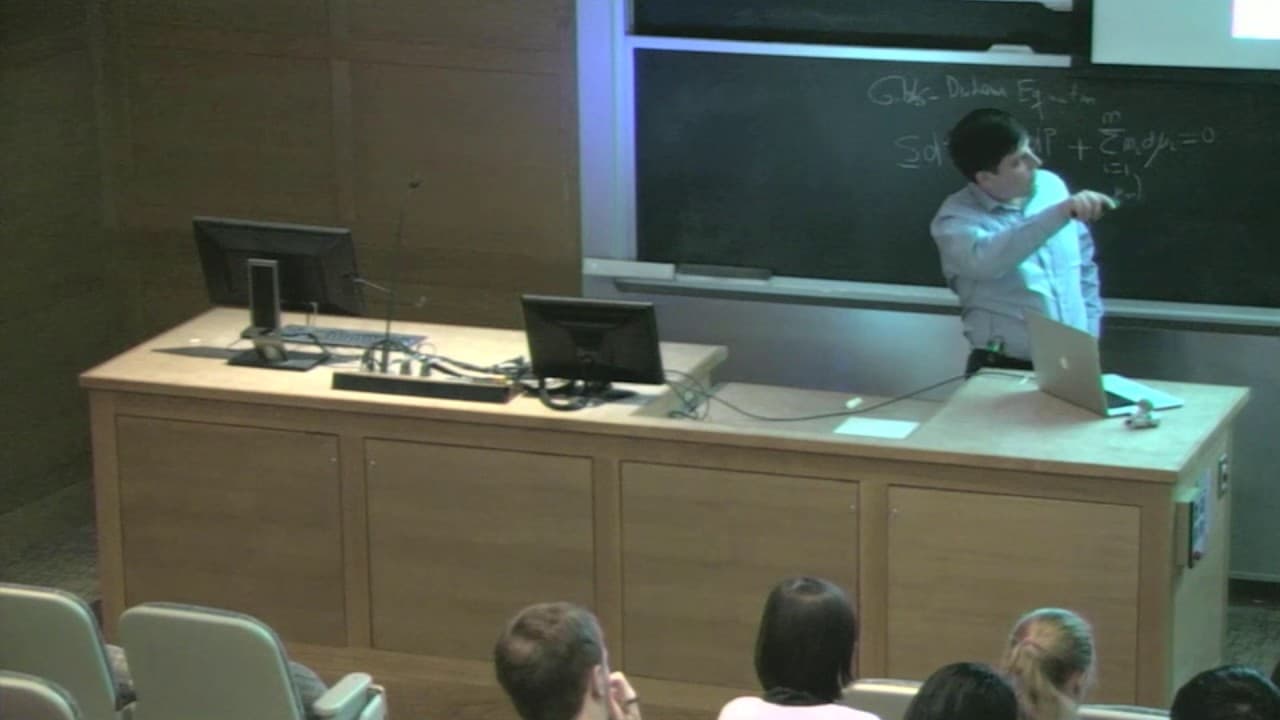
Differential algebraic equations (DAEs) pose challenges in solving due to their mixed differential and algebraic nature, requiring implicit methods. The choice of method and the formulation of the problem can greatly impact accuracy and stability.
Transcript
The following content is provided under a Creative Commons license. Your support will help MIT OpenCourseWare continue to offer high quality educational resources for free. To make a donation or to view additional materials from hundreds of MIT courses, visit MIT OpenCourseWare at ocw.mit.edu. WILLIAM GREEN, JR.: Shall we get started? Yes. Apologie... Read More
Key Insights
- ❓ DAEs combine differential equations and algebraic equations, requiring implicit methods for solving.
- 💥 Semi-explicit DAEs can be transformed into equivalent ODEs by inverting the mass matrix, while fully implicit DAEs require solving systems of nonlinear equations.
- 🪡 The backward Euler method is commonly used for solving DAEs, but accuracy and stability need to be considered.
Install to Summarize YouTube Videos and Get Transcripts
Explore YouTube Video Summarizer or Get YouTube Transcript Extractor
Questions & Answers
Q: What are differential algebraic equations (DAEs)?
DAEs combine differential equations and algebraic equations in a single system, posing challenges for numerical solution.
Q: How are semi-explicit DAEs different from fully implicit DAEs?
Semi-explicit DAEs can be reformulated into equivalent ODEs by inverting the mass matrix, while fully implicit DAEs require solving systems of nonlinear equations.
Q: What is the backward Euler approximation?
The backward Euler method is a numerical method commonly used for solving DAEs, where the derivative is approximated using backwards difference formulas.
Q: How does the choice of numerical method impact solving DAEs?
The choice of method, such as backward Euler, impacts the accuracy and stability of the solution. Higher-order methods can improve accuracy, but stability also needs to be considered.
Summary & Key Takeaways
-
DAEs combine differential equations and algebraic equations in a single system, requiring numerical methods for solving.
-
Semi-explicit DAEs can be reformulated into equivalent ODEs by inverting the mass matrix, while fully implicit DAEs require solving systems of nonlinear equations.
-
Backward Euler approximation is commonly used for solving DAEs, but the choice of method and problem formulation impacts accuracy and stability.
Read in Other Languages (beta)
Share This Summary 📚
Summarize YouTube Videos and Get Video Transcripts with 1-Click
Try YouTube Summary with ChatGPT & Claude or YouTube Transcript Generator
Explore More Summaries from MIT OpenCourseWare 📚


Summarize YouTube Videos and Get Video Transcripts with 1-Click
Try YouTube Summary with ChatGPT & Claude or YouTube Transcript Generator