(Q6.) Sample 3 GCC Math 101/120 Common Final Intermediate Algebra
TL;DR
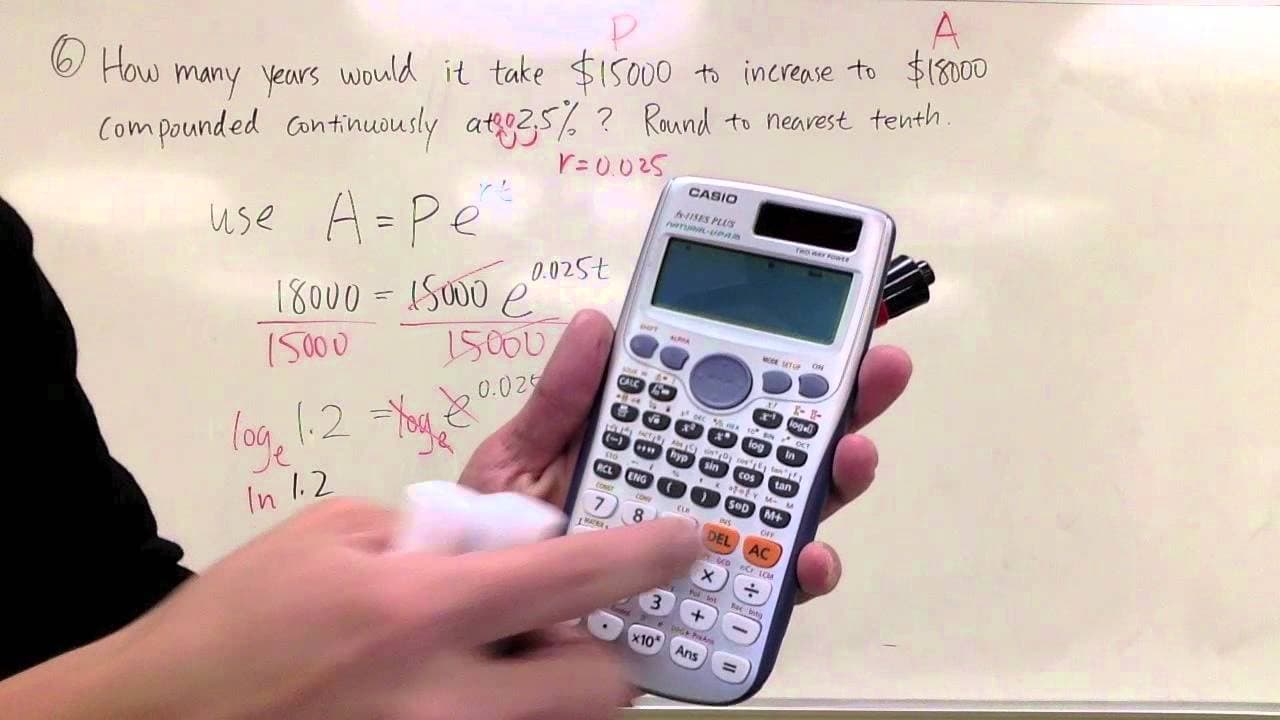
Calculate how many years it will take for an initial amount of $15,000 to increase to $18,000 with continuous compounding at a rate of 2.5%.
Transcript
question number six how many years will you take for fifteen thousand dollars to increase to eighteen thousand dollars if we compound it continuously at two point five percent we want our answer to be in the nearest tenth place because he says compounding continuously you should use the formula that i'll just write this down a which stands for the ... Read More
Key Insights
- ❓ Continuous compounding is a method used to calculate compound interest continuously.
- ❓ The formula A = P*e^(rt) is used to find the future amount (A) with continuous compounding.
- 🆘 Using logarithms can help solve for the unknown variable in the exponent of the formula.
- 🛝 Rounding the final answer is essential when the question specifies rounding to a specific decimal place.
- ❓ Understanding the concept of continuous compounding is important in financial and investment calculations.
- #️⃣ The constant e (Euler's number) is a significant part of the continuous compounding formula.
- ⌛ Calculations involving compound interest can help individuals understand the growth of their investments over time.
Install to Summarize YouTube Videos and Get Transcripts
Explore YouTube Video Summarizer or Get YouTube Transcript Extractor
Questions & Answers
Q: What is continuous compounding?
Continuous compounding is a method of calculating interest where the compounding happens continuously, meaning it is calculated and added to the principal constantly.
Q: How is the formula A = P*e^(rt) used?
The formula is used to find the amount (A) after t years when the principal (P) is compounded continuously at a rate (r). The constant e represents Euler's number, approximately 2.71828.
Q: How do you solve for the unknown variable in the exponent?
To solve for the unknown variable (t) in the exponent, you need to use logarithms. Taking the natural logarithm (ln) of both sides eliminates the exponent and converts the equation into a linear one.
Q: Why is rounding necessary in the final answer?
Rounding is necessary in the final answer because the question asks for the number of years to be rounded to the nearest tenth. In this case, the number to the right of the tenths place determines whether to round up or down.
Summary & Key Takeaways
-
The content explains how to use the formula A = P*e^(rt) to calculate compound interest with continuous compounding.
-
It provides a step-by-step example of solving for the number of years it takes for $15,000 to increase to $18,000 with a 2.5% interest rate.
-
The calculations involve isolating the unknown variable, using logarithms to eliminate the exponent, and rounding the final answer to the nearest tenth.
Read in Other Languages (beta)
Share This Summary 📚
Summarize YouTube Videos and Get Video Transcripts with 1-Click
Try YouTube Summary with ChatGPT & Claude or YouTube Transcript Generator
Explore More Summaries from blackpenredpen 📚
Summarize YouTube Videos and Get Video Transcripts with 1-Click
Try YouTube Summary with ChatGPT & Claude or YouTube Transcript Generator