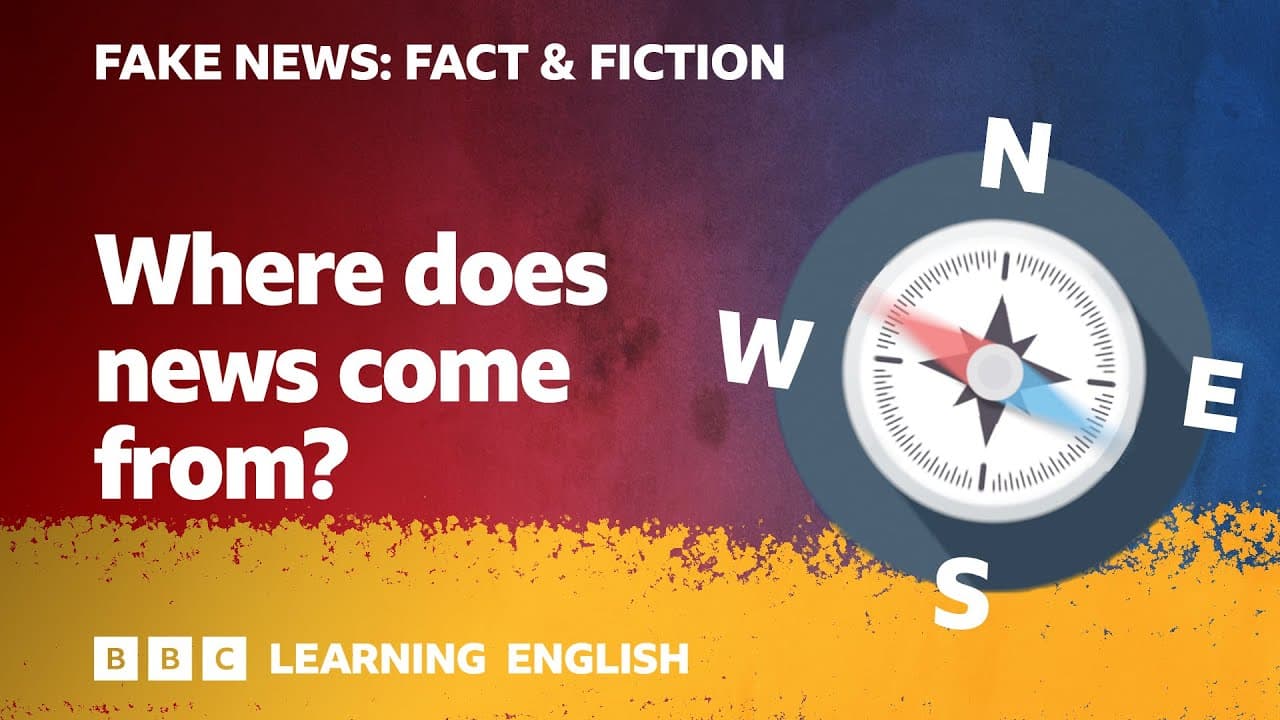
What Is the Origin of the Word 'News'?
TL;DR
The word 'news' originates from the French word 'nouvelle', meaning new information about events. It is an uncountable noun despite ending in 's'. Fake news involves false information spread for political or commercial purposes, often via social media. Disinformation is deliberately false information, and propaganda is biased information to support political agendas.
Transcript
Hello I'm Hugo and I'm Sam - welcome to Fake News: Fact and Fiction from BBC Learning English. In this series we're looking at the fake news phenomenon, what it is, where it comes from and how we can fight it. Yes and we're also looking at the language and vocabulary around fake news so words and expressions that you might hear or want to use when ... Read More
Key Insights
- The word 'news' comes from the French word 'nouvelle', meaning new information.
- News is an uncountable noun and always singular, despite ending in 's'.
- Fake news is false information spread for political or commercial gain.
- Propaganda is biased information used to support political causes.
- Disinformation is false information spread deliberately to mislead.
- Social media accelerates the spread of fake news due to unregulated information flow.
- Mainstream media traditionally controlled information flow, unlike today's digital platforms.
- Politicians may misuse the term 'fake news' to dismiss unfavorable coverage.
Install to Summarize YouTube Videos and Get Transcripts
Explore YouTube Video Summarizer or Get YouTube Transcript Extractor
Questions & Answers
Q: What is the origin of the word 'news'?
The word 'news' originates from the late 1300s and comes from the French word 'nouvelle', which means new information about events. Unlike the adjective 'new', 'news' is an uncountable noun in English, always used in the singular form, despite its plural-looking ending.
Q: How does fake news spread on social media?
Fake news spreads on social media due to the unregulated flow of information, where anyone with internet access can publish and share content. Unlike traditional media, which undergoes editorial checks, social media allows rapid dissemination, reaching wide audiences quickly without verification.
Q: What is the difference between fake news and disinformation?
Fake news refers to false information spread for political or commercial purposes, often unintentionally. Disinformation, however, is a subset of fake news that involves deliberately false information intended to mislead or manipulate the audience for specific objectives.
Q: Why is propaganda often associated with fake news?
Propaganda is associated with fake news because it involves biased or misleading information used to promote political agendas. While not always entirely false, propaganda often presents one-sided views, mixing truth and lies to influence public opinion and support specific policies or ideologies.
Q: How has social media changed the news landscape?
Social media has democratized information distribution, allowing anyone to publish content without traditional media gatekeeping. This change facilitates the rapid spread of both accurate and false information, as content can go viral quickly without undergoing the editorial scrutiny typical of mainstream media.
Q: What challenges do journalists face with fake news?
Journalists face challenges in verifying the truth amid the vast amount of information available online. The speed and reach of social media complicate fact-checking, while public distrust in media, fueled by accusations of fake news, undermines their credibility and complicates their role in informing the public.
Q: Why do politicians use the term 'fake news'?
Politicians may use the term 'fake news' to dismiss or discredit reports that are unfavorable to them. By labeling legitimate journalism as fake news, they aim to undermine trust in the media and avoid scrutiny or accountability for controversial or uncomfortable issues.
Q: What role does the mainstream media play in combating fake news?
Mainstream media plays a crucial role in combating fake news by adhering to journalistic standards, verifying facts, and providing balanced reporting. They act as gatekeepers, ensuring that information is accurate and credible, and correcting errors when they occur to maintain public trust and accountability.
Summary & Key Takeaways
-
The word 'news' derives from the French 'nouvelle', indicating new information. Despite ending in 's', it is an uncountable noun, always singular. Fake news, often spread via social media, consists of false information for political or commercial purposes. Disinformation is deliberately false, while propaganda is biased information supporting political agendas.
-
Social media platforms have changed the landscape of information dissemination, allowing fake news to spread rapidly without traditional checks by mainstream media. This democratization of information can lead to the spread of unverified or false stories, as anyone can publish content online.
-
The misuse of the term 'fake news' by politicians to dismiss unfavorable reports highlights the importance of distinguishing between genuine fake news and legitimate journalism. Understanding the vocabulary around news, including terms like propaganda and disinformation, is crucial in navigating today's media landscape.
Read in Other Languages (beta)
Share This Summary 📚
Summarize YouTube Videos and Get Video Transcripts with 1-Click
Try YouTube Summary with ChatGPT & Claude or YouTube Transcript Generator
Explore More Summaries from BBC Learning English 📚
Summarize YouTube Videos and Get Video Transcripts with 1-Click
Try YouTube Summary with ChatGPT & Claude or YouTube Transcript Generator