What Is the Number e and Why Is It Important?
TL;DR
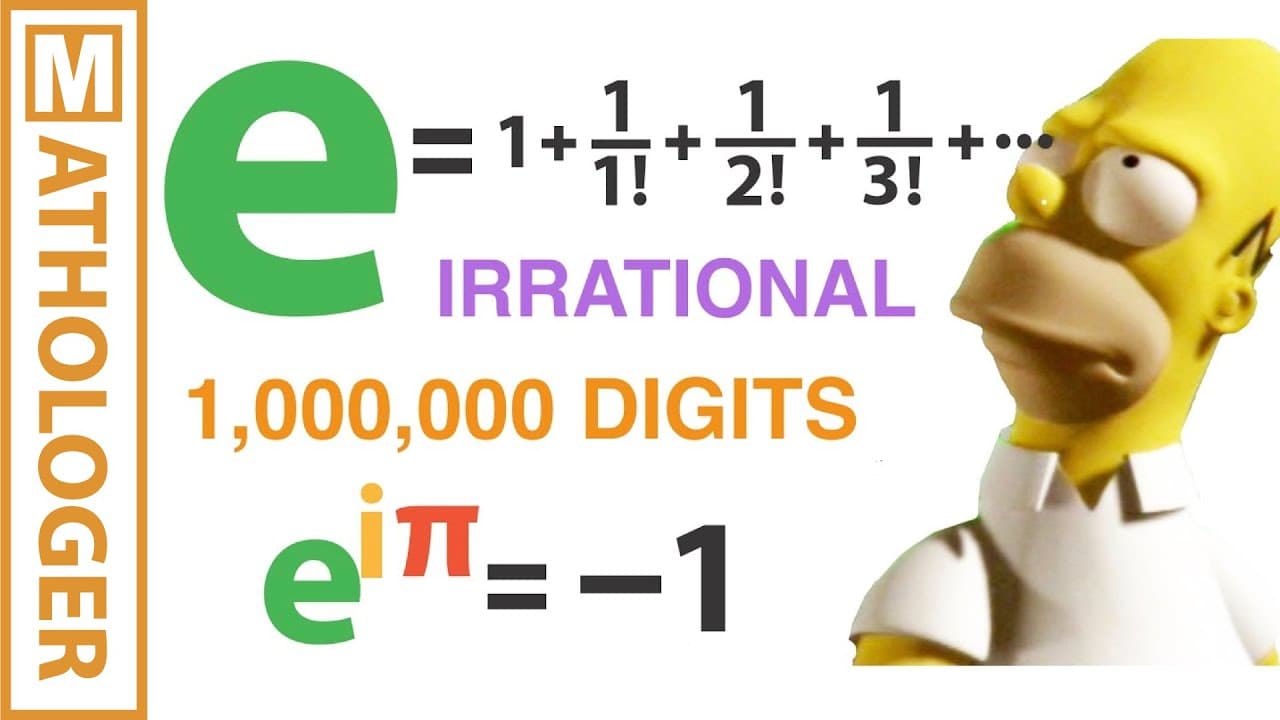
The number e, approximately 2.718, is vital in mathematics as it serves as the base for natural logarithms and exhibits unique properties like being its own derivative. It can be represented as an infinite sum, allowing for precise calculations of its digits. Additionally, e is irrational, meaning it cannot be expressed as a fraction, which underscores its mathematical significance.
Transcript
Welcome to another Mathologer video. A while ago I did this video in which I wanted to explain the mysterious identity e to the i pi is equal to minus 1 to Homer Simpson who encountered it in one of the Treehouse of Horror episodes. So my mission was to explain why this identity is true to someone who knows only basic arithmetic: plus, minus, times... Read More
Key Insights
- 🍹 The identity of the exponential function as an infinite sum can be derived using basic arithmetic.
- 🍉 Calculating more terms in the infinite sum provides increasingly accurate approximations of e.
- 😀 The error in approximating e with a fraction decreases rapidly, providing evidence for the irrationality of e.
- ☺️ The definite integral involving e has a geometric interpretation as the area under the graph of 1/x between 1 and e.
- 😀 Euler's formula connects e, π, i, and -1, demonstrating the interconnectedness of these mathematical constants.
- ❓ The exponential function is its own derivative, and the natural logarithm is the inverse function of the exponential function.
Install to Summarize YouTube Videos and Get Transcripts
Explore YouTube Video Summarizer or Get YouTube Transcript Extractor
Questions & Answers
Q: How does the Mathologer derive the identity of the exponential function as an infinite sum?
The Mathologer breaks down the derivation step by step, demonstrating how to calculate more accurate approximations of e by adding more terms in the infinite sum.
Q: How does the Mathologer prove that e is an irrational number?
By using an estimation of the error in approximating e with a fraction, the Mathologer shows that the error gets smaller and smaller, providing evidence that no fraction can equal e and concluding that e is irrational.
Q: What is the geometric interpretation of the definite integral involving e?
The definite integral represents the area under the graph of 1/x between 1 and e, which is exactly equal to 1. This geometric interpretation provides a visual understanding of the number e.
Q: How does the Mathologer connect Euler's formula to e^iπ = -1?
By substituting iπ for x in the infinite sum identity and manipulating the equation, the Mathologer arrives at Euler's formula, which relates e, π, i, and -1.
Summary & Key Takeaways
-
This video aims to explain the fundamental facts about the number e using basic arithmetic.
-
The Mathologer demonstrates how to derive the identity of the exponential function as an infinite sum and calculate digits of e.
-
The video also explores the irrationality of e and its connection to the derivative of the exponential function.
Read in Other Languages (beta)
Share This Summary 📚
Summarize YouTube Videos and Get Video Transcripts with 1-Click
Try YouTube Summary with ChatGPT & Claude or YouTube Transcript Generator
Explore More Summaries from Mathologer 📚



Summarize YouTube Videos and Get Video Transcripts with 1-Click
Try YouTube Summary with ChatGPT & Claude or YouTube Transcript Generator