Robot artists - 6 Minute English
TL;DR
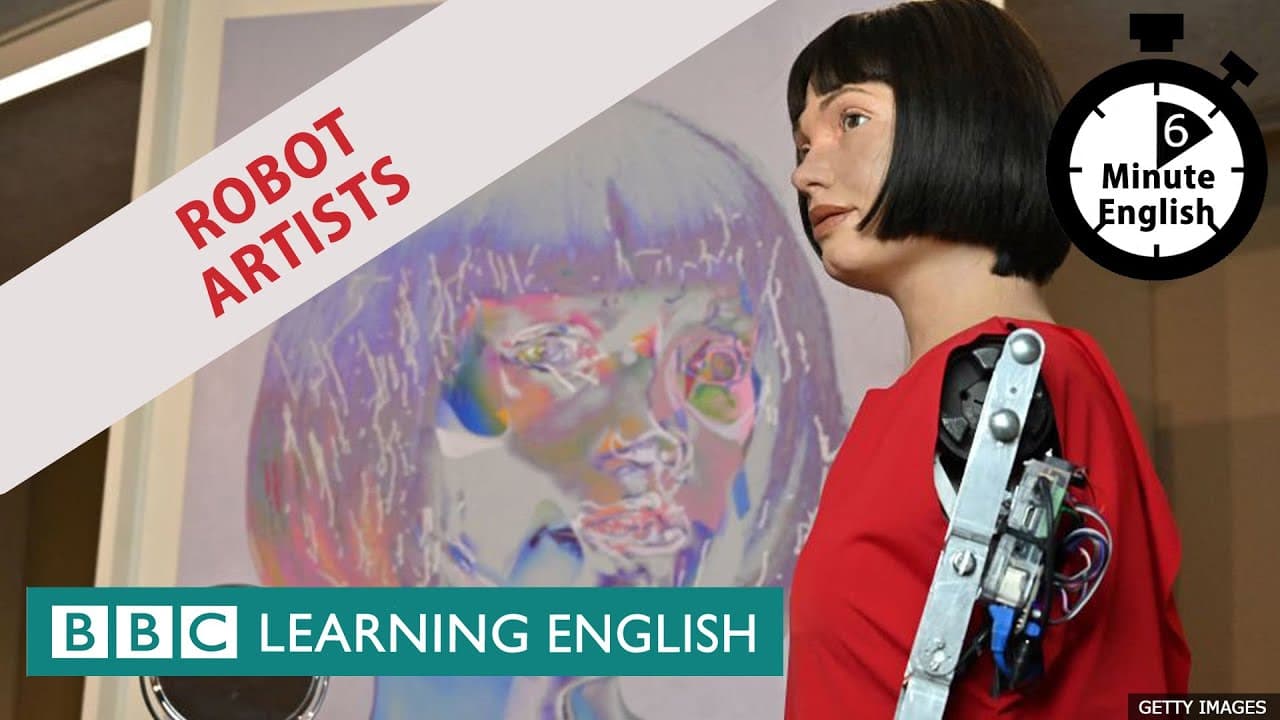
Ai-Da the robot artist challenges AI and creativity boundaries.
Transcript
Hi! Neil from BBC Learning English here. Did you know that we are now offering a new weekly extra episode of 6 Minute English exclusively on our website? So go to bbclearninenglish.com to find your favourite presenters on your favourite programme. The extra episodes are only available on our website: bbclearningenglish.com. See you there! Hello. Th... Read More
Key Insights
- Ai-Da is a humanoid robot capable of creating art, showcasing advancements in artificial intelligence and robotics.
- The name Ai-Da honors Ada Lovelace, a pioneering mathematician and considered the first computer programmer.
- Ai-Da's development involved a collaboration between Engineered Arts and Oxford University to integrate AI with mechanical systems.
- The robot can draw using a camera in its eye and a robotic arm, mimicking human-like non-verbal communication.
- Ai-Da's appeal lies in her ability to engage with people through expressions and gestures, making her seem more relatable.
- The creation of Ai-Da involved overcoming technical challenges, particularly in programming her to produce compelling artwork.
- The project highlights the potential of robots in creative fields, challenging traditional notions of art and creativity.
- The discussion raises questions about the future capabilities of AI, including the possibility of robots replacing human roles.
Install to Summarize YouTube Videos and Get Transcripts
Explore YouTube Video Summarizer or Get YouTube Transcript Extractor
Questions & Answers
Q: What is Ai-Da and what can she do?
Ai-Da is a humanoid robot designed to create art, such as drawings and sculptures, using advanced artificial intelligence and robotics. She uses a camera in her eye to see and a robotic arm to draw, engaging with people through human-like non-verbal communication, making her an intriguing figure in the field of AI and creativity.
Q: Who is Ai-Da named after and why?
Ai-Da is named after Ada Lovelace, a 19th-century mathematician known as the first computer programmer. The name reflects the integration of artificial intelligence (AI) with art, honoring Lovelace's contributions to computing and symbolizing the innovative blend of technology and creativity embodied by the robot.
Q: What challenges did the team face in developing Ai-Da?
The development of Ai-Da involved overcoming significant technical challenges, particularly in programming her to produce compelling artwork. The team had to integrate AI with mechanical systems, such as her robotic arms and camera eyes, to enable her to draw and interact with people, requiring collaboration between various experts in robotics and AI programming.
Q: How does Ai-Da interact with humans?
Ai-Da interacts with humans using non-verbal communication, such as facial expressions and gestures. This ability makes her seem more relatable and human-like, enhancing her appeal and allowing her to engage with people on a more personal level. Her human-like behavior is a key aspect of her design, drawing interest and curiosity from those who encounter her.
Q: What is the significance of Ai-Da's upcoming exhibition?
Ai-Da's upcoming exhibition at The Design Museum in London is significant as it showcases the potential of robots in creative fields, challenging traditional notions of art and creativity. The exhibition aims to highlight the capabilities of AI in producing compelling artwork and explore the broader implications of AI advancements in society.
Q: What does Ai-Da's development suggest about the future of AI?
Ai-Da's development suggests a future where AI could play a significant role in creative fields, potentially replacing or augmenting human creativity. Her capabilities raise questions about the boundaries of AI, including its ability to think, dream, and engage in artistic expression, challenging current perceptions of what machines can achieve.
Q: How does Ai-Da's design reflect advancements in AI and robotics?
Ai-Da's design reflects significant advancements in AI and robotics through her ability to create art and engage with people. Her development involved integrating AI with mechanical systems, showcasing the potential for robots to perform tasks traditionally associated with humans, such as artistic creation, and highlighting the rapid progress in these technologies.
Q: What inspired the creation of Ai-Da?
The creation of Ai-Da was inspired by the desire to explore the intersection of technology and art, challenging traditional boundaries of creativity. Her development was driven by advancements in AI and robotics, aiming to demonstrate the potential of machines in creative fields and provoke discussions about the future roles of robots and AI in society.
Summary & Key Takeaways
-
Ai-Da, a humanoid robot, is designed to create art using advanced AI and robotics, challenging the boundaries of creativity. Her development involved multiple teams working on AI programming and mechanical systems, resulting in a robot capable of drawing and engaging with people through non-verbal communication.
-
Named after Ada Lovelace, Ai-Da represents a blend of technology and art, drawing interest for her human-like appeal. Despite initial challenges in programming her to produce compelling artwork, the team behind Ai-Da aims to showcase her creations at The Design Museum in London.
-
The discussion around Ai-Da explores the potential of robots in creative fields and the broader implications of AI advancements. As Ai-Da's development progresses, she raises questions about the future roles of robots and AI, including their ability to think, dream, and potentially replace human roles.
Read in Other Languages (beta)
Share This Summary 📚
Summarize YouTube Videos and Get Video Transcripts with 1-Click
Try YouTube Summary with ChatGPT & Claude or YouTube Transcript Generator
Explore More Summaries from BBC Learning English 📚

Summarize YouTube Videos and Get Video Transcripts with 1-Click
Try YouTube Summary with ChatGPT & Claude or YouTube Transcript Generator