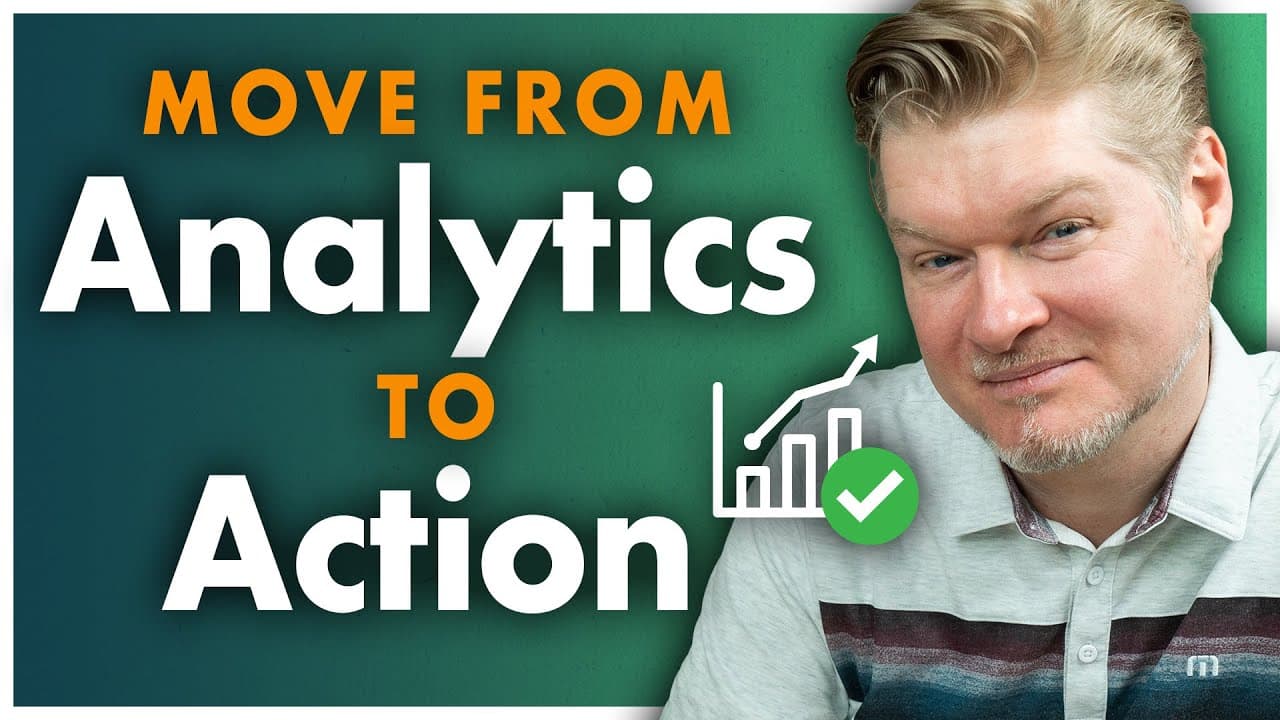
How to Get Started With Marketing Analytics: A 5-Step Framework
TL;DR
Learn a 5-step framework for effective marketing analytics.
Transcript
- Maybe you've been plagued with this in your own organization. You know a ton of numbers, but you're not actually getting anything done with those numbers. But how does this happen? Because this happens all too often in the world of measurement. It happens because there's no framework for those numbers. In this video we're gonna give you a very si... Read More
Key Insights
- The video introduces a 5-step framework for marketing analytics to effectively utilize collected data and drive actionable insights.
- The first step, planning, involves asking the right questions, identifying necessary data, and determining actions based on answers, known as the QIA model.
- Building involves using tools like Google Analytics and Google Tag Manager to collect data, ensuring comprehensive visibility into user behavior.
- Reporting focuses on using platforms like Google Data Studio to create dashboards that answer specific questions, avoiding unnecessary data overload.
- Forecasting, often overlooked, involves predicting results and understanding the process to achieve them, enabling performance assessment.
- Implementation and optimization involve measuring results against forecasts to identify areas for improvement and scaling successful strategies.
- A common mistake is skipping foundational steps and rushing to optimization, leading to ineffective data utilization and decision-making.
- The concept of 'marketing forward' encourages focusing on intended user interactions and measuring if those expectations are met, rather than just analyzing past behavior.
Install to Summarize YouTube Videos and Get Transcripts
Explore YouTube Video Summarizer or Get YouTube Transcript Extractor
Questions & Answers
Q: What is the QIA model in the planning stage?
The QIA model stands for Question, Information, and Action. It is a structured approach used during the planning stage of marketing analytics. The model emphasizes identifying the right questions to ask, determining the necessary information to collect, and defining the actions that will be taken based on the answers obtained. This ensures that the data collected is purposeful and leads to actionable marketing decisions.
Q: How does Google Tag Manager enhance data collection?
Google Tag Manager enhances data collection by providing marketers with greater visibility into user behaviors on a website. It allows for the implementation of tracking codes and tags without needing extensive coding knowledge. This tool enables more specific data to be collected, thus improving the quality of insights derived from the data. It complements tools like Google Analytics by offering detailed behavioral data that can answer more precise questions.
Q: Why is forecasting important in marketing analytics?
Forecasting is crucial in marketing analytics because it involves predicting not only the results but also the process of achieving those results. It allows marketers to set realistic goals and understand the steps needed to reach them. By forecasting, marketers can assess whether their strategies are on track and make informed adjustments. This step helps in evaluating the effectiveness of campaigns and ensuring that resources are allocated efficiently.
Q: What is the role of Google Data Studio in reporting?
Google Data Studio plays a significant role in reporting by allowing marketers to create customized dashboards that focus on specific questions and metrics. Unlike standard reports that may contain excessive and irrelevant data, Data Studio enables the creation of clear and concise visualizations tailored to the marketer's needs. This tool helps in presenting data in an actionable format, making it easier to interpret and use for decision-making.
Q: What is the biggest mistake marketers make according to the video?
The biggest mistake marketers make, as highlighted in the video, is asking the wrong questions, such as how users are using the site, without having a clear action plan based on the data. This leads to collecting vanity metrics that do not contribute to actionable insights. Instead, marketers should focus on 'marketing forward' by defining how users are supposed to interact with the site and measuring whether those expectations are met.
Q: How can marketers avoid collecting vanity metrics?
Marketers can avoid collecting vanity metrics by ensuring that every piece of data collected is tied to a specific marketing action. This involves using the QIA model to ask purposeful questions, gather relevant information, and define clear actions. By focusing on data that directly influences marketing strategies and outcomes, marketers can ensure that their analytics efforts lead to meaningful and actionable insights.
Q: What is the concept of 'marketing forward'?
The concept of 'marketing forward' involves shifting the focus from analyzing past user behaviors to defining how users are supposed to interact with a site. Marketers then measure whether these expected interactions occur as planned. This proactive approach ensures that data collection and analysis are aligned with business objectives and helps in designing user experiences that drive desired outcomes, thus improving the effectiveness of marketing strategies.
Q: Why is it important to follow the 5-step framework in order?
Following the 5-step framework in order is important because each step builds on the previous one, ensuring a structured approach to marketing analytics. Skipping steps can lead to incomplete data collection, ineffective analysis, and poor decision-making. By adhering to the sequence of planning, building, reporting, forecasting, and optimizing, marketers can establish a measurement culture that facilitates accurate insights, informed decisions, and successful marketing outcomes.
Summary & Key Takeaways
-
The video outlines a 5-step framework for marketing analytics, emphasizing the importance of planning, building, reporting, forecasting, and optimizing. Each step is crucial for transforming data into actionable insights and ensuring effective marketing strategies.
-
Planning involves the QIA model, which stands for Question, Information, and Action, ensuring that collected data leads to actionable marketing decisions. Building uses tools like Google Analytics to gather necessary data, enhancing visibility into user behavior.
-
Reporting utilizes Google Data Studio for creating targeted dashboards, while forecasting predicts results and processes. Implementation and optimization measure outcomes against forecasts, allowing marketers to identify and scale successful strategies while addressing underperforming areas.
Read in Other Languages (beta)
Share This Summary 📚
Summarize YouTube Videos and Get Video Transcripts with 1-Click
Try YouTube Summary with ChatGPT & Claude or YouTube Transcript Generator
Explore More Summaries from Social Media Examiner 📚


Summarize YouTube Videos and Get Video Transcripts with 1-Click
Try YouTube Summary with ChatGPT & Claude or YouTube Transcript Generator