Rectangular Wave guide | Propagation of TE waves | Part-1/3 | Microwave Engineering | Lec-13
TL;DR
This video derives wave equations for TE and TM modes in rectangular waveguides.
Transcript
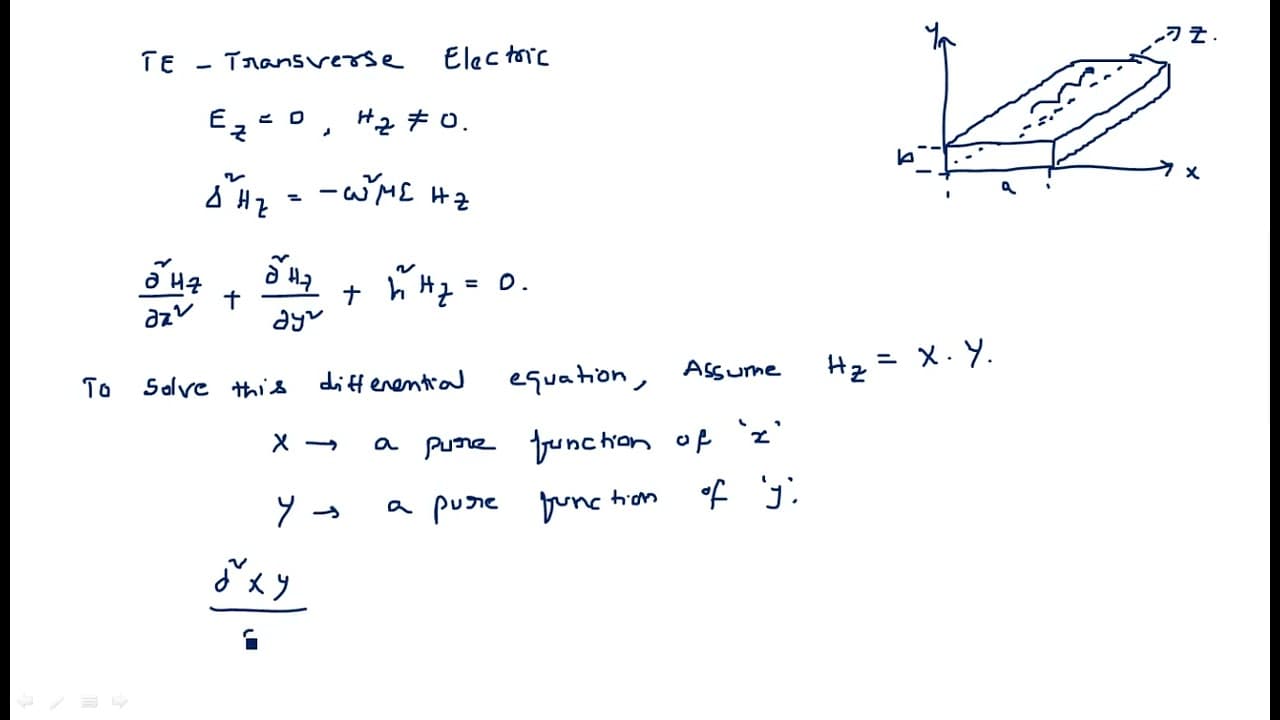
hi everyone in this video I am going to derive the wave equations for propagation of te waves in rectangular yogurt in the previous video I have explained about the propagation of waves in the PM wave so TMA we have calculated four different equations exe by h x and h y in the similar way here also we are going to calculate the those four equations... Read More
Key Insights
- 👋 TE waves propagate with electric fields perpendicular to the direction of travel, whereas TM waves have magnetic fields that are perpendicular.
- 📳 The TEM mode is not supported in rectangular waveguides due to boundary constraints.
- 👋 The derivation process of wave equations involves substituting simplified assumptions into fundamental wave equations.
- 😫 Boundary conditions play a pivotal role in determining the solution set for wave equations in confined structures.
- 🥳 Separation of variables effectively breaks down complex boundary value problems into manageable parts in mathematical physics.
- 👋 The constants obtained from boundary conditions form the complete solution describing wave behavior inside the waveguide.
- 🏧 Understanding TE and TM modes is significant for applications in telecommunications and microwave technology.
Install to Summarize YouTube Videos and Get Transcripts
Explore YouTube Video Summarizer or Get YouTube Transcript Extractor
Questions & Answers
Q: What are TE and TM modes?
TE (Transverse Electric) modes have an electric field component that is perpendicular to the direction of propagation, while TM (Transverse Magnetic) modes have a magnetic field component that is perpendicular. TEM modes do not exist in rectangular waveguides, as both components must be non-zero for their existence.
Q: Why does the TEM mode not exist in rectangular waveguides?
TEM modes require both electric and magnetic fields to have non-zero components in the direction of propagation. However, in rectangular waveguides, the configuration leads to cases where the electric field component along the propagation direction becomes zero.
Q: How is the wave equation for TE modes derived?
The wave equation for TE modes is derived by simplifying the general wave equation into specific components related to electric and magnetic fields, using the assumption that certain components are zero, and applying separation of variables to find solutions dependent on spatial coordinates.
Q: What is the significance of boundary conditions in solving wave equations?
Boundary conditions are crucial as they define the physical limits of the waveguide. They help in determining the constants in the equations derived, ensuring that the solutions accurately describe the behavior of electromagnetic waves within the confined structure of the waveguide.
Q: How are the constants C1, C2, C3, and C4 determined?
The constants C1, C2, C3, and C4 are determined by applying boundary conditions to the derived equations for the wave functions X and Y. These conditions ensure that the solutions are valid at the boundaries of the waveguide, thus leading to physically meaningful results.
Q: Can you explain the role of separation of variables in wave equation derivation?
Separation of variables is a mathematical technique employed to simplify partial differential equations by breaking them down into functions of individual variables. In wave propagation, this allows for intuitively solving complex equations by treating spatial and time-dependent components separately.
Q: What is the outcome of the wave equation simplification for TE modes?
Upon simplification, the wave equation for TE modes leads to a solution expressed as a product of sine and cosine functions that describe how the electromagnetic fields behave across the dimensions of the rectangular waveguide, dependent on specific boundary conditions.
Summary & Key Takeaways
-
The content discusses the derivation of wave equations for TE (Transverse Electric) and TM (Transverse Magnetic) modes in rectangular waveguides, specifically noting that TEM modes do not exist.
-
The derivation involves substituting boundary conditions into wave equations, with emphasis on components of electric and magnetic fields in different directions.
-
The process includes using separation of variables for differential equations, leading to solutions expressed in terms of sine and cosine functions.
Read in Other Languages (beta)
Share This Summary 📚
Summarize YouTube Videos and Get Video Transcripts with 1-Click
Try YouTube Summary with ChatGPT & Claude or YouTube Transcript Generator