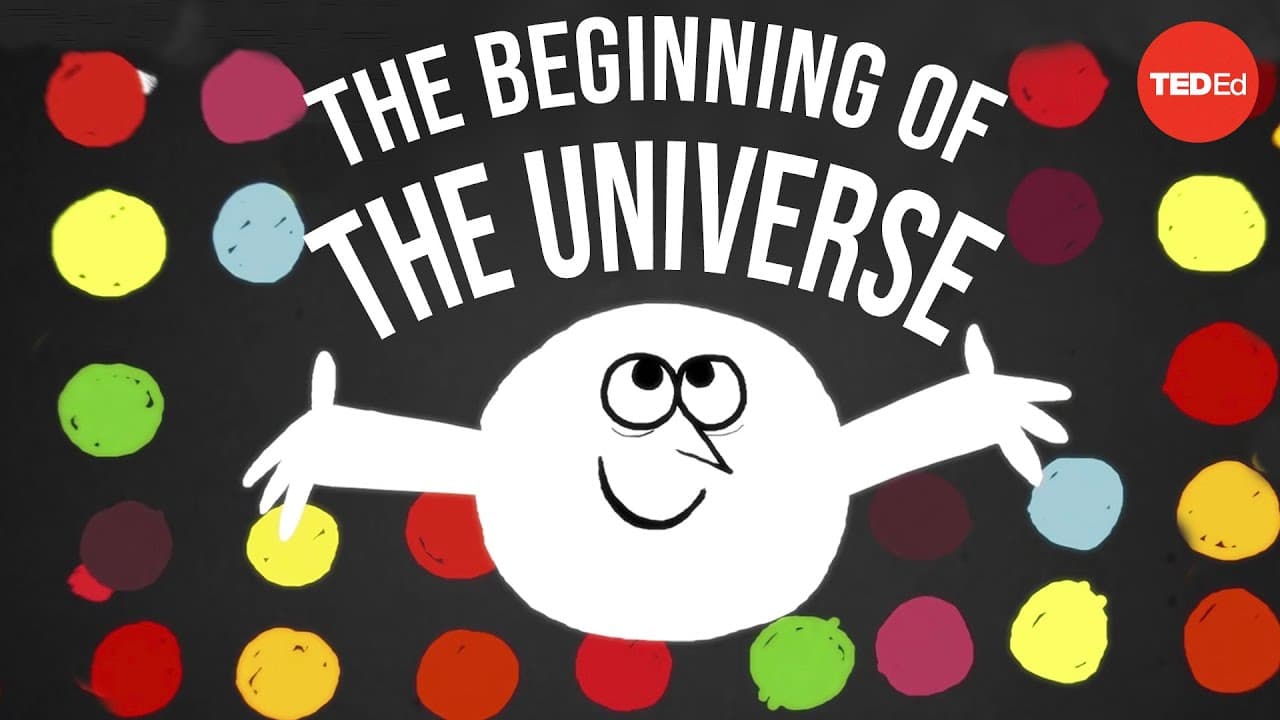
The beginning of the universe, for beginners - Tom Whyntie
TL;DR
Cosmologists study the universe to understand its evolution, from the Big Bang to the formation of stars and galaxies, while particle physicists recreate early universe conditions in laboratories to gain insights into its origins.
Transcript
Translator: Andrea McDonough Reviewer: Bedirhan Cinar The universe, rather beautiful, isn't it? It's quite literally got everything, from the very big to the very small. Sure, there are some less than savory elements in there, but on the whole, scholars agree that its existence is probably a good thing. Such a good thing that an entire field of sci... Read More
Key Insights
- ❓ Cosmology is the study of the universe's evolution, current state, and origins.
- 🇧🇩 The concept of the Big Bang originated from Edwin Hubble's observation of galaxies moving apart.
- 🔬 Recreating early universe conditions in laboratories helps particle physicists gain insights into its origins.
- ❓ Understanding the origins and evolution of the universe requires combining knowledge from cosmology and particle physics.
- 😅 The universe evolved from a hot, dense state to the formation of stars and galaxies.
- 👻 Recreating higher energy levels in particle accelerators allows scientists to peer further back in time.
- 🇧🇩 The universe consisted of subatomic matter immediately after the Big Bang.
Install to Summarize YouTube Videos and Get Transcripts
Explore YouTube Video Summarizer or Get YouTube Transcript Extractor
Questions & Answers
Q: How did Edwin Hubble's observation contribute to the concept of the Big Bang?
Edwin Hubble's observation of galaxies moving away from each other supported the idea that the universe is expanding, leading to the concept of the Big Bang as the origin of the universe.
Q: What is the role of cosmologists in understanding the universe?
Cosmologists study the universe to piece together its evolution, current state, and origins. They analyze various astronomical data, such as the movement of galaxies, to construct models that explain the universe's behavior.
Q: How do particle physicists contribute to understanding the origins of the universe?
Particle physicists recreate the hot, dense conditions of the early universe in laboratories by smashing subatomic particles together at high energies. By examining the fundamental building blocks and forces of nature, they aim to understand how the universe originated.
Q: Why is it important to combine knowledge from cosmologists and particle physicists?
Combining knowledge from cosmology and particle physics allows for a more comprehensive understanding of the universe. It bridges the gap between the very big (cosmology) and the very small (particle physics), providing valuable insights into the origins and evolution of the universe.
Summary & Key Takeaways
-
Cosmology is the scientific field devoted to studying the universe's evolution, current state, and origins.
-
Edwin Hubble's observation of galaxies moving apart led to the idea of the Big Bang, an explosion from an infinitely small point.
-
While cosmologists study the universe, particle physicists recreate early universe conditions in laboratories to gain insights into its origins.
Read in Other Languages (beta)
Share This Summary 📚
Summarize YouTube Videos and Get Video Transcripts with 1-Click
Try YouTube Summary with ChatGPT & Claude or YouTube Transcript Generator
Explore More Summaries from TED-Ed 📚




Summarize YouTube Videos and Get Video Transcripts with 1-Click
Try YouTube Summary with ChatGPT & Claude or YouTube Transcript Generator