Neuroscientist explains consciousness | Karl Deisseroth and Lex Fridman
TL;DR
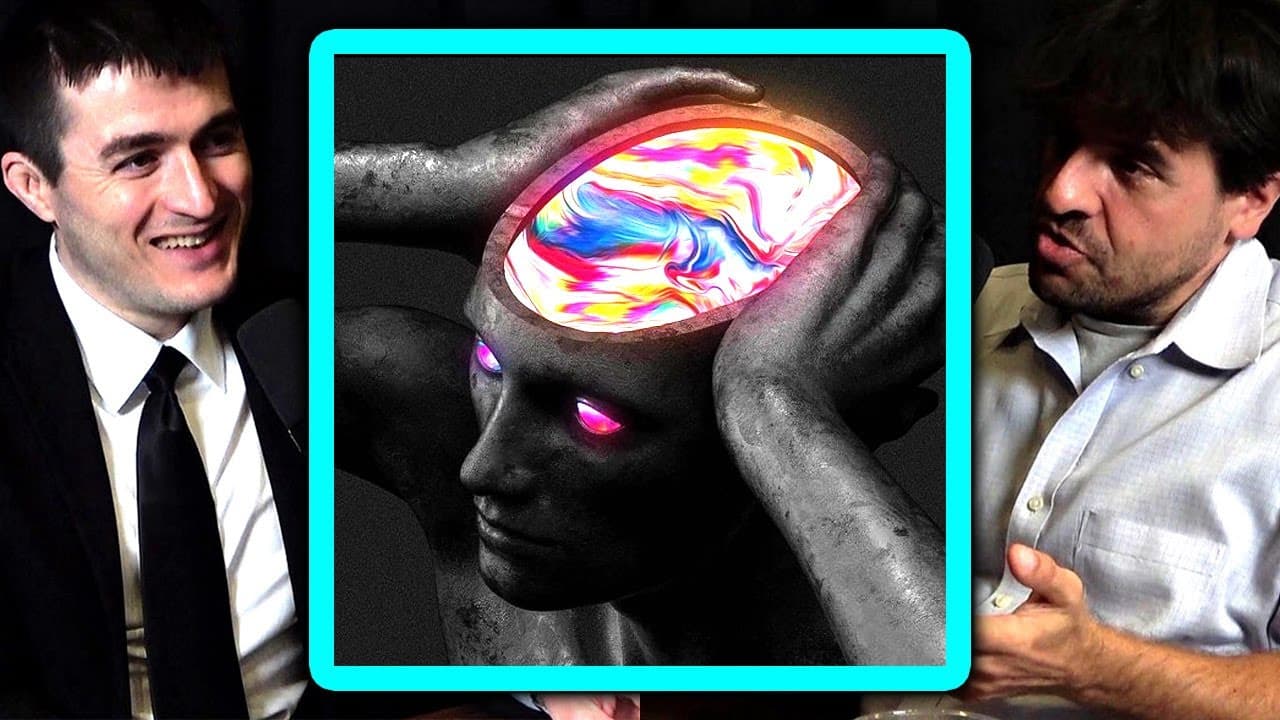
The hard problem of consciousness, which questions the nature of subjective experience, remains a challenging enigma for neuroscientists.
Transcript
what is consciousness bro so you're actually using techniques i mean even putting psychiatry aside just looking at optogenetics you're trying to understand some of these deep aspects of the human mind and maybe this is a good time to return to a question you mentioned you might have an opinion on if there's such a thing as a theory of everything fo... Read More
Key Insights
- 🍽️ The hard problem of consciousness focuses on the subjective nature of human experience and the inner state of subjectivity.
- 🔬 Optogenetic techniques provide a means to manipulate neurons and investigate consciousness in animal models.
- ❓ Paradoxes arise when contemplating the distributed nature of consciousness and the binding of neuron activity.
- ❓ Understanding how neurons coordinate and become relevant to each other is essential for comprehending the overall conscious experience.
- 🧠 Uniting cellular and brain-wide perspectives is crucial for making significant breakthroughs in understanding consciousness.
- 🤞 The ability to explain consciousness fully remains uncertain, but ongoing research brings hope for future discoveries.
- 🏑 While the hard problem of consciousness may persist, the field of neuroscience continues to uncover exciting findings.
Install to Summarize YouTube Videos and Get Transcripts
Explore YouTube Video Summarizer or Get YouTube Transcript Extractor
Questions & Answers
Q: What is the hard problem of consciousness?
The hard problem of consciousness refers to the challenge of understanding the subjective experience and nature of consciousness, including the inner state of subjectivity and the essence of human perception.
Q: How do neuroscientists use optogenetics to study consciousness?
Optogenetics allows researchers to manipulate the activity of specific neurons, shedding light on their role in generating conscious experiences. By stimulating neurons, scientists can induce behavioral responses in mice.
Q: Can consciousness exist if neurons are distributed across different locations?
The distributed nature of consciousness raises questions about the binding of neuron activity. It remains unknown what allows activity patterns to become relevant to each other and form a joint representation.
Q: Is there a possibility of achieving a theory of everything for the human mind?
Neuroscientists aim to understand the coordination of signals within the brain and how they contribute to the conscious experience. Uniting the understanding of individual neurons with the overall functioning of the mind is a significant goal.
Summary & Key Takeaways
-
Neuroscientists grapple with the hard problem of consciousness, seeking to understand the inner subjective sense of human experience.
-
Optogenetic techniques allow researchers to manipulate neurons and investigate the nature of consciousness in mice.
-
Paradoxes arise when contemplating the distributed nature of consciousness and the binding of neuron activity to form a joint representation.
Read in Other Languages (beta)
Share This Summary 📚
Summarize YouTube Videos and Get Video Transcripts with 1-Click
Try YouTube Summary with ChatGPT & Claude or YouTube Transcript Generator
Explore More Summaries from Lex Clips 📚




Summarize YouTube Videos and Get Video Transcripts with 1-Click
Try YouTube Summary with ChatGPT & Claude or YouTube Transcript Generator