What Is the Epsilon Delta Definition for Limits?
TL;DR
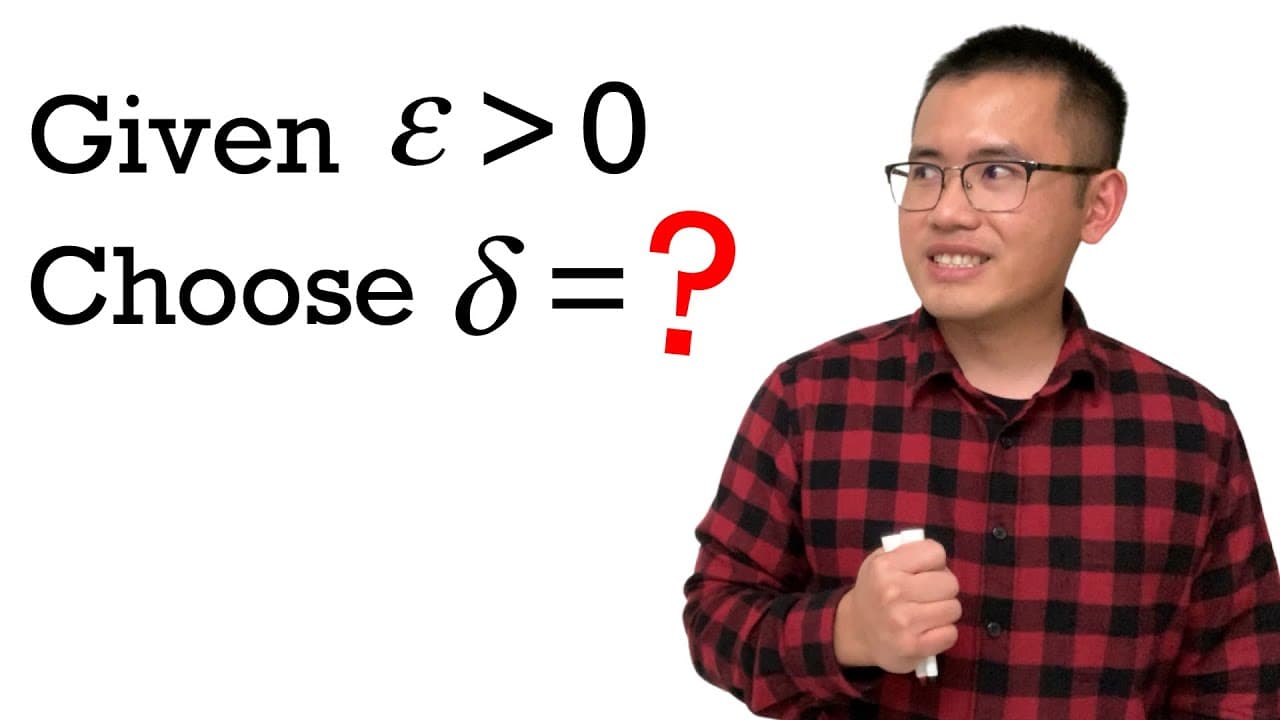
The epsilon delta definition proves limits by establishing that for any epsilon greater than zero, a corresponding delta exists such that if the absolute value of x minus a is less than delta, then the absolute value of f(x) minus L is less than epsilon. This provides a rigorous method to show that a function approaches a limit as its input approaches a specific value.
Transcript
i am pretty sure this is the hardest topic in calculus one yes we are talking about the epsilon delta definition for proving limits and the first thing that we have to do is just to calm down it's not so bad i'm going to show you guys the definition and we'll explain the definition with an actual example an actual number and a picture and... Read More
Key Insights
- 👍 The epsilon delta definition is a powerful tool in proving limits in calculus.
- 💨 It provides a precise way to establish the relationship between the limit of the function and its input values.
- 🧡 It allows for the determination of a specific range within which the function's output values must fall based on the input values' range.
- ❓ Choosing an appropriate delta value is crucial in ensuring the accuracy of the proof.
- 👍 The epsilon delta definition provides a mathematical foundation for proving limit theorems in calculus.
- 😑 Understanding the epsilon delta definition requires careful analysis and interpretation of the mathematical expressions involved.
- ❓ The epsilon delta definition can be challenging to grasp initially, but with practice and examples, it becomes more comprehensible.
Install to Summarize YouTube Videos and Get Transcripts
Explore YouTube Video Summarizer or Get YouTube Transcript Extractor
Questions & Answers
Q: What is the epsilon delta definition used for in calculus?
The epsilon delta definition is used to prove limits in calculus by showing that the value of the function approaches a specific limit as x approaches a certain value.
Q: How is the epsilon delta definition applied to prove a limit?
To apply the epsilon delta definition, we need to find a delta value that ensures the absolute difference between x and a is less than delta, resulting in the absolute difference between f(x) and L being less than epsilon.
Q: Why is it important to choose a smaller delta value when applying the epsilon delta definition?
Choosing a smaller delta value ensures that the function's value is as close as possible to the limit, resulting in a more accurate proof.
Q: How does the epsilon delta definition account for different epsilon values?
The epsilon delta definition works for any positive epsilon value. The delta value can be calculated based on the given epsilon value using the formula delta = epsilon/2.
Summary & Key Takeaways
-
The epsilon delta definition is used to prove limits in calculus.
-
The definition states that if the absolute value of x minus a is less than delta, then the absolute value of f(x) minus L is less than epsilon.
-
An example is provided to illustrate how the epsilon delta definition is applied to prove a limit.
Read in Other Languages (beta)
Share This Summary 📚
Summarize YouTube Videos and Get Video Transcripts with 1-Click
Try YouTube Summary with ChatGPT & Claude or YouTube Transcript Generator
Explore More Summaries from blackpenredpen 📚
Summarize YouTube Videos and Get Video Transcripts with 1-Click
Try YouTube Summary with ChatGPT & Claude or YouTube Transcript Generator