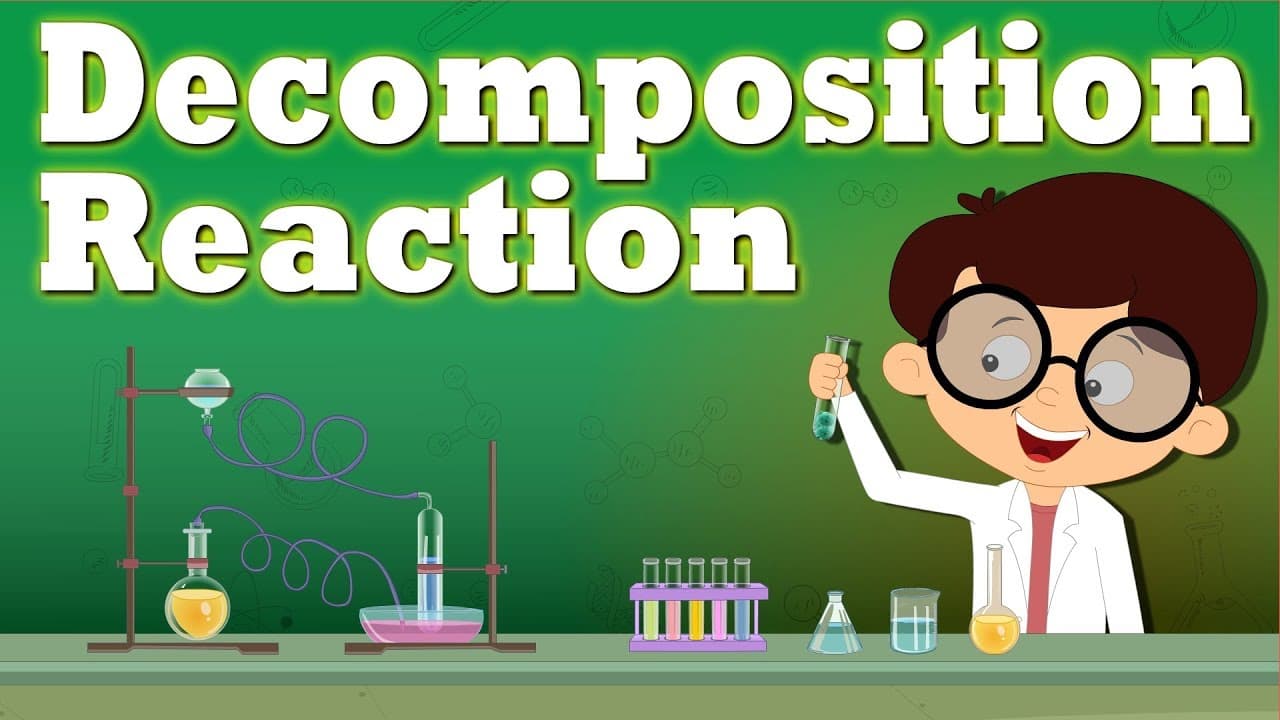
Decomposition Reaction | #aumsum #kids #science #education #children
TL;DR
Decomposition reactions involve compounds breaking down into simpler substances, as demonstrated by the example of ferrous sulfate changing colors and releasing gases.
Transcript
Decomposition Reaction. Graham Bell. Edison. Charles Babbage. Albert Einstein. Newton. Master Scientist. My Science World. Eye Scanner, Lock System. Match Found. A reaction in which a compound splits up into two or more simpler substances is known as a decomposition reaction. Let us take an example. Ferrous Sulfate. Color of ferrous sulfate crystal... Read More
Key Insights
- 🍳 Decomposition reactions involve compounds breaking down into simpler substances.
- 🫢 The example of ferrous sulfate demonstrates the color changes and gas release during a decomposition reaction.
- 🫢 Sulfur dioxide and sulfur trioxide gases are released, which have a pungent smell and are toxic if inhaled.
- 🥡 Proper precautions should be taken when conducting or observing a decomposition reaction.
- 🏑 Understanding decomposition reactions is fundamental in various fields, including chemistry and materials science.
- 👨🔬 The ability to identify and predict decomposition reactions is valuable in industry and research.
- ❓ Decomposition reactions are an essential part of the Earth's natural processes, such as the decay of organic matter.
Install to Summarize YouTube Videos and Get Transcripts
Explore YouTube Video Summarizer or Get YouTube Transcript Extractor
Questions & Answers
Q: What is a decomposition reaction?
A decomposition reaction is when a compound breaks down into simpler substances, which can occur due to heating, chemical reactions, or other factors.
Q: What happens to ferrous sulfate during a decomposition reaction?
When ferrous sulfate is heated, it undergoes a decomposition reaction, changing its color from green to white and then to reddish brown due to the formation of ferric oxide.
Q: What gases are released during the decomposition of ferrous sulfate?
Sulfur dioxide and sulfur trioxide gases are released during the decomposition of ferrous sulfate, resulting in a pungent and rotten smell due to the burning of sulfur.
Q: Are the released gases during the decomposition reaction of ferrous sulfate harmful?
Yes, the sulfur dioxide and sulfur trioxide gases released during the decomposition of ferrous sulfate are toxic and should not be inhaled, as they can cause harm to the respiratory system.
Summary & Key Takeaways
-
A decomposition reaction occurs when a compound breaks down into two or more simpler substances, as shown by the example of ferrous sulfate.
-
Ferrous sulfate crystals have a green color, but when heated, they change to white and then to reddish brown due to the formation of ferric oxide.
-
During this reaction, sulfur dioxide and sulfur trioxide gases are released, which have a pungent smell and are toxic if inhaled.
Read in Other Languages (beta)
Share This Summary 📚
Summarize YouTube Videos and Get Video Transcripts with 1-Click
Try YouTube Summary with ChatGPT & Claude or YouTube Transcript Generator
Explore More Summaries from It's AumSum Time 📚


Summarize YouTube Videos and Get Video Transcripts with 1-Click
Try YouTube Summary with ChatGPT & Claude or YouTube Transcript Generator