Dominant and Degenerate modes | TE and TM | Microwave Engineering | Lec-27
TL;DR
The video explains dominant and degenerate modes in waveguides, defining their characteristics and differences.
Transcript
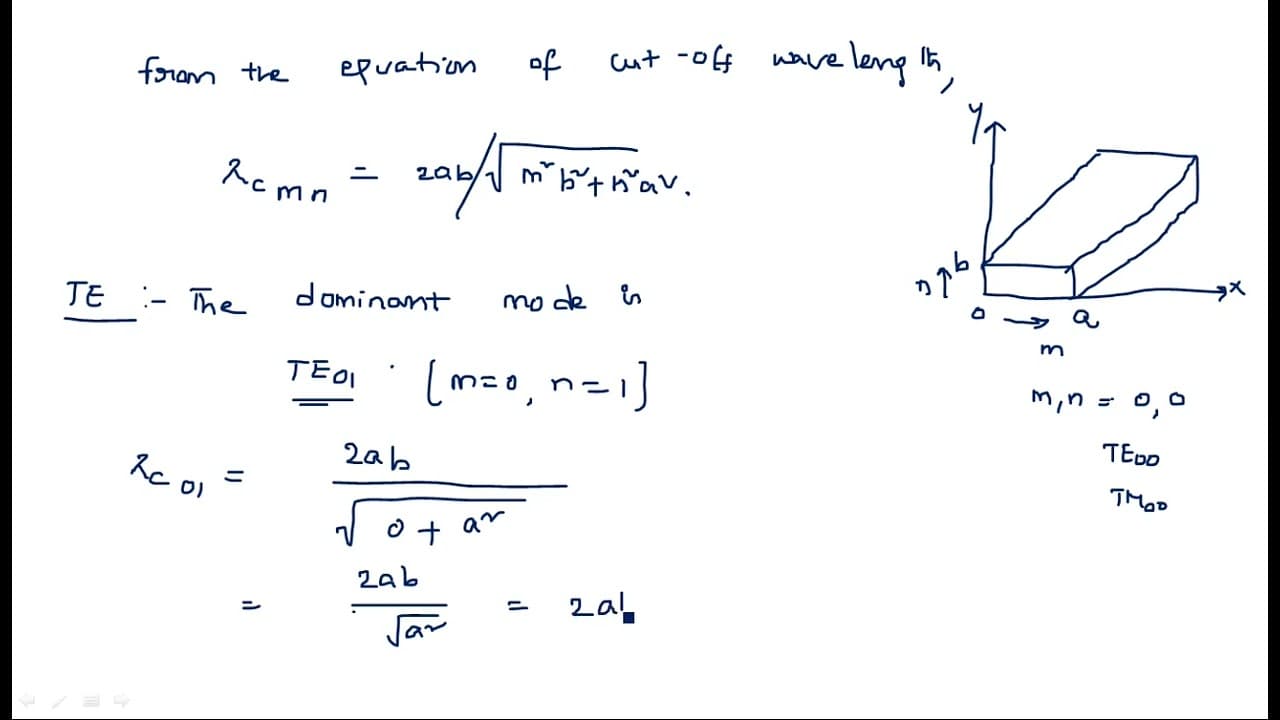
hi everyone in this video I am going to explain about a dominant modern degenerate mode what do you mean by dominant model so first let us see the definition of dominant mode and regenerator mode then we will go what are the different dominant modes and date generate modes in d e and DM dominant mode dominant mode before going to the definition of ... Read More
Key Insights
- 😘 Dominant modes are identified as having the lowest cutoff frequency, impacting wave propagation efficiency.
- 🇲🇰 The relationship between M and N values affects the cutoff wavelengths and frequencies, determining mode existence.
- 👋 TE and TM modes are studied for their unique characteristics in wave propagation through waveguides.
- 🥺 The considerations of cutoff wavelength lead to understanding which modes can effectively propagate in communication systems.
- 📡 The existence of degenerate modes in waveguides allows for multiple mode propagation, which can enhance signal integrity and reduce signal loss.
- 🗺️ Rectangular waveguides display distinct patterns based on the modes, each influencing how electromagnetic energy travels.
- 🎨 The concept of dominant and degenerate modes is fundamental in designing optimal waveguide systems for various applications.
Install to Summarize YouTube Videos and Get Transcripts
Explore YouTube Video Summarizer or Get YouTube Transcript Extractor
Questions & Answers
Q: What is meant by "dominant mode" in waveguides?
A dominant mode in waveguides refers to the mode that has the lowest cutoff frequency or the highest cutoff wavelength compared to other available modes. In rectangular waveguides, characteristics of dominant modes determine which wave will propagate the most efficiently, crucial for effective communication and signal transmission.
Q: How do M and N values determine the modes in waveguides?
In a rectangular waveguide, M and N values specify the distribution of the electric field along the horizontal and vertical axes, respectively. These values create different characteristic patterns of wave propagation known as modes. For example, a mode labeled TE(m,n) will have specific field patterns based on the integers M and N chosen, affecting its behavior and propagation characteristics.
Q: Why is TM01 considered the dominant mode over TE01?
TM01 is considered the dominant mode because, upon evaluation, it has the highest cutoff wavelength compared to TE01, thus allowing it to exist and propagate efficiently in a rectangular waveguide. Since dominant modes are defined by their frequency characteristics, TM01’s parameters ensure it is more favorable for transmission.
Q: Can you explain what degenerate modes are in detail?
Degenerate modes occur when two or more modes exhibit the same cutoff frequency within a waveguide, meaning they can propagate simultaneously without interference. This property is crucial for optimizing the design of waveguides, as it allows for redundancy and greater flexibility in waveguide operation and signal management.
Summary & Key Takeaways
-
The video discusses dominant modes in rectangular waveguides, focusing on their definition as modes with the least cutoff frequency and highest cutoff wavelength, illustrating with the TM and TE classes.
-
It elaborates on the relationship between electric field distribution along the axes and the designation of modes (denoted by indices M and N), showcasing how to compute cutoff frequencies for different modes.
-
Degenerate modes are defined as multiple modes sharing the same cutoff frequency, with examples from TE and TM modes to clarify their characteristics and implications in waveguide physics.
Read in Other Languages (beta)
Share This Summary 📚
Summarize YouTube Videos and Get Video Transcripts with 1-Click
Try YouTube Summary with ChatGPT & Claude or YouTube Transcript Generator