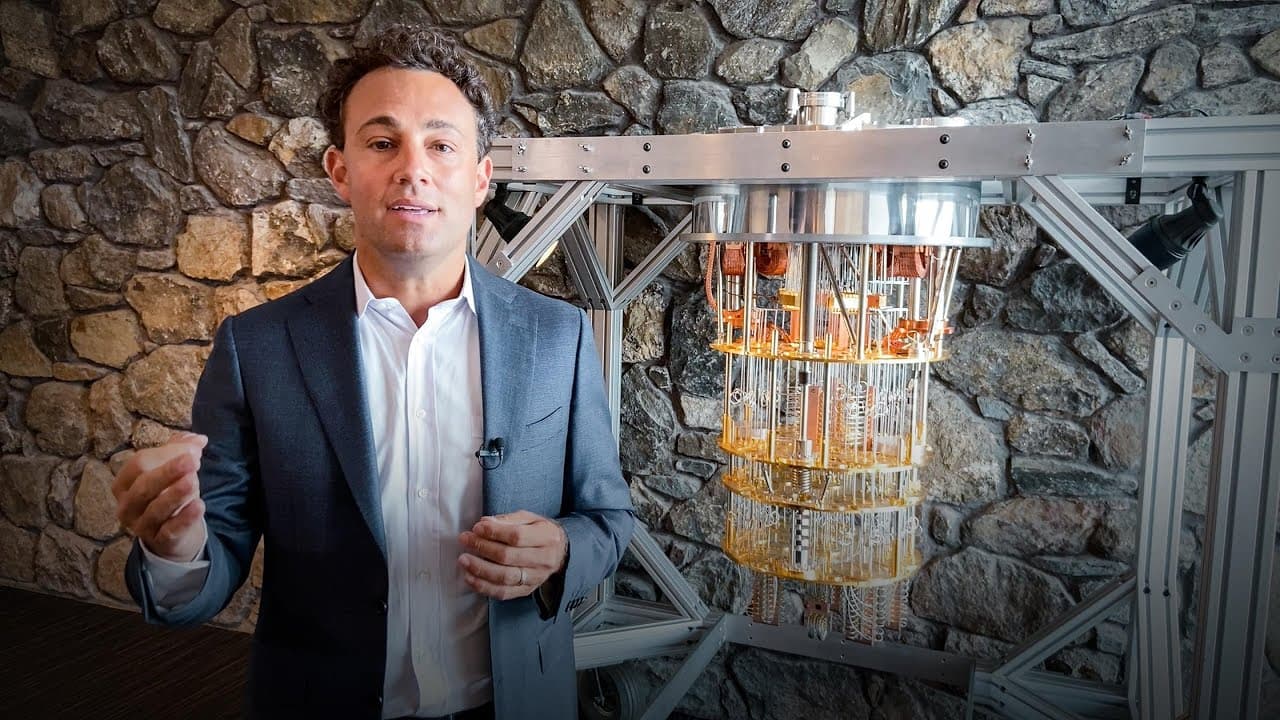
The promise of quantum computers | Matt Langione
TL;DR
In this article, the author explores the challenges faced by traditional supercomputers and highlights the potential of quantum computing as a revolutionary solution.
Transcript
Transcriber: What will the biggest challenges of the 21st century turn out to be? Today, one might guess climate change, public health, inequality, but the truth is we don't yet know. What we do know is that supercomputing will have to be part of the solution. For nearly a hundred years, our reliance on high-performance computers in the face of ou... Read More
Key Insights
- 💻 Supercomputing has been crucial in solving urgent challenges throughout history, but progress in compute power is now stagnating, limiting our ability to tackle complex problems in areas like drug discovery and climate change.
- ⏰ Quantum computing offers a potential solution by leveraging subatomic properties, allowing for simultaneous exploration of multiple possibilities and exponential speedups for certain complex problems.
- 🔬 Traditional supercomputers lack the computational resources to simulate molecular interactions efficiently, hindering advancements in areas like fertilizer production and drug discovery.
- 💰 Banks face compute constraints that hinder their risk simulations, leading to larger cash reserves and restricted lending. Quantum computing could enable more comprehensive risk assessment and stimulate investment.
- ⌛ The timeline for quantum advantage is uncertain, but waiting to invest may be a mistake as quantum computing has already achieved critical milestones ahead of schedule. Preparation and experimentation with real quantum computers are necessary for businesses.
- 🌍 Governments and VCs are heavily investing in quantum technologies, highlighting the urgency for businesses to join in developing use cases and onboarding talent.
- ✨ Quantum computers are poised to lead a new age of supercomputing, but integrating them into workflows, attracting talent, and identifying high-value problems will require time, vision, and imagination.
- 🏁 The race for quantum computing dominance is already underway, and leaders need to act now to stay competitive and drive innovation in a world where traditional processors are reaching their limits.
Install to Summarize YouTube Videos and Get Transcripts
Explore YouTube Video Summarizer or Get YouTube Transcript Extractor
Questions & Answers
Q: What are some of the challenges of the 21st century that require supercomputing solutions?
Some of the challenges of the 21st century that require supercomputing solutions include climate change, public health, inequality, drug discovery, and value creation in areas like finance and logistics.
Q: Why is progress in compute power coming to a standstill?
Progress in compute power is coming to a standstill because, despite the increasing reliance on computers, the physical limits of computer processors have been reached. Transistors have become so small that they are approaching the size of an atom, making it difficult to further increase compute power.
Q: What is quantum computing and how does it differ from classical computing?
Quantum computing is a type of computing that exploits subatomic physical properties to overcome the limitations of classical computing. Unlike classical computers that operate deterministically and sequentially, quantum computers operate probabilistically and simultaneously. They use the properties of superposition, entanglement, and interference to explore multiple possibilities at once.
Q: How can quantum computing benefit industries and society?
Quantum computing can benefit industries and society by providing faster solutions to complex problems. For example, it can drastically reduce the time required for drug discovery and simulation of molecular interactions, leading to more efficient processes and potential breakthroughs. It can also enable improved risk simulations for banks, allowing them to lend more freely and stimulate economic growth. Quantum computing has the potential to transform various sectors and address critical challenges of the 21st century.
Summary & Key Takeaways
-
Supercomputing has been crucial in addressing urgent challenges over the years, but progress is slowing down, posing limitations in various fields like drug discovery and climate change.
-
Quantum computing offers a solution by leveraging subatomic properties and operating probabilistically and simultaneously.
-
Quantum computers could significantly speed up processes like fertilizer production, drug discovery, and risk simulations in banking, leading to cost savings, efficiency, and innovation. Business investment and preparation are needed to fully harness the potential of quantum computing.
Read in Other Languages (beta)
Share This Summary 📚
Summarize YouTube Videos and Get Video Transcripts with 1-Click
Try YouTube Summary with ChatGPT & Claude or YouTube Transcript Generator
Explore More Summaries from TED 📚





Summarize YouTube Videos and Get Video Transcripts with 1-Click
Try YouTube Summary with ChatGPT & Claude or YouTube Transcript Generator