Klystron amplifier | Mathematical analysis | Microwave Engineering | Lec-86
TL;DR
This video explains the mathematical analysis of a Klystron amplifier's electron velocity and signal amplification.
Transcript
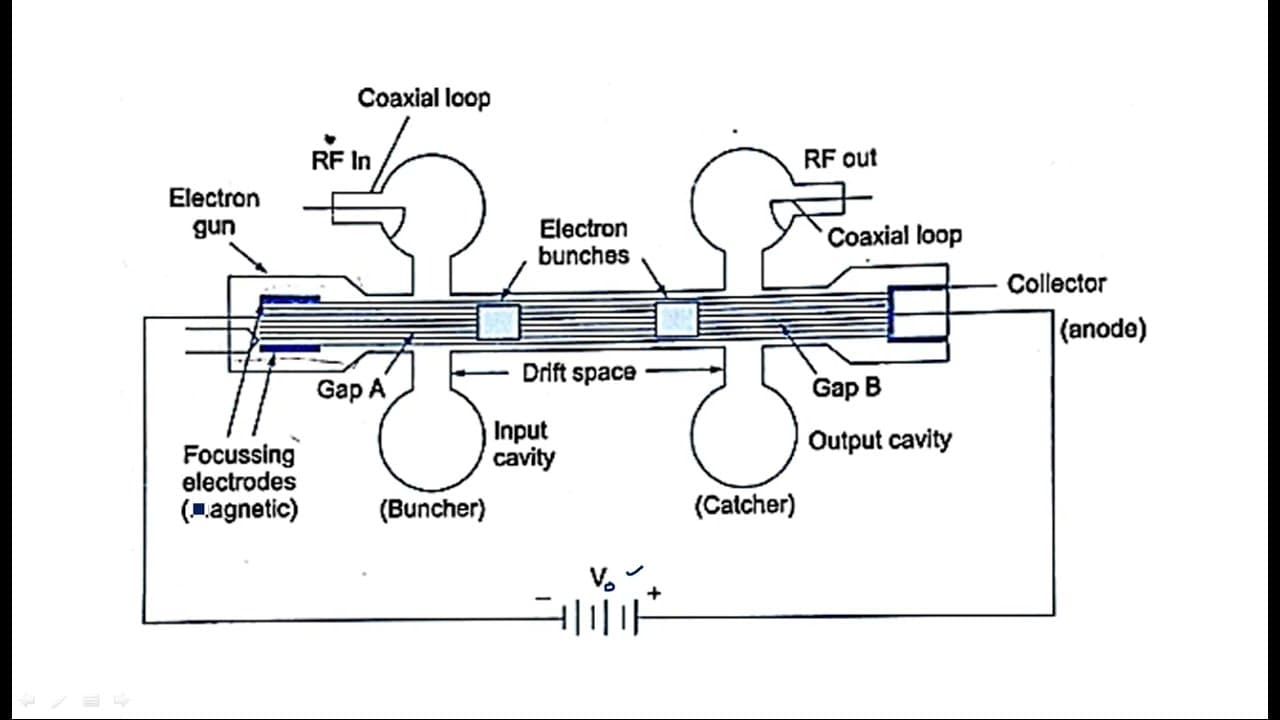
hi everyone in this video I am going to explain about the mathematical analysis of Klystron amplifier in the mathematical analysis of Klystron amplifier first we will see the velocity with which the electron travels from cathode to anode after the application of RF input voltage and later we can calculate the drift space between the two cavities no... Read More
Key Insights
- 📡 Understanding electron velocity manipulation is crucial for optimizing Klystron amplifier performance and signal amplification.
- ⚡ The behavior of electrons in response to RF input voltage is a fundamental principle that drives the design and operation of Klystron amplifiers.
- 👾 Different electron types during RF modulation influence the efficiency of signal amplification through their collective behavior in the drift space.
- 📡 Phase relationships between RF signals and electron movements significantly impact the overall operation and effectiveness of Klystron amplifiers.
- 🦻 Mathematical representation offers a clear insight into physical phenomena occurring within electronic devices, aiding engineers in designing better circuitry.
- ⚡ The interaction of varying voltages on electron motion highlights the complexities in RF signal processing and electromagnetic theory.
- 👖 Applications of Klystron amplifiers span various technologies, including communications and radar systems, highlighting their importance in modern electronics.
Install to Summarize YouTube Videos and Get Transcripts
Explore YouTube Video Summarizer or Get YouTube Transcript Extractor
Questions & Answers
Q: What is the primary focus of the video regarding Klystron amplifiers?
The video concentrates on the mathematical analysis of electron behavior within Klystron amplifiers, especially their velocity modifications when subjected to RF input voltage and how this influences the amplification process.
Q: How does the application of RF input voltage affect electron velocity in a Klystron amplifier?
When RF input voltage is applied, the previously constant velocity of the electrons (small V naught) changes to a variable state (small V1) due to the modulation effect, enabling the creation of electron bunching that amplifies RF signals.
Q: What are the different types of electrons discussed in the video, and what do they signify?
The video mentions three types of electrons: reference, late, and early electrons. These represent the various positions of electrons at different phases of the RF input voltage, which contributes to the electron bunching necessary for effective signal amplification.
Q: Can you explain the significance of the drift space in Klystron operation?
Drift space refers to the gap between the cavities in a Klystron amplifier, where electrons travel after being modulated. This space is critical for the electrons to bunch together, which amplifies the RF output signal when these bunches reach the capture cavity.
Q: What is the relationship between the phase angle Theta G and the performance of the Klystron?
The phase angle Theta G determines how effectively the RF signal can influence electron acceleration. It is derived from the angular velocity and the distance traveled by the electrons, which directly affects the timing and efficiency of signal amplification.
Q: How is velocity modulation calculated in the Klystron amplifier according to the video?
Velocity modulation is calculated by comparing the velocity of electrons before and after RF input. Using specific formulas derived from electron mass and charge, the velocity changes are expressed mathematically to illustrate the amplification process.
Q: What upcoming topic will the presenter address in future videos?
The next video will explore the bunching process of the electron beam in greater detail, including the calculations for drift velocity and its significance between the buncher and capture cavities in the Klystron amplifier.
Summary & Key Takeaways
-
The video details the mathematical principles of Klystron amplifiers, focusing on electron velocity changes before and after applying RF input voltage. It explains how these changes affect signal amplification.
-
It introduces crucial concepts such as drift space between cavities and the behavior of electrons under various voltage conditions, enhancing understanding of Klystron amplifier mechanics.
-
The discussion includes the phase angle of the RF signal and its relationship with electron acceleration, offering insight into the dynamic processes involved in signal modulation and amplification.
Read in Other Languages (beta)
Share This Summary 📚
Summarize YouTube Videos and Get Video Transcripts with 1-Click
Try YouTube Summary with ChatGPT & Claude or YouTube Transcript Generator