Inductors - What Are They And How Do They Work?
TL;DR
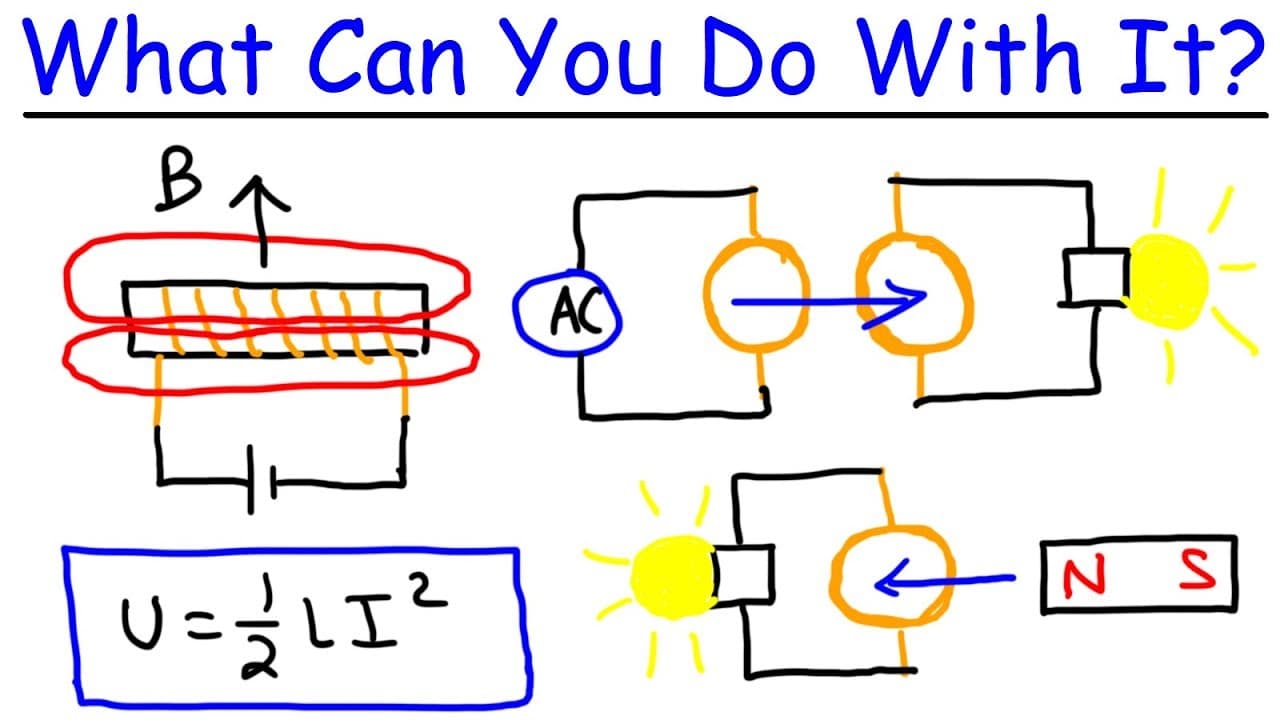
Inductors are coils of wire that store energy and create magnetic fields, allowing for various applications such as electromagnets, energy transfer, and conversion of mechanical energy into electrical energy.
Transcript
what exactly is an inductor and what can you do with it an inductor is basically a coil of wire now you can wrap it around a ferrite core or another metal or it could just be air in between it but it's basically a coil of wire and you could do a lot of things with an inductor an inductor can be used to store energy let's connect it to a battery and... Read More
Key Insights
- 🏪 An inductor is a coil of wire that stores energy and creates magnetic fields.
- 💐 The energy stored in an inductor is based on the current flowing through it and can be calculated using the equation for potential energy.
- 🤘 Inductors can be used to build electromagnets by wrapping coils of wire around a piece of metal and applying current.
- 🏑 They can transfer energy between circuits through the changing magnetic field they create.
- ⚡ Transformers utilize inductors to step up or step down voltages in electrical circuits.
- 🦾 Inductors can convert mechanical energy into electrical energy by moving a magnet into or out of the coil.
- 🐎 Increasing the number of coils and the speed of magnet movement can enhance energy generation.
Install to Summarize YouTube Videos and Get Transcripts
Explore YouTube Video Summarizer or Get YouTube Transcript Extractor
Questions & Answers
Q: What is an inductor?
An inductor is a coil of wire that can store energy and create a magnetic field when connected to a battery or a current source.
Q: How does the magnetic field of an inductor change?
The magnetic field of an inductor expands when the current flowing through it increases and collapses when the current decreases, releasing stored energy back into the circuit.
Q: What can you do with an electromagnet?
An electromagnet can be created by wrapping a coil of wire around a piece of metal, such as a screw. Increasing the number of coils and the current strengthens the electromagnet, allowing it to attract nearby pieces of metal.
Q: How can inductors transfer energy between circuits?
Inductors can transfer energy from one circuit to another by inducing a current in a nearby coil of wire through the changing magnetic field created by the first coil.
Q: What is the purpose of a transformer?
A transformer is a device that consists of two coils of wire, the primary and secondary coils. By varying the number of turns in each coil, transformers can step up or step down voltages in electrical circuits.
Q: How does increasing the number of coils in an inductor affect energy generation?
Adding more coils to an inductor increases the efficiency of converting mechanical energy into electrical energy, resulting in higher energy generation.
Q: What is required for an inductor to generate electrical energy from a magnet?
To generate electrical energy, the magnet needs to be moved into or out of the coil, causing the changing magnetic field to induce a current. Leaving the magnet stationary in the coil will not generate any energy.
Q: What factors determine the energy generated by an inductor?
The number of coils and the speed at which the magnet is moved into or out of the coil are key factors that determine the amount of energy generated by an inductor.
Summary & Key Takeaways
-
Inductors are coils of wire that can be wrapped around a ferrite core or another metal, or simply have air in between them.
-
They store energy by creating a magnetic field when connected to a battery, with the strength of the field increasing or decreasing based on the current flowing through the inductor.
-
Inductors can be used to build electromagnets, transfer energy from one circuit to another, and convert mechanical energy into electrical energy by moving a magnet in and out of the coil.
Read in Other Languages (beta)
Share This Summary 📚
Summarize YouTube Videos and Get Video Transcripts with 1-Click
Try YouTube Summary with ChatGPT & Claude or YouTube Transcript Generator
Explore More Summaries from The Organic Chemistry Tutor 📚



Summarize YouTube Videos and Get Video Transcripts with 1-Click
Try YouTube Summary with ChatGPT & Claude or YouTube Transcript Generator