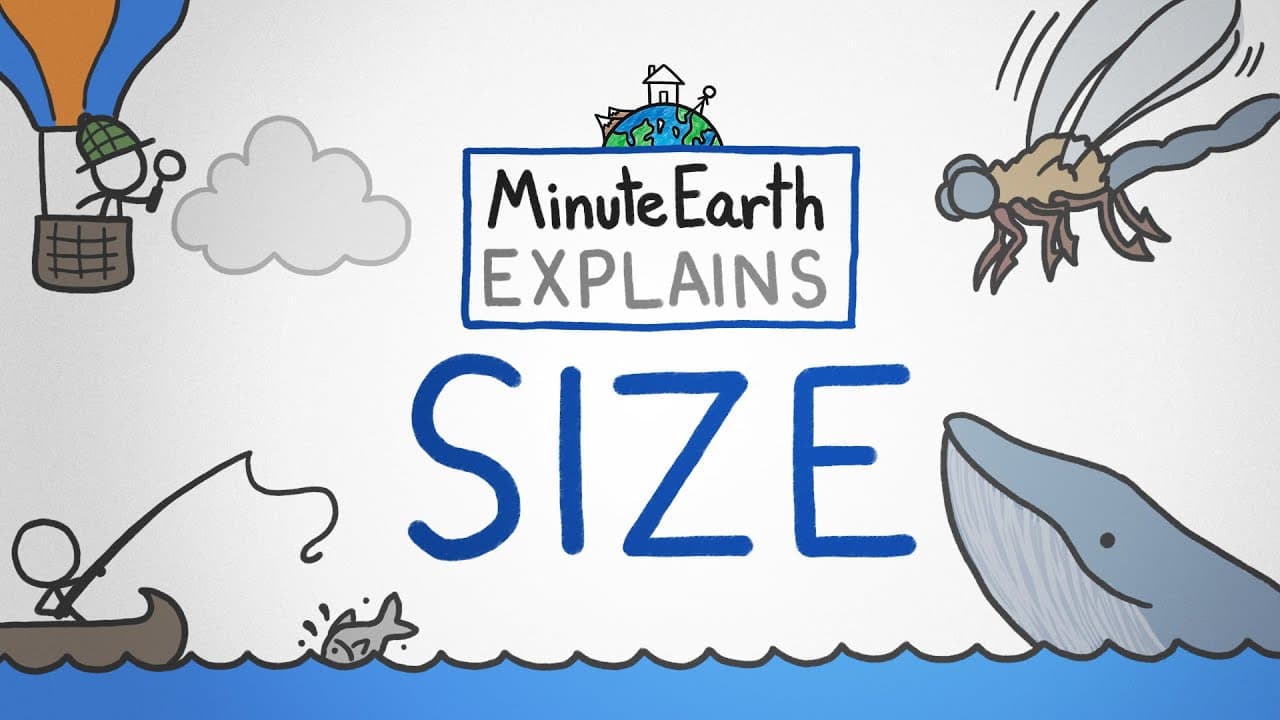
MinuteEarth Explains: Size
TL;DR
The biggest living organism on Earth is a humongous fungus that covers 2385 acres in Oregon, while the tallest living organism is a California redwood. Animals can grow to immense sizes due to factors like increased oxygen levels and evolutionary adaptations.
Transcript
Hi! I'm Emily from MinuteEarth. Or, as I've sometimes heard it pronounced, "my-nute Earth." Coming up, we've got four short stories about the science of size, why big things are big, small things are small, and as far as Mother Nature is concerned, size really does matter. First up, a quest for the biggest organism on the planet. Blue whales are th... Read More
Key Insights
- 😃 The biggest living organism on Earth is a humongous fungus covering 2385 acres in Oregon.
- 📛 The tallest organism is a California redwood named "Hyperion."
- 💗 Animals can grow to immense sizes through increased oxygen levels and evolutionary adaptations.
- 🎣 Size-selective fishing leads to fewer and smaller fish in the water, impacting fisheries worldwide.
- 🔸 A new approach called "balanced harvesting" aims to catch a smaller number of fish across a wider range of sizes to maintain balanced populations.
- 💦 Water droplets require impurities like dirt particles to condense into rain, making them crucial for precipitation.
- 👻 The presence of impurities allows water molecules to form clusters and grow into raindrops, enabling the existence of rain.
Install to Summarize YouTube Videos and Get Transcripts
Explore YouTube Video Summarizer or Get YouTube Transcript Extractor
Questions & Answers
Q: What is the biggest living organism on Earth?
The biggest living organism on Earth is a humongous fungus covering 2385 acres in Oregon.
Q: What is the tallest living organism?
The tallest living organism is a California redwood named "Hyperion," reaching a height of 115 meters.
Q: How do giant pandas hold the record for being the heaviest organism?
Giant pandas do not hold the record for being the heaviest organism. The title goes to a single quaking aspen named "Pando," weighing over 6000 tonnes, equivalent to 40 blue whales.
Q: How does the humongous fungus steal nutrients from trees in the forest?
The humongous fungus spreads its mycelia through the soil, roots, and bark of trees in the forest, attacking them and stealing their nutrients.
Q: How do animals grow to immense sizes?
Animals can grow to immense sizes due to factors like increased oxygen levels, which allowed arthropods to grow larger, and evolutionary adaptations such as air sacs in dinosaurs' skeletons, enabling them to get bigger without getting heavier.
Summary & Key Takeaways
-
The biggest organism on Earth is a humongous fungus covering 2385 acres in Oregon, while the tallest organism is a California redwood named "Hyperion."
-
Giant pandas and quaking aspens also hold records for being the heaviest and covering the largest area, respectively, as single organisms.
-
Oxygen levels and evolutionary adaptations play a significant role in allowing animals and arthropods to grow to enormous sizes.
Read in Other Languages (beta)
Share This Summary 📚
Summarize YouTube Videos and Get Video Transcripts with 1-Click
Try YouTube Summary with ChatGPT & Claude or YouTube Transcript Generator
Explore More Summaries from MinuteEarth 📚





Summarize YouTube Videos and Get Video Transcripts with 1-Click
Try YouTube Summary with ChatGPT & Claude or YouTube Transcript Generator