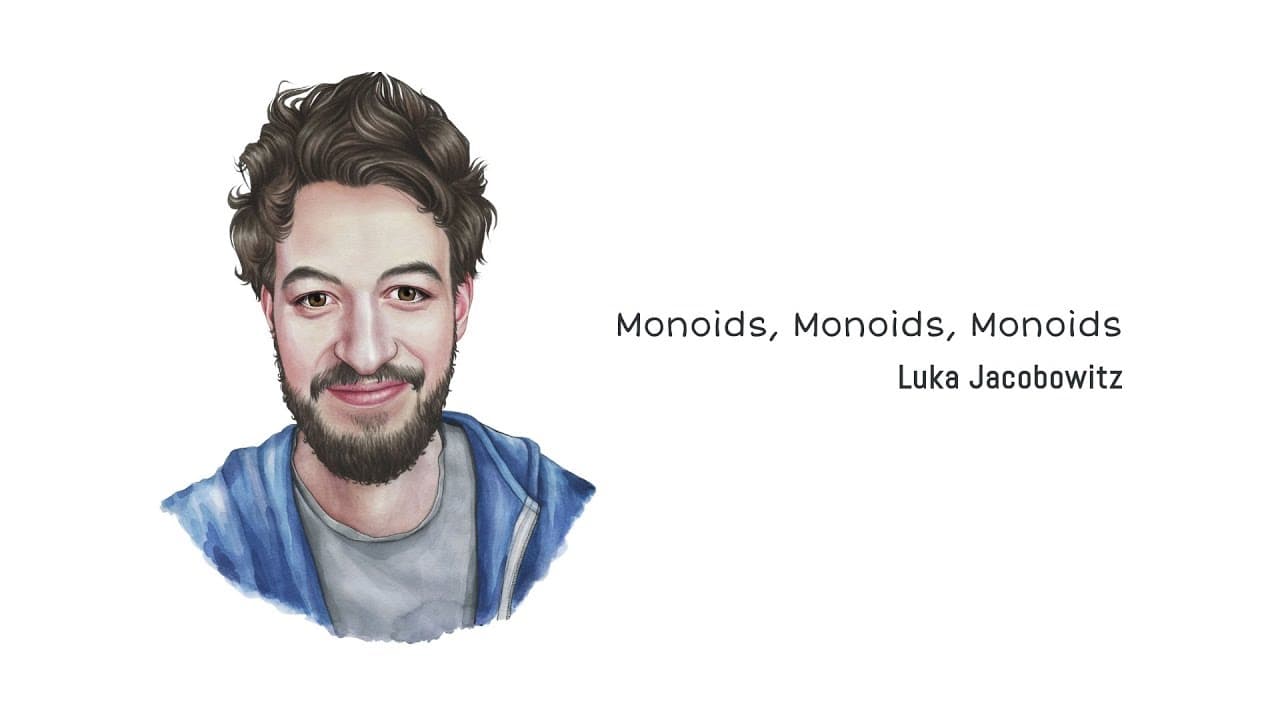
Luka Jacobowitz—Monoids, Monoids, Monoids
TL;DR
This talk explores the concept of algebraic structures in Scala, including monoids, rings, and lattices, and how they can be applied to functional programming.
Transcript
thanks to a lot to John who invited me here I don't think I don't know where he is but I'm very very grateful to be here it's my first time with Scala world and it's already been great like the conference just started there's already been so many great things I've great made great memories and yeah so my talk is titled mano y mano it's mah notes an... Read More
Key Insights
- 🎵 Luca Jacobi claims that monoids are at the heart of almost everything in Scala and more generally talks about abstract algebra and type theory which might sound academic but he believes they are simple and can be understood together.
- 📚 Luca Jacobi works at Comstock which is hiring for purely functional Scala developers who want to revolutionize the commercial real estate industry. He also maintains various type level libraries with "cats" in the name.
- 🗓 The talk is titled "Mano y Mano" and Luca Jacobi provides a quick overview of monoids, explaining that they are type classes with empty and combined methods.
- 🔢 He gives examples of basic monoids, such as integer addition and string concatenation, and explains how they can be useful to combine and fold different types of data.
- 🔗 Other types, such as functions, options, tuples, and maps, can also be monoids as long as the underlying types have a monoid instance.
- ✨ Monoids have the associativity and identity laws, which enable parallel aggregation and determinism in processing large amounts of data.
- 🔑 The laws of monoids are important because they provide determinism and allow for parallel processing, which is useful in various scenarios like event sourcing, distributed systems, and aggregating large datasets.
- 📝 Luca Jacobi also discusses other algebraic laws, such as invertibility, commutativity, idempotency, absorption, and distributivity, that form different algebraic structures like groups, rings, lattices, and fields.
- 💡 These algebraic structures and their laws provide a powerful and abstract way of thinking about and modeling various problems, and they are also encoded as type classes in libraries like Cats.
- 🤝 Luca Jacobi gives examples of how these algebraic structures, like monoidal and applicative, are used in Cats to provide powerful abstractions and enable generic programming.
- 🧠 The concepts of monoids, semi-lattices, rigs, and other algebraic structures are not just theoretical but have practical applications in libraries, parallel processing, MTL type classes, and more.
- 💭 The talk ends by discussing some new features in Scala 3, such as union types and intersection types, that further enhance the type system's ability to reason about and encode algebraic structures.
- 🎯 The key insight is that understanding and applying abstract algebraic concepts, such as monoids and other algebraic structures, can lead to more powerful and generic solutions in functional programming and type systems.
Install to Summarize YouTube Videos and Get Transcripts
Explore YouTube Video Summarizer or Get YouTube Transcript Extractor
Questions & Answers
Q: What is a monoid and how does it relate to abstract algebra?
A monoid is a type class with two methods, empty and combine. It represents a set of values along with an associative binary operation. In abstract algebra, monoids are a fundamental concept and can be used to study properties and relationships between different types of computations.
Q: How can algebraic structures be applied in functional programming?
Algebraic structures provide a framework for modeling computations and data transformations in a precise and composable manner. They enable us to perform operations on different types in a consistent and predictable way, leading to more robust and maintainable code. Additionally, algebraic structures can be used to optimize and parallelize data processing, improving performance and scalability.
Q: What are some real-world examples where algebraic structures are used in Scala libraries?
Some examples include the Cats library, which provides type classes for monoids, semigroups, and other algebraic structures. Cats also includes type classes for applicatives and monads, which are higher-level abstractions built on top of monoids. Additionally, the Dotty compiler (the next generation of Scala) incorporates algebraic structures in its type system, allowing for more expressive and powerful code.
Q: How do algebraic structures contribute to parallel and deterministic data processing?
By following the laws and properties of algebraic structures, such as associativity and idempotency, we can design computations that can be distributed and executed in parallel without losing determinism. This allows for efficient and scalable data processing, where computations can be performed independently and then combined together to achieve the desired result.
Summary & Key Takeaways
-
The talk introduces the concept of monoids, which are types with two methods, empty and combine, and explains how they can be used to combine values of the same type.
-
It explores the connection between monoids and abstract algebra, showing examples of monoids in different contexts such as addition, string concatenation, and set union.
-
The talk introduces other algebraic structures such as groups, semi-lattices, and distributive lattices, and how they can be used to model different types of computations.
-
It discusses the application of algebraic structures in functional programming and shows examples of how they can be used to process data in a parallel and deterministic manner.
Read in Other Languages (beta)
Share This Summary 📚
Summarize YouTube Videos and Get Video Transcripts with 1-Click
Try YouTube Summary with ChatGPT & Claude or YouTube Transcript Generator
Explore More Summaries from Scala World 📚

Summarize YouTube Videos and Get Video Transcripts with 1-Click
Try YouTube Summary with ChatGPT & Claude or YouTube Transcript Generator