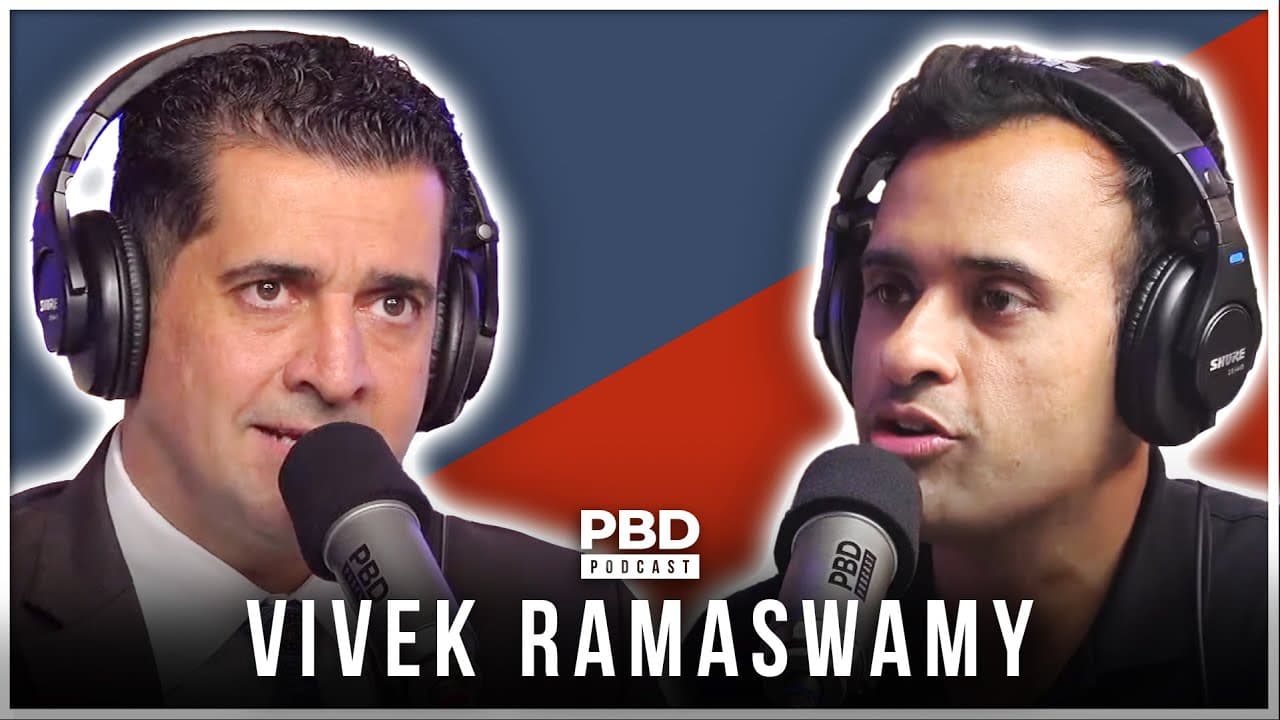
Vivek Ramaswamy | PBD Podcast | Ep. 226
TL;DR
Vivek Ramaswamy critiques ESG and its impact on capitalism and democracy.
Transcript
I'm the one okay our guest today is Vivek ramaswamy our topic today will be around ESG which is a topic that a lot of people are talking about musk is concerned about it there's this uh a man who uh just when you see his picture how he speaks just seems like a total sweetheart the kind of a person you want telling bedtime stories to your kids his n... Read More
Key Insights
- 🌎 Ramaswamy critiques the merging of corporate America with progressive ideologies as detrimental to capitalism and democracy.
- 😮 He identifies the 2008 financial crisis as a catalyst for the rise of ESG, noting the connection to social movements.
- 🛄 His company, Strive, aims to redirect corporate focus back to profit-making rather than social justifications.
- ❓ Ramaswamy emphasizes the importance of maintaining shareholder value and corporate integrity over social agendas.
- 😮 He correlates the current identity crisis in America to the rise of victimhood, jeopardizing the values of hard work and excellence.
- 🏈 Ramaswamy advocates for a nuanced understanding of what it means to be American, stressing collective aspirations over divisive politics.
- 🌥️ The influence of large financial institutions like BlackRock has exacerbated pressures on corporations to adopt ESG practices.
Install to Summarize YouTube Videos and Get Transcripts
Explore YouTube Video Summarizer or Get YouTube Transcript Extractor
Questions & Answers
Q: What does Vivek Ramaswamy believe is the relationship between ESG and capitalism?
Ramaswamy argues that ESG represents a dangerous integration of social agendas into corporate governance, which he believes distracts companies from their primary mission of maximizing shareholder value. He sees this trend as detrimental not just to businesses but also to the larger fabric of American democracy.
Q: How does Ramaswamy view the origins of ESG as a movement?
He traces the modern concept of ESG back to the 2008 financial crisis, contending that the left's reaction to the crisis, including movements like Occupy Wall Street, created an environment ripe for corporations to align with progressive causes in exchange for political favor, leading to the current ESG framework.
Q: What are the implications of corporate support for social agendas according to Ramaswamy?
He suggests that endorsing social causes can dilute the effectiveness of companies, diverting focus from product quality and service. This shift, he argues, erodes public trust in capitalism, as firms begin to prioritize political correctness over business efficiency.
Q: Why does Ramaswamy believe it is crucial to address the role of corporate America in politics?
Ramaswamy insists that companies must refrain from engaging in politics if they are to maintain public trust and ensure the proper functioning of democracy. He warns that using corporate power to serve partisan agendas undermines the foundational principle of equal representation in democratic societies.
Q: What is Strive, and how does it differ from other financial institutions according to Ramaswamy?
Strive is a company founded by Ramaswamy that aims to support corporations in focusing on their core business objectives rather than pursuing political or social agendas dictated by ESG pressures. Unlike other financial institutions, Strive promotes shareholder engagement without imposing external social obligations on companies.
Q: In what way does Ramaswamy correlate the rise of ESG with America's national identity?
He draws a parallel between the rise of ESG and a crisis of national identity, suggesting that America's shift towards focusing on identity politics and victimhood has allowed social agendas to infiltrate capitalism, ultimately threatening the traditional values of hard work and excellence that he believes should define the American identity.
Q: What does Ramaswamy say about the future of America's corporate structure?
Ramaswamy is optimistic about a potential shift away from ESG as more individuals and states push back against the entrenchment of progressive ideals in business. He believes that a return to traditional principles of capitalism, aligned with a revival of American identity, is possible if individuals become aware and take action.
Q: How does Ramaswamy view the current political landscape in relation to ESG and corporate influence?
Ramaswamy contends that the political landscape is currently too focused on individual personalities rather than fundamental issues like identity and core values. He calls for a reevaluation of what it means to be conservative and American, advocating for a movement toward shared values and principles that transcend party lines.
Summary & Key Takeaways
-
Vivek Ramaswamy discusses his background in biotech and finance, explaining how his experiences led him to critique the ESG movement which he believes compromises both capitalism and democracy.
-
He argues that the rise of ESG was a response to the 2008 financial crisis, driven by political elites and large financial institutions seeking to maintain their power while appeasing social movements.
-
Ramaswamy introduces his company Strive, which advocates for a return to focusing on corporate core missions instead of social and political agendas, aiming to empower shareholders.
Read in Other Languages (beta)
Share This Summary 📚
Summarize YouTube Videos and Get Video Transcripts with 1-Click
Try YouTube Summary with ChatGPT & Claude or YouTube Transcript Generator