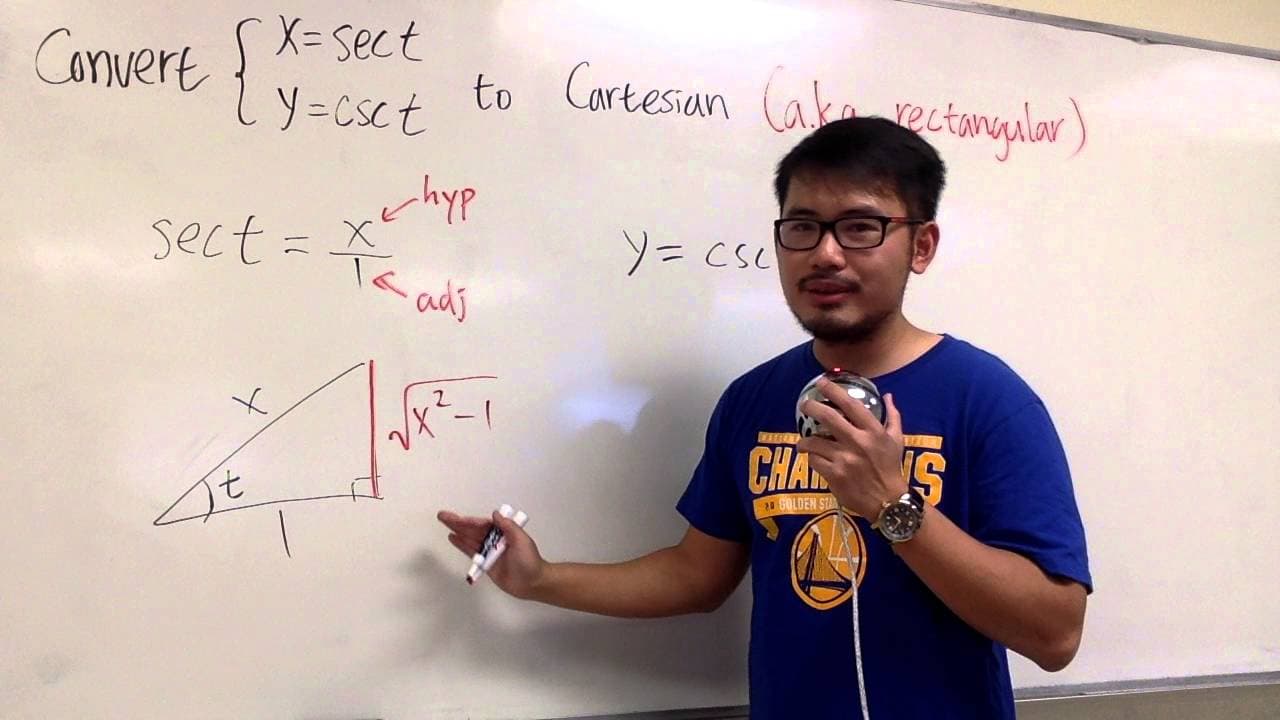
convert parametric to cartesian (an exam problem), x=sec(t), y=csc(t)
TL;DR
Learn how to convert parametric equations to Cartesian form using trigonometric functions.
Transcript
we are going to come for this parametric equation to Cartesian here we have X is equal to secant he and then Y is equal to cosecant he so usually we would like to just isolate that he found the X equation and plug in into the Y equation right here right however when we are dealing with trig functions let's do it this way let's look at the X equatio... Read More
Key Insights
- 🗯️ Converting parametric equations to Cartesian form involves isolating the parameter and creating a right triangle.
- ❓ Trigonometric functions like secant and cosecant are used to determine the values of X and Y.
- ❎ Squaring both sides of an equation helps simplify and eliminate square roots in the final Cartesian equation.
Install to Summarize YouTube Videos and Get Transcripts
Explore YouTube Video Summarizer or Get YouTube Transcript Extractor
Questions & Answers
Q: How do you convert parametric equations to Cartesian form using trigonometric functions?
To convert, isolate the parameter in one equation and substitute it in the other. Create a right triangle using secant or cosecant to determine the values of X and Y.
Q: Why do we square both sides when converting the equation Y = secant E?
Squaring both sides helps us eliminate the square root in the denominator, simplifying the equation. The resulting equation is a Cartesian equation in terms of X and Y.
Q: Can we graph the equation Y = secant E directly without squaring both sides?
Yes, it is possible to graph the original equation without squaring both sides. However, it will only show half of the graph. To see the full graph, we need to include a plus and minus symbol.
Q: What is the significance of the plus and minus symbol in the equation Y = secant E?
The plus and minus symbol accounts for both the positive and negative values of secant. By including the symbol, we ensure that the graph represents the entire range of possible solutions.
Summary & Key Takeaways
-
The video explains the process of converting parametric equations to Cartesian form using secant and cosecant.
-
By isolating the parameter in one equation and substituting it in the other, a right triangle can be created to determine the values of X and Y.
-
The final answer is a Cartesian equation in terms of X and Y.
Read in Other Languages (beta)
Share This Summary 📚
Summarize YouTube Videos and Get Video Transcripts with 1-Click
Try YouTube Summary with ChatGPT & Claude or YouTube Transcript Generator
Explore More Summaries from blackpenredpen 📚
Summarize YouTube Videos and Get Video Transcripts with 1-Click
Try YouTube Summary with ChatGPT & Claude or YouTube Transcript Generator