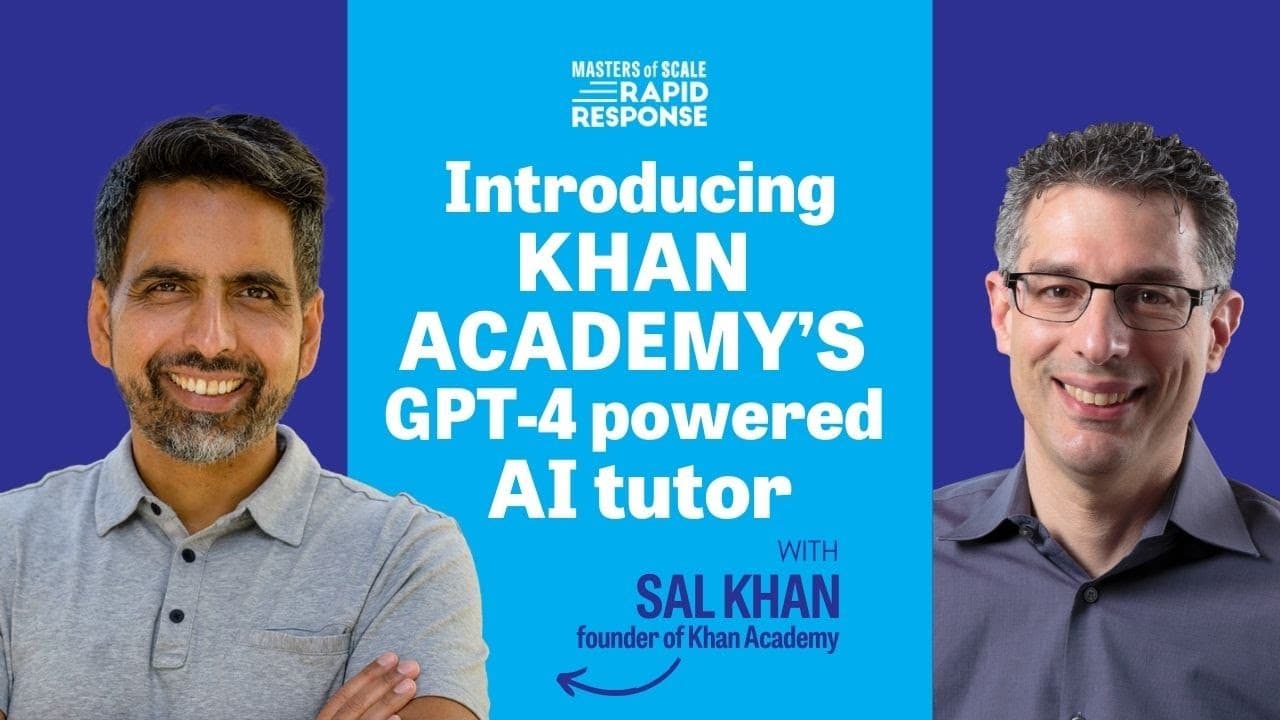
Meet your kid’s new AI tutor (with Khan Academy founder and CEO Sal Khan) | Rapid Response
TL;DR
Sal Khan discusses AI's transformative potential in education.
Transcript
Sam Alman and Greg Brockman of open AI reached out to me and said hey we have a model coming up even though it had issues with math it had issues with hallucinations it was able to really not just pretend but in some substantive ways really act like a strong tutor would do used well this could get us much closer to this ideal of free world-class ed... Read More
Key Insights
- Sal Khan believes AI can democratize education, offering free, world-class learning opportunities globally, akin to his tutoring beginnings.
- Khan Academy's AI tool, Khanmigo, acts as a tutor and teaching assistant, enhancing personalized learning experiences for students.
- AI in education can liberate classrooms, shifting from traditional lectures to interactive, human-centric learning environments.
- Despite fears of AI in education, Khan argues it can enhance teaching, allowing more focus on human connections and personalized support.
- Khanmigo has shown that while some students thrive with AI, others need to adapt to new ways of learning, revealing systemic educational challenges.
- AI tools can streamline administrative tasks for teachers, reducing burnout and allowing more time for meaningful student interactions.
- Khan emphasizes the importance of balancing knowledge acquisition with AI tool usage, ensuring students are well-equipped for the future.
- Educated bravery is crucial in navigating AI's risks and opportunities, advocating for thoughtful advancement rather than avoidance.
Install to Summarize YouTube Videos and Get Transcripts
Explore YouTube Video Summarizer or Get YouTube Transcript Extractor
Questions & Answers
Q: How did Khan Academy start using AI?
Khan Academy began integrating AI after Sal Khan was approached by OpenAI, who showcased a model capable of acting as a strong tutor. Despite initial issues like math errors and hallucinations, the potential for AI to offer personalized education was clear, leading to the development of Khanmigo.
Q: What is Khanmigo's role in education?
Khanmigo serves as both a tutor for students and a teaching assistant for teachers. It helps personalize learning experiences, provides simulations, and assists with administrative tasks like grading and lesson planning, thereby enhancing the educational process and reducing teacher burnout.
Q: What challenges does AI face in education?
AI in education faces challenges such as handling cheating, hallucinations, and ensuring appropriate interactions. Additionally, not all students are accustomed to the inquiry-based learning AI promotes, highlighting systemic issues in the education system that need addressing.
Q: How does AI change the classroom dynamic?
AI liberates classrooms from traditional lecture-based teaching, allowing for more interactive, human-centric learning experiences. It enables teachers to focus on personalized support and Socratic dialogues, making education more engaging and effective for students.
Q: What are the risks of AI in education?
The risks of AI in education include potential biases, inappropriate content, and privacy concerns. Khan Academy addresses these by implementing guardrails and features to mitigate risks while ensuring AI tools are used to enhance learning and support teachers.
Q: How does Khan Academy ensure AI is used effectively?
Khan Academy ensures effective AI usage by focusing on pedagogy first, integrating AI tools like Khanmigo to enhance learning and teaching processes. They address risks by turning challenges into features and continuously gathering feedback from users to improve the system.
Q: What is the concept of 'educated bravery'?
Educated bravery involves being informed about the potential risks and opportunities of AI while being bold enough to advance its positive applications. Sal Khan advocates for this approach, emphasizing the importance of thoughtful progress in leveraging AI's benefits while mitigating its risks.
Q: How does AI impact the future of education?
AI has the potential to revolutionize education by making it more accessible, personalized, and effective. It can streamline administrative tasks, enhance teaching methods, and provide scalable solutions for learning, ultimately preparing students better for future challenges and opportunities.
Summary & Key Takeaways
-
Sal Khan discusses how AI, particularly through Khan Academy's Khanmigo, is transforming education by providing personalized, scalable learning solutions. He highlights AI's potential to democratize education, making it accessible to anyone, anywhere.
-
Khan emphasizes the importance of AI in liberating classrooms from traditional lectures, enabling more interactive and human-centric learning experiences. He also addresses the challenges and risks associated with AI, advocating for thoughtful implementation.
-
AI tools like Khanmigo not only assist students but also streamline administrative tasks for teachers, reducing burnout and enhancing educational outcomes. Khan stresses the need for a balance between knowledge acquisition and AI tool usage.
Read in Other Languages (beta)
Share This Summary 📚
Summarize YouTube Videos and Get Video Transcripts with 1-Click
Try YouTube Summary with ChatGPT & Claude or YouTube Transcript Generator
Explore More Summaries from Masters of Scale 📚

Summarize YouTube Videos and Get Video Transcripts with 1-Click
Try YouTube Summary with ChatGPT & Claude or YouTube Transcript Generator