How to Use Behavioral Economics in Business
TL;DR
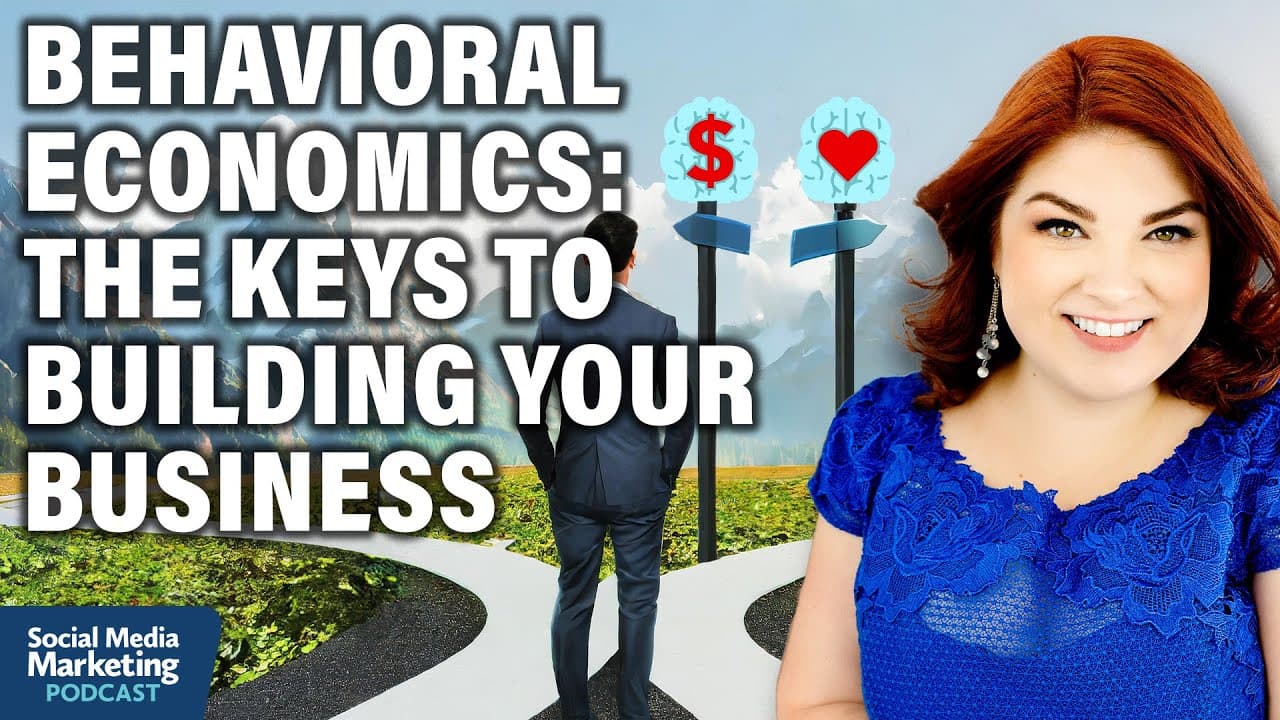
Understanding behavioral economics can significantly enhance business strategies by leveraging the subconscious decision-making processes of the brain. Key concepts such as framing, priming, anchoring, and relativity can be applied to marketing and sales to improve customer engagement and conversion rates. These insights reveal how subtle changes in messaging and presentation can influence consumer behavior.
Transcript
and what research has found by having psychology and economics and Neuroscience come together are the rules that that subconscious brain typically uses what it's going to think hey this makes sense here or I'm going to apply this those Concepts become what we use as foundations of Behavioral economics of how that subconscious brain is most like... Read More
Key Insights
- Behavioral economics combines psychology and economics to explain decision-making.
- Framing affects decisions; how something is presented matters more than the content.
- Priming influences choices; prior stimuli can alter perceptions and decisions.
- Anchoring uses initial information to set a reference point for decision-making.
- Relativity impacts price perception; context changes how prices are perceived.
- Humans make 35,000 decisions daily, mostly subconsciously.
- Behavioral economics can enhance marketing by understanding consumer psychology.
- Effective communication in business can be improved by applying behavioral science.
Install to Summarize YouTube Videos and Get Transcripts
Explore YouTube Video Summarizer or Get YouTube Transcript Extractor
Questions & Answers
Q: How does framing impact consumer decisions?
Framing impacts consumer decisions by altering how information is perceived. The way a message is presented can change its effectiveness; for instance, describing beef as '90% fat-free' rather than '10% fat' can make it more appealing. This technique leverages the brain's tendency to focus on positive attributes, influencing purchasing behavior without changing the actual product.
Q: What is priming in behavioral economics?
Priming in behavioral economics refers to the influence that prior exposure to certain stimuli has on subsequent decisions. For example, holding a warm drink can make people perceive others as more warm and friendly. Marketers can use priming by carefully selecting words and images that evoke desired emotions or associations, subtly guiding consumer behavior.
Q: How does anchoring affect pricing strategies?
Anchoring affects pricing strategies by establishing a reference point that influences subsequent judgments. When consumers see a high initial price, they perceive discounts or lower prices as more attractive. This can be used in marketing to make offers seem like better deals, encouraging purchases by setting expectations with an initial anchor price.
Q: Why is relativity important in pricing?
Relativity is important in pricing because it shapes how consumers perceive value. Presenting a high-priced item first can make subsequent prices seem more reasonable, encouraging purchases. This context-driven perception helps marketers position products strategically, ensuring that consumers view them as favorable options compared to other available choices.
Q: What role does behavioral economics play in marketing?
Behavioral economics plays a crucial role in marketing by providing insights into consumer psychology. It helps marketers understand how people make decisions, often irrationally, and how to craft messages that resonate on a subconscious level. By applying principles like framing, priming, and anchoring, businesses can enhance engagement, drive sales, and improve customer satisfaction.
Q: How can businesses apply behavioral economics?
Businesses can apply behavioral economics by integrating its principles into their marketing and sales strategies. Techniques such as framing messages positively, using anchoring for pricing, and priming consumers with strategic stimuli can enhance communication effectiveness. These approaches help align business practices with how consumers naturally think and make decisions, leading to better outcomes.
Q: What is the significance of decision-making in behavioral economics?
Decision-making is central to behavioral economics, which examines how people make choices. Unlike traditional economics, which assumes rational decision-making, behavioral economics acknowledges that decisions are often influenced by subconscious biases and heuristics. Understanding these processes allows businesses to tailor strategies that better meet consumer needs and expectations.
Q: How does understanding the brain benefit businesses?
Understanding the brain benefits businesses by revealing how consumers process information and make decisions. This knowledge enables companies to design more effective marketing strategies, improve customer interactions, and enhance product appeal. By aligning business practices with cognitive processes, companies can increase engagement, build loyalty, and drive sales more effectively.
Summary & Key Takeaways
-
Behavioral economics merges psychology and economics to understand decision-making, emphasizing that humans often act irrationally. Concepts like framing, where presentation alters perception, and priming, where previous stimuli affect choices, are crucial. Anchoring sets a reference point for decisions, while relativity influences price perception. These tools help marketers tailor strategies to align with consumer psychology, enhancing engagement and conversion.
-
Melina Palmer, an expert in behavioral economics, explains how businesses can leverage these insights. By understanding the brain's decision-making processes, companies can craft more effective marketing messages. Small changes in wording, order, and presentation can significantly impact consumer behavior, leading to increased sales and customer satisfaction.
-
Behavioral economics offers practical applications for businesses seeking to improve communication and influence. Techniques like using high anchors in pricing or framing offers positively can drive consumer action. These insights are not only applicable to sales but also in managing change and gaining buy-in from employees, showcasing the broad utility of behavioral science in business.
Read in Other Languages (beta)
Share This Summary 📚
Summarize YouTube Videos and Get Video Transcripts with 1-Click
Try YouTube Summary with ChatGPT & Claude or YouTube Transcript Generator
Explore More Summaries from Social Media Examiner 📚


Summarize YouTube Videos and Get Video Transcripts with 1-Click
Try YouTube Summary with ChatGPT & Claude or YouTube Transcript Generator