CataractCoach™ 2090: mastering stop and chop phaco technique
TL;DR
Stop-and-chop technique combines divide-and-conquer and phaco chop methods for cataract surgery.
Transcript
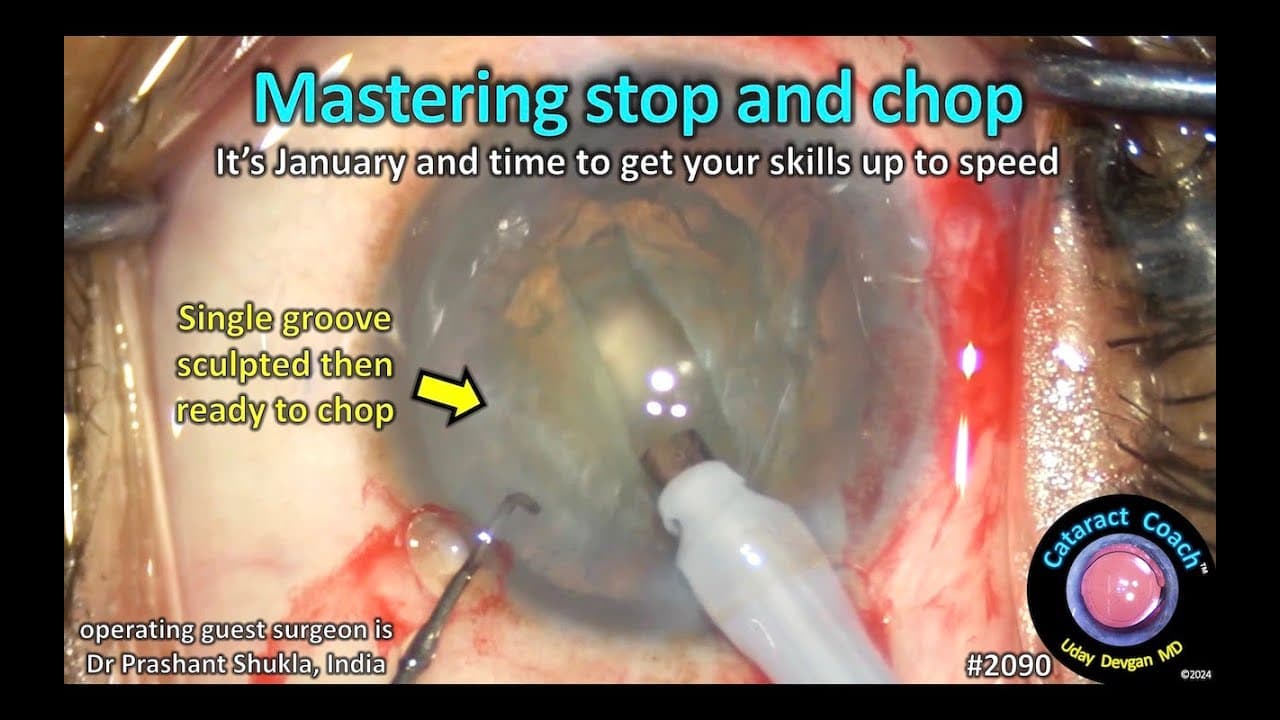
cataract coach.com mastering stop and chop hey it's January time to get your skills up to speed now stop and chop you know is a technique where a single Groove is created down the middle of the nucleus it is then split into two halves using a cracking technique and then each half is further sub chopped so there's divide and conquer ... Read More
Key Insights
- The stop-and-chop technique involves creating a single groove in the nucleus, splitting it into two halves, and then chopping each half into smaller pieces for easier removal.
- This method combines elements of both divide-and-conquer and phaco chop techniques, offering a versatile approach to cataract surgery.
- Creating a groove down the middle of the nucleus allows for a controlled split, providing a stable base for further chopping and removal.
- The technique requires adjusting machine settings, such as increasing vacuum and flow rates during the chopping phase to ensure efficient removal of lens fragments.
- Proper execution of the stop-and-chop technique involves mastering related methods like divide-and-conquer and phaco chop, enhancing surgical proficiency.
- The surgeon must adapt their approach based on the nucleus density, using appropriate power, flow, and vacuum settings for optimal results.
- Educational resources, such as the free CataractCoach curriculum and book, offer valuable guidance on mastering the stop-and-chop technique and other surgical methods.
- Continuous learning and practice are crucial for surgeons to maintain and improve their skills, especially with evolving techniques in cataract surgery.
Install to Summarize YouTube Videos and Get Transcripts
Explore YouTube Video Summarizer or Get YouTube Transcript Extractor
Questions & Answers
Q: What is the stop-and-chop technique in cataract surgery?
The stop-and-chop technique is a method used in cataract surgery that combines elements of divide-and-conquer and phaco chop techniques. It involves creating a single groove in the middle of the lens nucleus, splitting it into two halves, and then chopping each half into smaller fragments. This approach allows for efficient removal of the lens material, offering a controlled and versatile method for surgeons.
Q: How does the stop-and-chop technique differ from divide-and-conquer?
The stop-and-chop technique differs from divide-and-conquer by incorporating a chopping phase after creating a central groove and splitting the nucleus. While divide-and-conquer involves sculpting multiple grooves to create quadrants, stop-and-chop uses a single groove followed by chopping, allowing for more efficient fragmentation and removal of the lens material. This hybrid approach provides greater control and adaptability during surgery.
Q: What are the key machine settings for the stop-and-chop technique?
Key machine settings for the stop-and-chop technique include adjusting vacuum and flow rates during different phases of the procedure. During the grooving phase, lower vacuum and flow rates are used to aspirate grooves, while higher vacuum and flow rates are required during the chopping phase to hold and remove lens fragments efficiently. Surgeons must tailor these settings based on the density of the nucleus to optimize surgical outcomes.
Q: Why is mastering the stop-and-chop technique important for surgeons?
Mastering the stop-and-chop technique is important for surgeons as it enhances their surgical repertoire, providing a versatile and efficient method for cataract removal. This technique combines the benefits of divide-and-conquer and phaco chop, allowing surgeons to adapt to different surgical scenarios. Proficiency in stop-and-chop can improve surgical outcomes, especially in complex cases, and is a valuable skill for any cataract surgeon.
Q: How can surgeons learn and improve their stop-and-chop skills?
Surgeons can learn and improve their stop-and-chop skills through educational resources such as the free CataractCoach curriculum and book. These resources offer detailed explanations and demonstrations of the technique, helping surgeons understand the nuances of machine settings and surgical execution. Continuous practice and exposure to various surgical scenarios are essential for honing skills and staying updated with advancements in cataract surgery techniques.
Q: What are the benefits of the stop-and-chop technique in cataract surgery?
The benefits of the stop-and-chop technique in cataract surgery include its versatility and efficiency in fragmenting and removing the lens material. By combining elements of divide-and-conquer and phaco chop, this technique offers greater control over the surgical process, allowing for precise fragmentation and removal of lens fragments. It is particularly useful in complex cases, such as those with dense nuclei or shallow anterior chambers.
Q: What role do vacuum and flow rates play in the stop-and-chop technique?
Vacuum and flow rates play a crucial role in the stop-and-chop technique, as they determine the efficiency and control during lens removal. During the grooving phase, lower vacuum and flow rates are used to aspirate grooves, while higher settings are required during the chopping phase to effectively hold and remove lens fragments. Adjusting these settings based on the nucleus density is essential for optimizing surgical outcomes and ensuring a smooth procedure.
Q: How does the stop-and-chop technique improve surgical outcomes?
The stop-and-chop technique improves surgical outcomes by providing a controlled and efficient method for lens fragmentation and removal. By combining the benefits of divide-and-conquer and phaco chop, this technique allows for precise control over the surgical process, reducing the risk of complications and enhancing the overall efficiency of the procedure. Mastery of this technique can lead to better visual outcomes for patients and increased confidence for surgeons in managing complex cases.
Summary & Key Takeaways
-
The stop-and-chop technique is a hybrid method of cataract surgery that combines the divide-and-conquer and phaco chop techniques. It involves creating a groove in the nucleus, splitting it into halves, and chopping each half into smaller pieces for removal. This method is beneficial for surgeons looking to improve their surgical proficiency.
-
Mastering the stop-and-chop technique requires understanding the nuances of machine settings, such as adjusting vacuum and flow rates during the chopping phase. Surgeons must also be proficient in related methods like divide-and-conquer and phaco chop to execute this technique effectively, especially in complex cases with dense nuclei.
-
Educational resources, such as the free CataractCoach curriculum and book, provide essential knowledge for learning the stop-and-chop technique. Continuous practice and adaptation to different surgical scenarios are vital for surgeons to enhance their skills and stay updated with advancements in cataract surgery techniques.
Read in Other Languages (beta)
Share This Summary 📚
Summarize YouTube Videos and Get Video Transcripts with 1-Click
Try YouTube Summary with ChatGPT & Claude or YouTube Transcript Generator
Explore More Summaries from Uday Devgan 📚
Summarize YouTube Videos and Get Video Transcripts with 1-Click
Try YouTube Summary with ChatGPT & Claude or YouTube Transcript Generator