Bode Plot Problem 1 - Frequency Response Analysis -Control Systems
TL;DR
Learn how to construct a boat plot on a semi-log graph sheet for a unity feedback system and check for system stability.
Transcript
hello friends in this video we are going to solve a problem on how we can draw a boat plot for a system whose open loop transfer function is given to us so let's take a problem so our problem is to construct the boats board plot on a semi log graph sheet for a unity feedback system whose open loop transfer function is given to us as gs equals 250 u... Read More
Key Insights
- 🚣 Boat plots are used to visualize the frequency response of a system.
- 👷 The construction of a boat plot involves converting the transfer function into the frequency domain and calculating the magnitude and phase angles.
- 🚣 The gain margin and phase margin can be determined from the boat plot to assess system stability.
- ❎ Negative gain and phase margins indicate system instability.
Install to Summarize YouTube Videos and Get Transcripts
Explore YouTube Video Summarizer or Get YouTube Transcript Extractor
Questions & Answers
Q: What is a boat plot and how is it constructed?
A boat plot is a graphical representation of the frequency response of a system, showing the magnitude and phase angles. It is constructed by converting the transfer function into the frequency domain, calculating the magnitude and phase angles for different frequencies, and plotting them on a semi-log graph sheet.
Q: How is the stability of the closed loop system determined?
The stability of the closed loop system is determined by analyzing the gain margin, phase margin, and crossover frequencies. If the gain and phase margins are negative, the system is unstable. If they are positive, the system is stable. If they are zero or equal, the system is marginally stable.
Q: What are the steps to construct a boat plot?
The steps to construct a boat plot are as follows:
- Convert the transfer function into the frequency domain by substituting s with jω.
- Calculate the magnitude and phase angles of the transfer function for different frequencies.
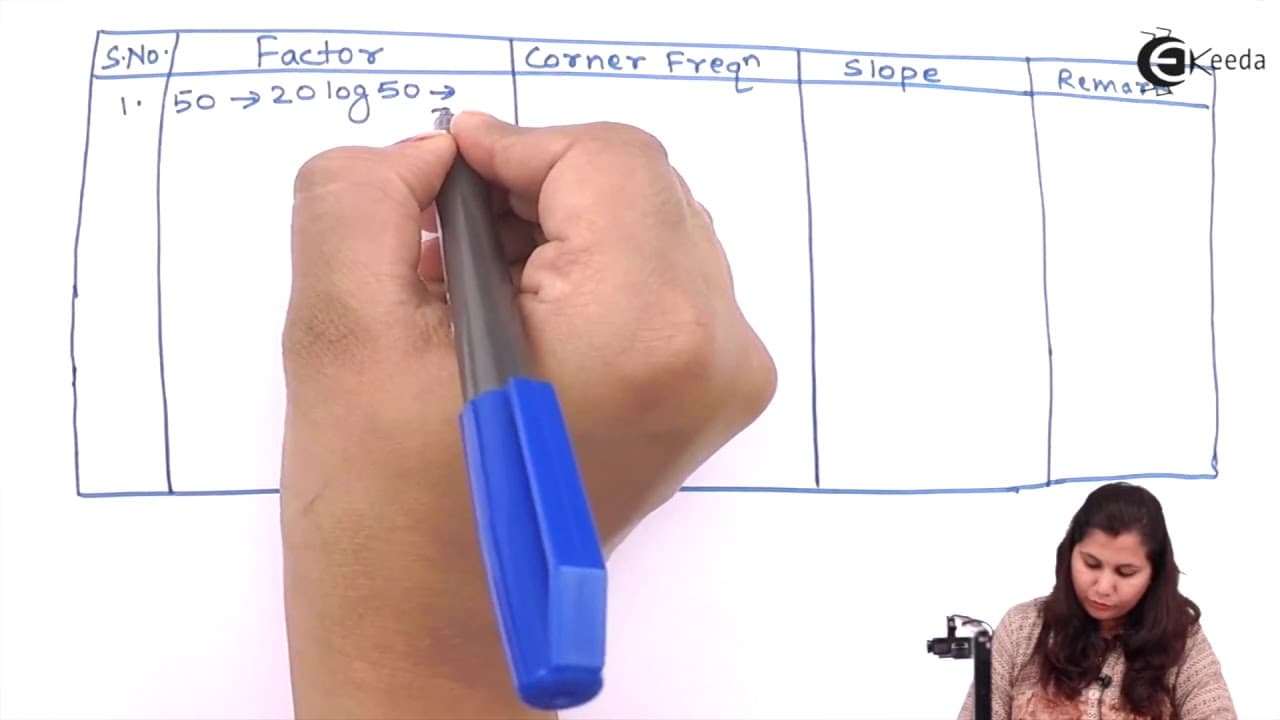
- Form tables for the magnitude plot and phase plot, including information such as corner frequencies, slopes, and magnitudes.
- Plot the magnitude and phase angles on a semi-log graph sheet, using appropriate scales for the axes.
- Analyze the gain margin, phase margin, and crossover frequencies to determine the stability of the system.
Q: How is the gain margin and phase margin calculated?
The gain margin is determined by finding the frequency at which the phase plot intersects the -180 degrees line. The difference between the magnitude plot and the 0 dB line at this frequency is the gain margin. The phase margin is determined by finding the frequency at which the magnitude plot intersects the 0 dB line. The difference between the -180 degrees line and the actual phase angle at this frequency is the phase margin.
Summary & Key Takeaways
-
The video explains how to construct a boat plot for a unity feedback system with given open loop transfer function.
-
The process involves converting the transfer function into the frequency domain, calculating the magnitude and phase angles, and plotting them on a semi-log graph sheet.
-
The boat plot helps determine the stability of the closed loop system by analyzing the gain margin, phase margin, and crossover frequencies.
Read in Other Languages (beta)
Share This Summary 📚
Summarize YouTube Videos and Get Video Transcripts with 1-Click
Try YouTube Summary with ChatGPT & Claude or YouTube Transcript Generator
Explore More Summaries from Ekeeda 📚

Summarize YouTube Videos and Get Video Transcripts with 1-Click
Try YouTube Summary with ChatGPT & Claude or YouTube Transcript Generator