Computing the Four Fundamental Subspaces
TL;DR
Learn how to find the basis and dimension of the four fundamental subspaces of a given matrix using LU decomposition.
Transcript
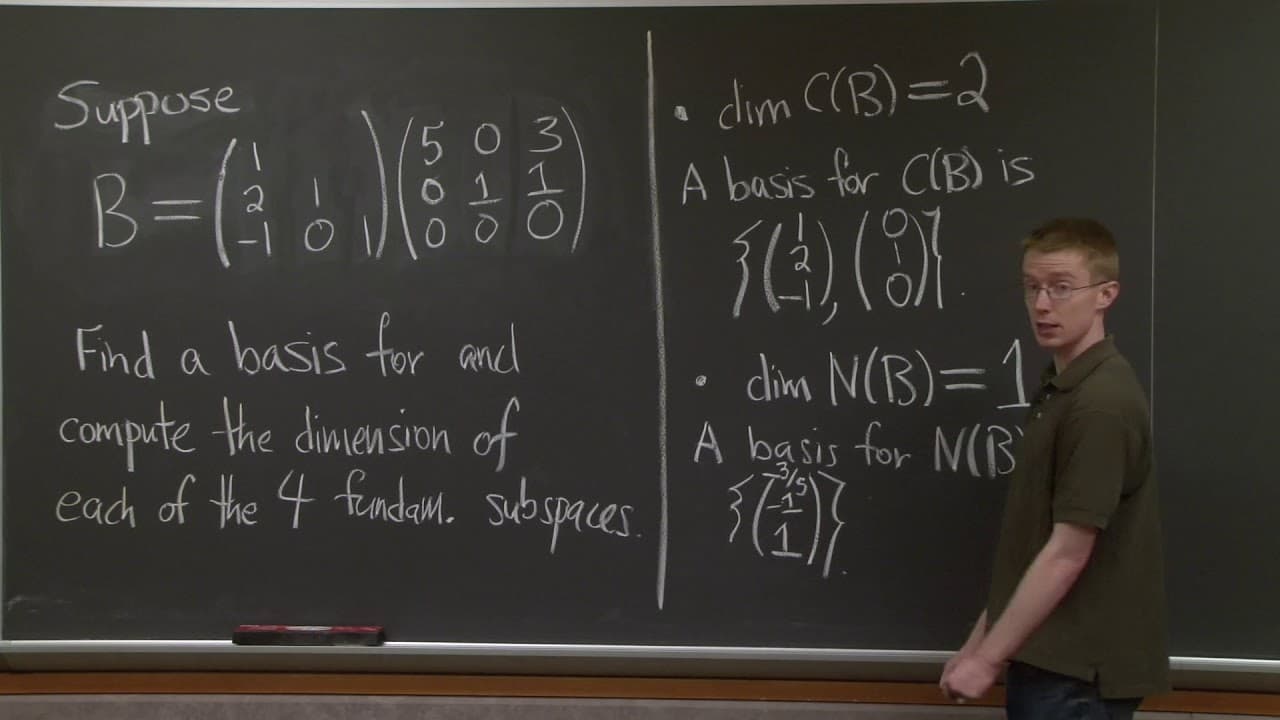
BEN HARRIS: Hi, and welcome back. Today we're going to do a problem about the four fundamental subspaces. So here we have a matrix B. B is written as the product of a lower triangular matrix and an upper triangular matrix. And we're going to find a basis for, and compute the dimension of, each of the four fundamental subspaces of B. I'll give you a... Read More
Key Insights
- ❓ LU decomposition can be used to find the basis and dimension of the four fundamental subspaces of a matrix.
- 👾 The column space has the same dimension as the row space and can be determined by the number of pivots in the upper triangular matrix.
- 🥶 The null space can be found by substituting different values for the free variables and solving for the remaining variables.
- ↙️ The left null space can be obtained by inverting the L matrix and looking at the free row.
Install to Summarize YouTube Videos and Get Transcripts
Explore YouTube Video Summarizer or Get YouTube Transcript Extractor
Questions & Answers
Q: How do you determine the dimension of the column space?
The dimension of the column space is equal to the number of pivots in the upper triangular matrix obtained from the LU decomposition. In this case, it is 2.
Q: How can the basis for the column space be found?
The basis for the column space can be formed by selecting the pivot columns either from the original matrix or the L matrix. In this example, the basis is [1, 2, -1] and [0, 1, 0].
Q: What is the dimension of the null space?
The dimension of the null space is equal to the number of columns minus the number of pivots. In this case, it is 1.
Q: How can the basis for the null space be determined?
By plugging in 1 for the free variable and backsolving for the other variables, we can find the basis for the null space. In this example, the basis is [1, -1, -3/5].
Q: How is the dimension of the row space calculated?
The dimension of the row space is the same as the dimension of the column space, which is equal to the number of pivots. In this case, it is 2.
Q: How can the basis for the row space be obtained?
The basis for the row space can be formed by using the pivot rows of the upper triangular matrix obtained from the LU decomposition. In this example, the basis is [1, 2, -1] and [0, 1, 0].
Q: What is the dimension of the left null space?
The dimension of the left null space is equal to the number of rows minus the number of pivots. In this case, it is 1.
Q: How can the basis for the left null space be found?
By inverting the L matrix and looking at the free row, we can determine the basis for the left null space. In this example, the basis is [1, 0, 1].
Summary & Key Takeaways
-
The video discusses how to find the basis and dimension of the four fundamental subspaces of a matrix using LU decomposition.
-
The column space has a dimension equal to the number of pivots in the upper triangular matrix of the LU decomposition, and its basis can be formed by selecting the pivot columns in either the original matrix or the L matrix.
-
The null space has a dimension equal to the number of free variables, which is obtained by subtracting the number of pivots from the number of columns. Its basis can be found by plugging in 1 for the free variable and backsolving for the other variables.
-
The row space has the same dimension as the column space, and its basis can be formed by using the pivot rows of the upper triangular matrix obtained from the LU decomposition.
-
The left null space has a dimension equal to the number of rows minus the number of pivots. Its basis can be extracted by inverting the L matrix and looking at the free row.
Read in Other Languages (beta)
Share This Summary 📚
Summarize YouTube Videos and Get Video Transcripts with 1-Click
Try YouTube Summary with ChatGPT & Claude or YouTube Transcript Generator
Explore More Summaries from MIT OpenCourseWare 📚


Summarize YouTube Videos and Get Video Transcripts with 1-Click
Try YouTube Summary with ChatGPT & Claude or YouTube Transcript Generator