What Is a Tensile Test and How Is It Conducted?
TL;DR
A tensile test measures how materials behave under tension, assessing their elastic and plastic deformation. The test identifies key characteristics such as yield strength, tensile strength, and the percentage elongation after fracture, providing essential insights into material ductility and toughness.
Transcript
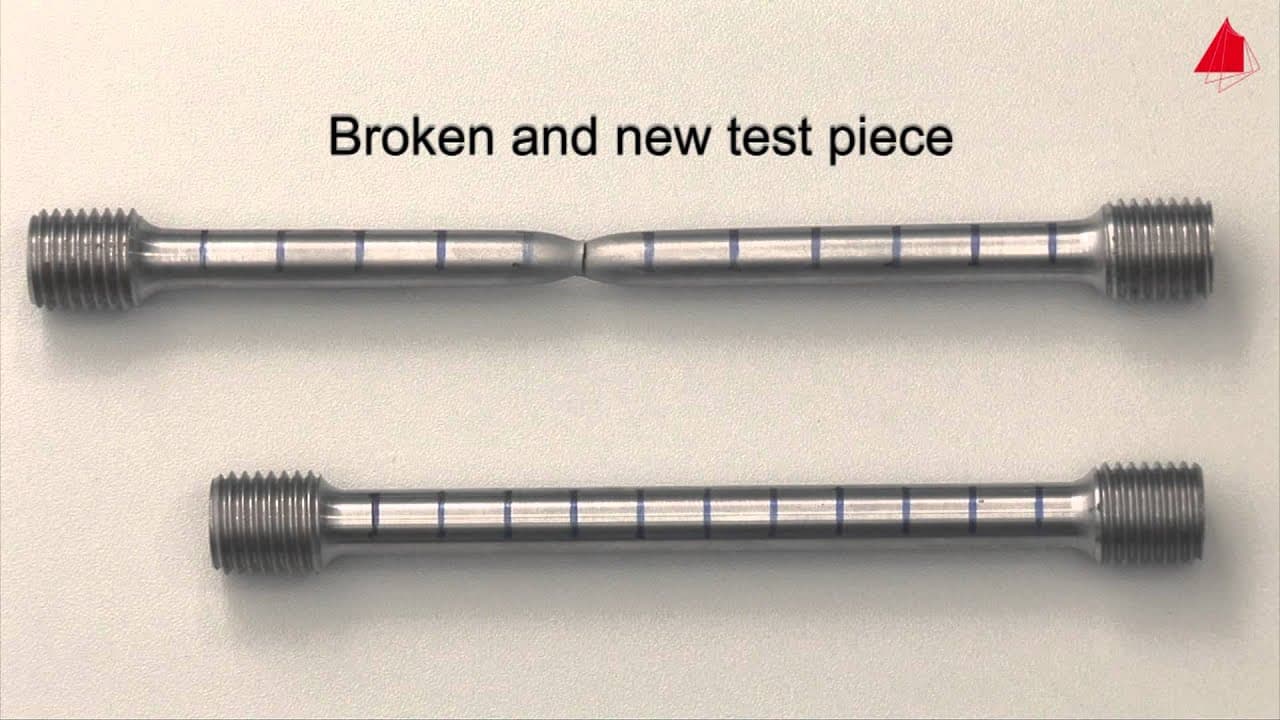
the tensile test first test material with yield point phenomenon in the first tensile test a plain carbon steel with yield point phenomenon is to be tested this is the test piece it has a cylindrical test region with an original diameter of 10 millimeters and an original gauge length of 100 millimeters within this test region distance marks have be... Read More
Key Insights
- 🎭 Tensile testing is performed to study the behavior of materials under tension, including elastic and plastic deformation.
- 😥 The yield point phenomenon is characterized by a sudden drop in force and the beginning of plastic deformation.
- 🙂 The ludus effect occurs after the yield point, with an almost constant force level and slight fluctuations.
- 😥 Materials can be strain hardened until the point of maximum force is reached.
- 📶 The upper yield strength, lower yield strength, and tensile strength can be calculated from the forces measured in the tensile test.
- ❓ Percentage elongation after fracture and percentage reduction of area indicate the ductility and toughness of the material.
- 📶 The 0.2% proof strength is often used as a substitute for the yield strength.
Install to Summarize YouTube Videos and Get Transcripts
Explore YouTube Video Summarizer or Get YouTube Transcript Extractor
Questions & Answers
Q: What is the purpose of a tensile test?
The purpose of a tensile test is to understand the behavior of a material under tension, including its elastic and plastic deformation, yield point, and fracture characteristics.
Q: What is the significance of the yield point in a tensile test?
The yield point is significant because it marks the transition from elastic to plastic deformation. It is characterized by a sudden drop in force and the beginning of permanent elongation in the test piece.
Q: What is the ludus effect in a tensile test?
The ludus effect is observed after the yield point in a tensile test. It is characterized by an almost constant force level with slight fluctuations. This effect represents strain hardening of the material until the point of maximum force.
Q: How are the strength properties of materials calculated from a tensile test?
The upper yield strength is calculated by dividing the force at the upper yield point by the original cross-sectional area. The lower yield strength and tensile strength are calculated in a similar way using the force at the lower yield point and maximum force, respectively.
Summary & Key Takeaways
-
Tensile test measures the force and elongation of a test piece to understand material behavior.
-
Yield point phenomenon in materials is observed as a sudden drop in force and the beginning of plastic deformation.
-
Ludus effect occurs after the yield point, with an almost constant force level, and strain hardening until the point of fracture.
Read in Other Languages (beta)
Share This Summary 📚
Summarize YouTube Videos and Get Video Transcripts with 1-Click
Try YouTube Summary with ChatGPT & Claude or YouTube Transcript Generator