3.2.10 Introduction to Logistical Regression - Video 6: ROC Curves
TL;DR
ROC curves help to select the best threshold value for a model by visualizing the trade-off between sensitivity and specificity.
Transcript
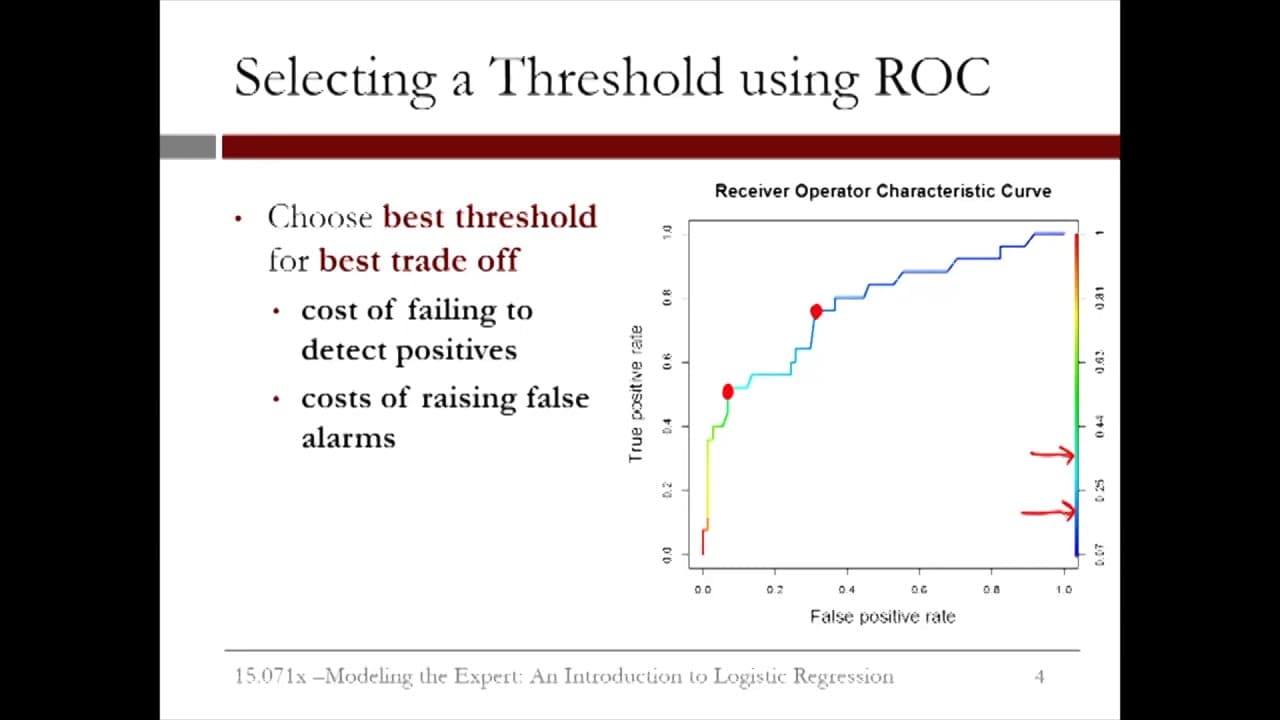
Picking a good threshold value is often challenging. A Receiver Operator Characteristic curve, or ROC curve, can help you decide which value of the threshold is best. The ROC curve for our problem is shown on the right of this slide. The sensitivity, or true positive rate of the model, is shown on the y-axis. And the false positive rate, or 1 minus... Read More
Key Insights
- ❓ The ROC curve captures the performance of a model at all possible threshold values simultaneously.
- 😘 Higher threshold values increase specificity and decrease sensitivity, while lower threshold values increase sensitivity and decrease specificity.
- ☠️ The choice of threshold value should be based on the desired trade-off between false positive rate and true positive rate.
- 👨💻 R can be used to generate and customize ROC curves, including color-coding and adding specific threshold labels.
Install to Summarize YouTube Videos and Get Transcripts
Explore YouTube Video Summarizer or Get YouTube Transcript Extractor
Questions & Answers
Q: What is the purpose of a ROC curve?
The main purpose of a ROC curve is to help determine the best threshold value for a model by visualizing the relationship between sensitivity and specificity.
Q: What does the starting point (0,0) of a ROC curve represent?
The starting point represents a threshold value of 1, where all positive cases are labeled as negative, resulting in a sensitivity of 0 and a false positive rate of 0.
Q: What does the ending point (1,1) of a ROC curve represent?
The ending point represents a threshold value of 0, where all positive cases are labeled as positive, resulting in a sensitivity of 1 and a false positive rate of 1.
Q: How can ROC curves help with threshold selection?
ROC curves provide a visual representation of the trade-off between sensitivity and specificity at different threshold values, allowing decision-makers to choose the desired balance based on their preferences.
Summary & Key Takeaways
-
A Receiver Operator Characteristic (ROC) curve is used to determine the optimal threshold value for a model.
-
The ROC curve shows the relationship between sensitivity (true positive rate) and specificity (1 minus true negative rate) at different threshold values.
-
The curve starts at (0,0) and ends at (1,1), representing threshold values of 1 and 0 respectively.
-
The choice of threshold value depends on the trade-off between specificity and sensitivity desired.
Read in Other Languages (beta)
Share This Summary 📚
Summarize YouTube Videos and Get Video Transcripts with 1-Click
Try YouTube Summary with ChatGPT & Claude or YouTube Transcript Generator
Explore More Summaries from MIT OpenCourseWare 📚



Summarize YouTube Videos and Get Video Transcripts with 1-Click
Try YouTube Summary with ChatGPT & Claude or YouTube Transcript Generator