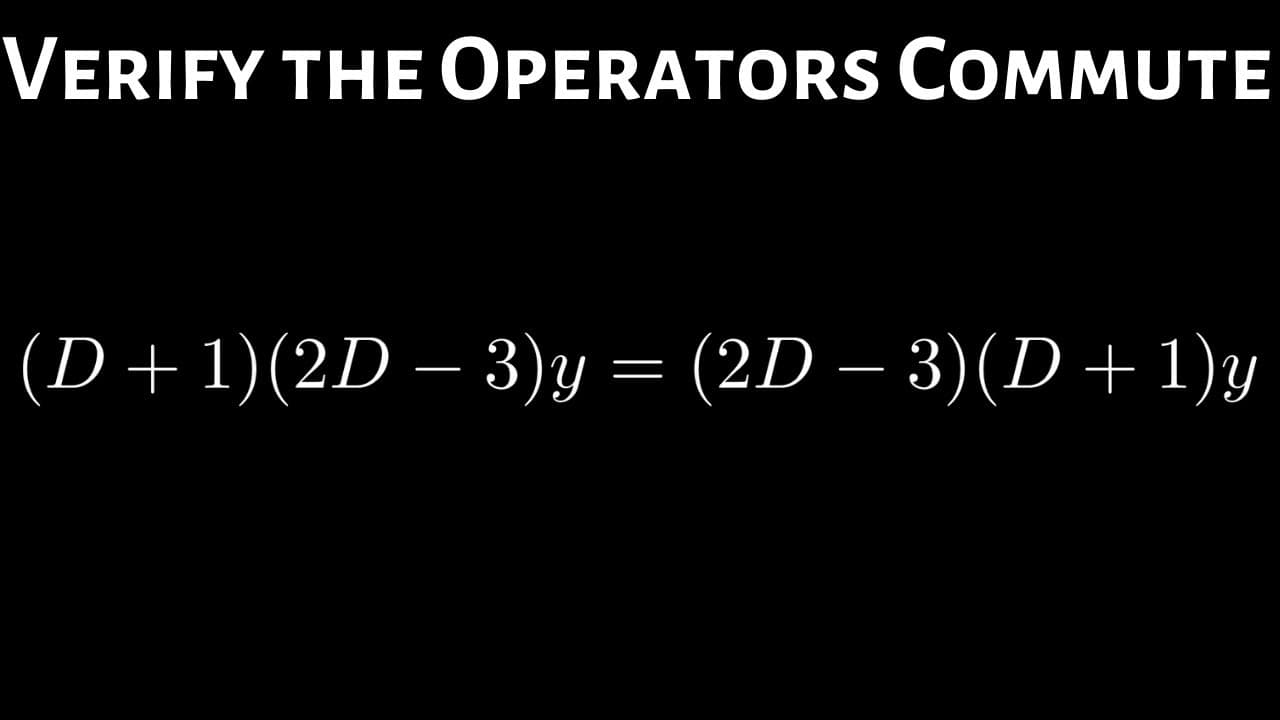
Verify (D + 1)(2D - 3)y = (2D - 3)(D + 1)y where D is the Differential Operator
TL;DR
Verify an equation using a differential operator by taking derivatives and applying them to the equation.
Transcript
hi everyone in this problem we're going to verify this equation so here big d is what's called a differential operator it means you just take the derivative so we're applying this to y so let's work out the left hand side first so we have d plus one and then we have two d minus three and it's being applied to y so let's first go ahead and do this p... Read More
Key Insights
- ❓ The content demonstrates the process of verifying an equation using a differential operator.
- 🫱 The left-hand side (LHS) and right-hand side (RHS) are calculated separately, using the differential operator.
- 🍵 Constant coefficients can be handled easily using the differential operator, while variables in front of the operator can make the equation more complex.
Install to Summarize YouTube Videos and Get Transcripts
Explore YouTube Video Summarizer or Get YouTube Transcript Extractor
Questions & Answers
Q: What is a differential operator?
A differential operator, denoted as "d," is an operator that takes the derivative of a function. In this context, it is used to verify the given equation.
Q: How is the LHS calculated?
The LHS is calculated by applying the differential operator to the equation. Each term is multiplied by the derivative of the variable it is applied to.
Q: How is the RHS calculated?
Similarly, the RHS is calculated by applying the differential operator to the equation. Each term is multiplied by the derivative of the variable it is applied to.
Q: Why do constant coefficients work in this equation?
The equation in the content works intuitively with constant coefficients because when differentiating constant terms, their derivatives are always zero. Thus, they do not affect the equation.
Summary & Key Takeaways
-
The content demonstrates the process of verifying an equation using a differential operator.
-
The left-hand side (LHS) and right-hand side (RHS) of the equation are worked out separately using the differential operator.
-
By taking derivatives and applying them to the equation, it is shown that the LHS is equal to the RHS.
Read in Other Languages (beta)
Share This Summary 📚
Summarize YouTube Videos and Get Video Transcripts with 1-Click
Try YouTube Summary with ChatGPT & Claude or YouTube Transcript Generator
Explore More Summaries from The Math Sorcerer 📚



Summarize YouTube Videos and Get Video Transcripts with 1-Click
Try YouTube Summary with ChatGPT & Claude or YouTube Transcript Generator