Moon dust, tricky squid, and the world's biggest telescope
TL;DR
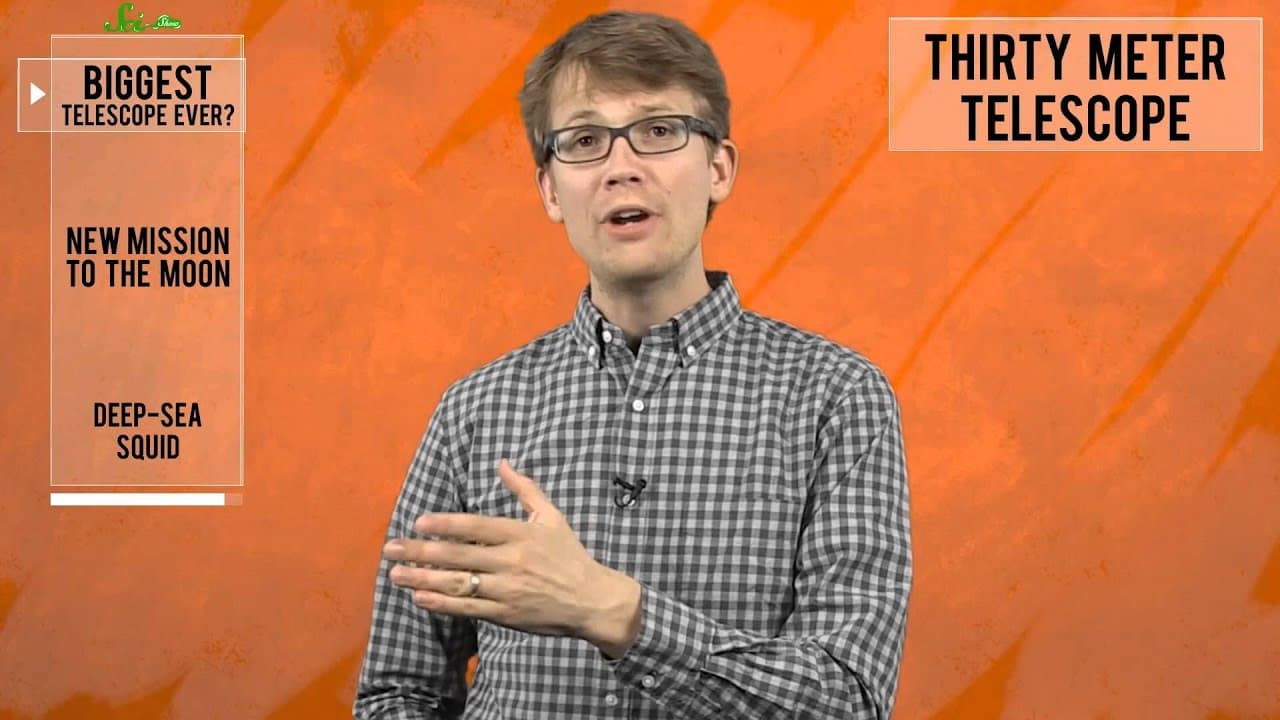
Engineers have made progress in constructing the largest optical telescope, a lunar probe is set to study the moon's atmosphere and solve the mystery of Moonglow, while biologists observe deep sea squid using unique tactics to catch prey.
Transcript
from the habits of deep sea squid to strange lights on the moon science is solving some pretty weird mysteries we found out this week and we're probing ever deeper into space and time to answer even bigger questions I'm Hank Green and this is sow news this week Engineers reached a milestone in constructing what will become the largest optical teles... Read More
Key Insights
- 🙂 The Giant Magellan Telescope and the 30m telescope in Hawaii are the next generation of massive ground-based telescopes, with the GMT aiming to collect enough light to see 13.7 billion years back in time.
- 🥮 The lunar probe, NASA's lunar atmosphere and dust environment Explorer, will study the moon's atmosphere and help solve the mystery of Moonglow, providing insights into other celestial bodies.
- 🤢 Deep sea squid, like galus Boni, have unique tactics such as aggressive mimicry to catch prey, showcasing the fascinating adaptations found in the deep sea ecosystem.
Install to Summarize YouTube Videos and Get Transcripts
Explore YouTube Video Summarizer or Get YouTube Transcript Extractor
Questions & Answers
Q: What is the significance of the Giant Magellan Telescope?
The GMT will be the largest optical telescope and will allow us to see images with 10 times the resolution of Hubble, helping us observe the formation of the first stars and solve mysteries about the physical Universe.
Q: What is the purpose of the lunar probe?
The lunar probe will study the moon's atmosphere and collect data on its composition, as well as investigate the mystery of Moonglow, the strange streaks of light observed before lunar sunrise.
Q: How are deep sea squid using aggressive mimicry?
Deep sea squid, such as galus Boni, have seemingly worthless tentacles but imitate the movements of harmless organisms like fish and worms in order to get closer to their prey, showcasing their unique tactic of aggressive mimicry.
Q: How will the lunar probe help solve the mystery of Moonglow?
The lunar probe will search for dust in the moon's atmosphere to test the theory that Moonglow is caused by charged dust particles lifted by the sun's rays, thus helping to solve the decades-old mystery.
Summary & Key Takeaways
-
Engineers have successfully forged the third mirror of the Giant Magellan Telescope (GMT), which will be the largest optical telescope ever built, allowing us to observe the formation of the first stars.
-
A new lunar probe will collect data on the moon's ultra-thin atmosphere and investigate the mystery of Moonglow, the strange streaks of light observed by Apollo Astronauts.
-
Biologists have observed deep sea squid in their natural habitat for the first time, discovering their unique tactic of aggressive mimicry to catch prey.
Read in Other Languages (beta)
Share This Summary 📚
Summarize YouTube Videos and Get Video Transcripts with 1-Click
Try YouTube Summary with ChatGPT & Claude or YouTube Transcript Generator
Explore More Summaries from SciShow 📚


Summarize YouTube Videos and Get Video Transcripts with 1-Click
Try YouTube Summary with ChatGPT & Claude or YouTube Transcript Generator